
Since the start of this decade, digital technologies have proven to be a major market force. Cloud computing, data analytics, and artificial intelligence (AI) have already had a substantial impact on consumer expectations, operating models, and revenue generation capabilities.
These technology advancements (and many others) would have been impossible without continuous innovation in the IT sector.
As we enter the new year, the 8allocate team decided to look into the latest trends in software engineering. In this post, you’ll find a data-backed summary of the new themes in the market, covering the technology and strategy aspects of software development.
Software Engineering Trends for 2024
Last year was a roller-coaster for the tech sector. After a massive growth spree, most companies had to adjust their appetites as their growth didn’t fully translate to profitability.
Yet, despite operational challenges, accelerating inflation, and ongoing layoffs, the majority of business leaders (94%) plan to increase investment in IT and emerging technologies in 2024 to drive ongoing innovation and growth.
More specifically, our team believes that the following software engineering trends will dominate the business agenda in 2024.
Platform Engineering Will Help Improve SDLC
Enterprises have a sizable tech portfolio. More technology inevitably leads to higher total cost of ownership (TCO), interoperability issues, and a larger carbon footprint.
To optimize operating costs, leading teams are switching to platform engineering — a software development paradigm, which assumes using a shared engineering platform, designed to promote common tools, reusable components, shared services, and common knowledge for software development teams.
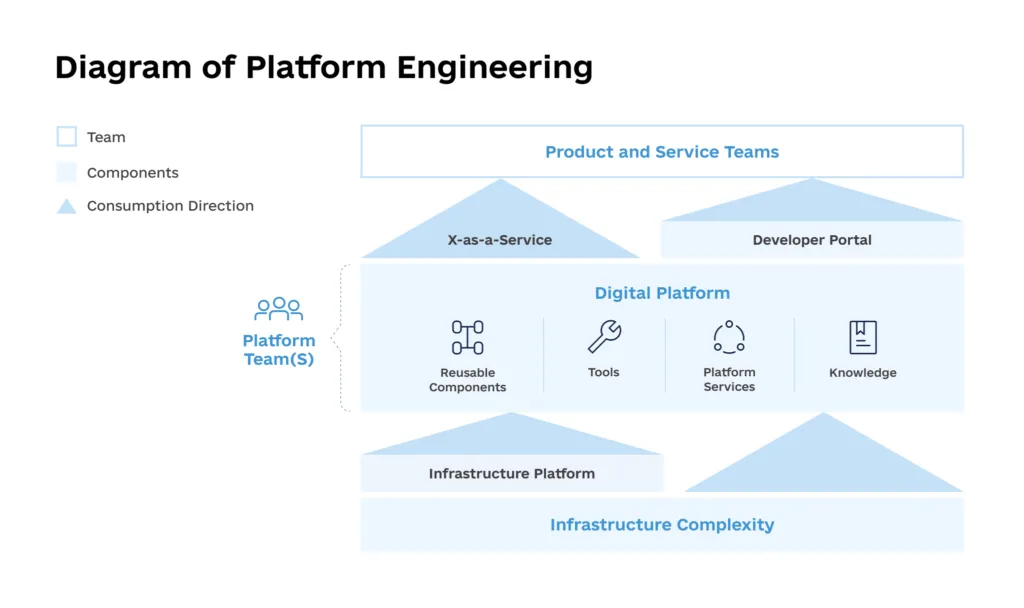
Source: Gartner
Effectively, platform engineering builds upon the DevOps best practices of continuous integration (CI), continuous delivery (CD), infrastructure as a code (IaaS), and increased collaboration. But, unlike DevOps, platform engineering focuses on improving the developer experience, not just the end product quality.
Platform engineering promotes the creation of standardized toolchains and workflows that enable developer self-service aka allow your software engineers to create, improve, and modernize new apps faster using tools from an internal developer portal (IDP).
Platform engineering teams perform essential “housekeeping tasks”, ranging from automatic infrastructure provisioning and workflow automation to proactive management of IDPs.
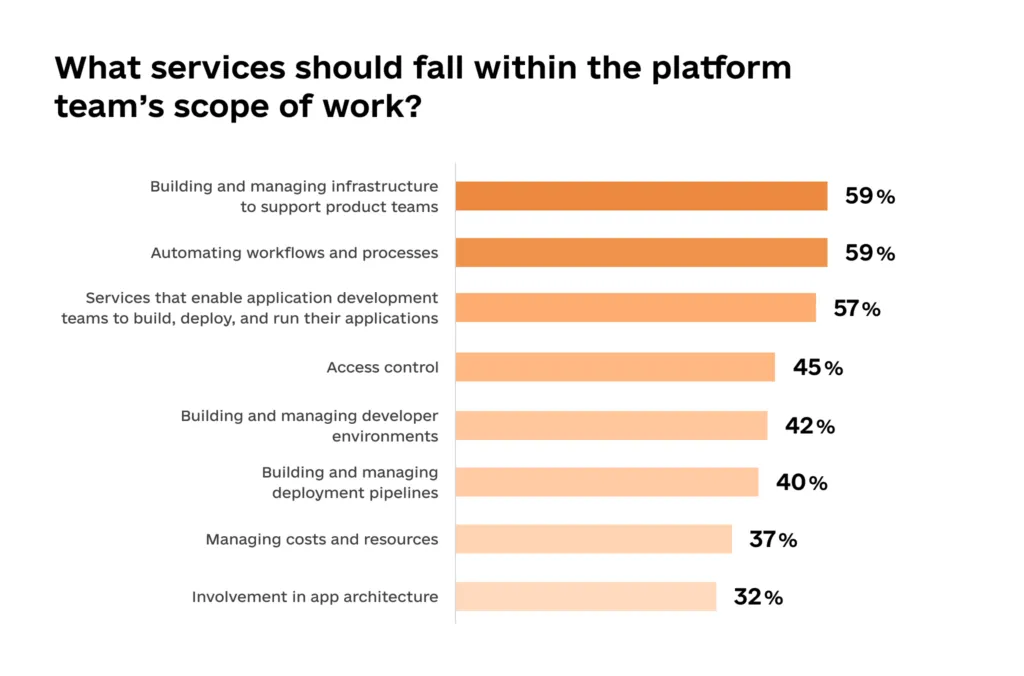
Source: The State of Platform Engineering Report 2023.
By offering a ‘golden path’ with all of the tools required for product development, testing, deployment, and management, the IDP facilitates developer self-service. This allows developers to complete these tasks without having to master individual tools, which can reduce cognitive load and boost efficiency.
Nike, Nordstrom, and Starbucks attribute a substantial part of their software engineering productivity to platform engineering practices. Overall, adopters report improvements in system reliability (60%), greater software developers’ productivity (59%), and better workflow standards (57%).
Apart from improving team performance and software quality, platform engineering also helps minimize waste, both in the form of unproductive fiddling with manual tasks and computing resources overuse, leading to better ESG performance.
Accelerated Adoption of Industry Cloud Platforms
Cloud adoption has been going strong since the mid-2010s. In 2023, global businesses spent over $563 billion on public cloud services, including PaaS, IaaS, SaaS, and DaaS solutions.
Cloud-native operations have already proven more cost-effective, environmentally friendly, and innovation-oriented, paving the way for new application development.
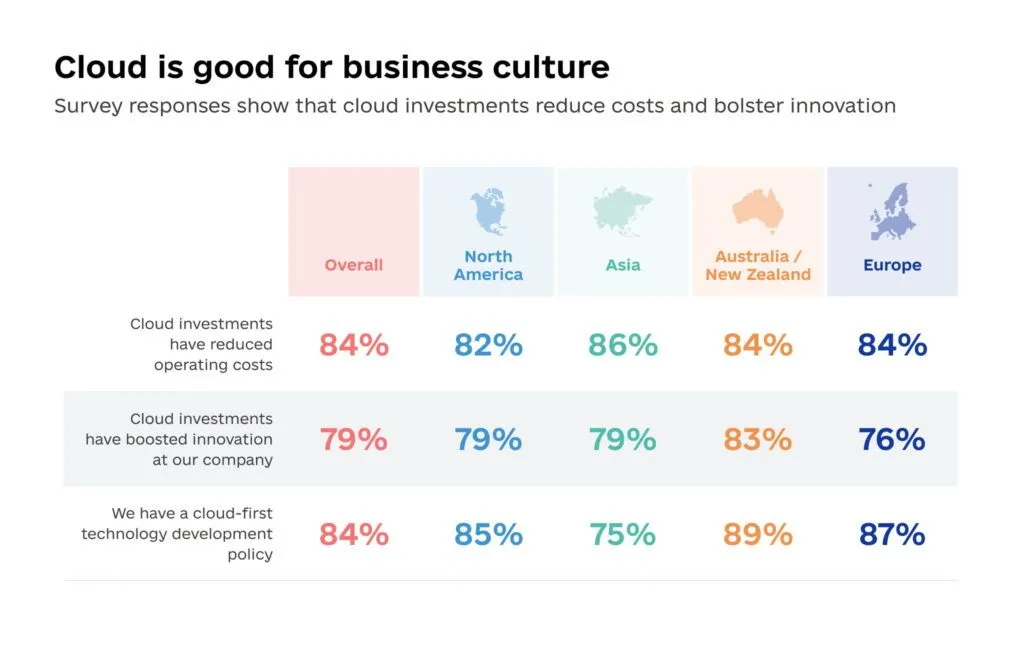
Source: MIT Technology Review
Until recently, however, cloud technology has been industry agnostic, offering a standard set of capabilities, each company had to configure to meet their operating demands. In response, some vendors are now evolving their offerings to industry cloud platforms.
An industry cloud platform consists of cloud solutions, tailored to the needs of a particular industry, such as healthcare, retail, finance, or AdTech. It’s purpose-built to meet the industry requirements for data storage, auditability, and security, plus provides a combination of composable SaaS, PaaS, and IaaS services to support specific use cases.
Industry cloud capabilities can range from optimized data architectures and new development tools (e.g., for data fabric) to a collection of pre-installed SaaS apps on managed cloud infrastructure. For example, Salesforce Health Cloud is a HIPAA-compliant platform, pre-furnished with patient management software and healthcare analytics. Snowflake, in turn, released a Media Data Cloud, with data architecture, adjusted for the needs of AdTech businesses.
By 2027 as many as 70% of enterprises will use industry cloud platforms, up from just 15% in 2023. If you’re looking to transition to cloud-native operations, the 8allocate cloud engineering team would be delighted to advise you on the optimal choice of cloud platforms, as well as facilitate the adoption.

New AI Frameworks like RAG Will Accelerate Gen AI Development
At present, only 5% of market leaders have implemented Gen AI in production at scale, but the majority (62%) name investments in this area as a top organization priority, according to Wavestone’s 2024 Data & Analytics Survey.
In particular, business leaders are looking for ways to improve their data analytics capabilities and new frameworks such as retrieval-augmented generation (RAG) help make that happen.
Originally introduced by Patrick Lewis of Facebook AI Research, RAG is a collection of techniques and methods that enable generative AI models to fetch facts from external sources.
Effectively, RAG allows large language models (LLMs) to access extra data, which wasn’t part of its training or parameter optimization to provide more accurate user replies. RAG models can scan specific corporate documents to look up data or browse indexed documents on the Internet to provide users with the freshest data and cite sources for the output. RAG also helps provide better responses to ambiguous user queries and minimizes the occurrence of model hallucinations.
Initially, RAG techniques were primarily focused on optimizing the end-to-end pipeline of retrievers and generators. However, RAG is now shifting towards a more modular approach where retrievers and generators are separate entities that can be optimized independently. This allows for greater customization of knowledge sources, retrieval techniques, and the selection of LLMs, according to a 2024 survey.
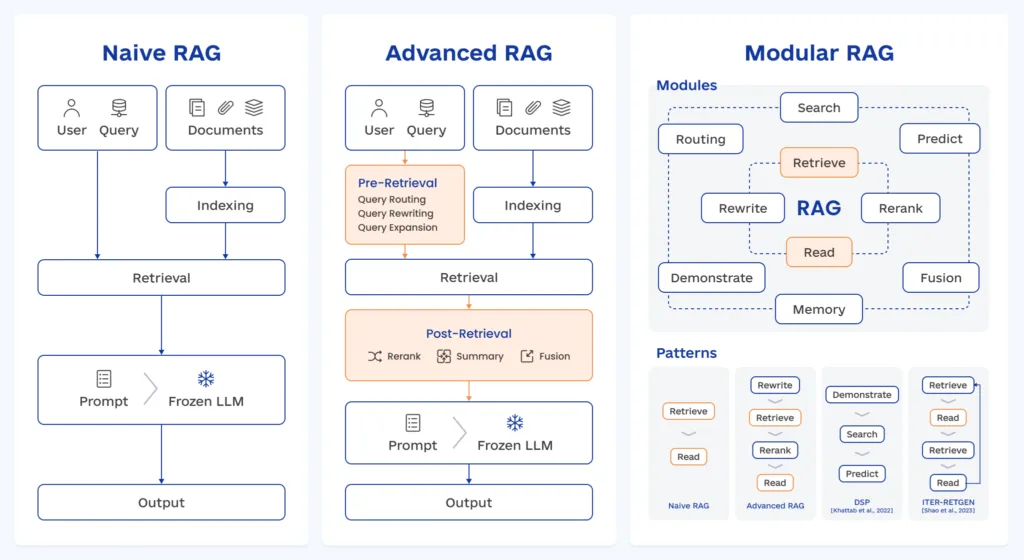
Source: arXiv
Last year, we saw plenty of new open-source RAG frameworks emerge, ranging from native ones like Parent Document Retriever to more complex, modular patterns like RAG Fusion.
At the end of 2023, Microsoft also launched a commercial, enterprise-grade RAG solution for deploying corporate LLMs — and we’re likely to see more offerings from large tech vendors in 2024.
Practically speaking, RAG dramatically improves the quality and relevancy of LLM outputs, allowing organizations to create custom “Copilots” and “GPTs”, trained on internal data and vetted for accuracy in performance.
AI Will Further Increase Software Development Productivity
Generative AI tools made a strong entrance in 2023, with Microsoft releasing GitHub Copilot and Microsoft Security Copilot, Amazon — CodeWhisperer, and Replit — Ghostwriter (not to mention all the coding use cases of ChatGPT).
Generative AI tools have already demonstrated value across various software engineering tasks, ranging from debugging code to brainstorming different application design ideas and scanning software for security vulnerabilities. Scientific tests have proved that some AI tools are capable of professional-level performance on different coding tests.
Although Gen AI usage is still relatively low among software engineering teams, the technology potential is massive.
GitHub estimates that AI software developer tools can add an equivalent of an extra 15 million “effective developers” to worldwide capacity by 2030. In monetary terms, this translates to a global increase in GDP of $1.5 trillion.
Apart from making software engineering teams more productive, Gen AI tools can also help developers improve their coding skills, while 4 out of 5 developers believe that AI coding tools will make their team more collaborative.
Gartner also predicts that in the next several years, organizations will embed gen AI into a wider range of software engineering processes:
- 30% of enterprises will implement an AI-augmented development and testing strategy by 2025.
- 60% of website and mobile app design efforts will be automated with Gen AI by 2026
- 15% of new applications will be auto-generated by AI without a human in the loop by 2027.
By reducing the learning curve, gen AI can also entice more people into tech careers and empower a new generation of citizen developers, helping organizations close the persisting skills gaps.
On the flip side, however, new approaches will be required to quality-check AI-generated code outputs. Likewise, AI tools can also become a new vector of attack for malicious actors, meaning such systems will require extra security measures.
IT Outsourcing Will Continue to Remain a Key Strategy for Talent Acquisition
Business leaders continue to grapple with tech talent shortages. Globally, 75% of employers still report talent constraints, with IT, data, and engineering being the hardest roles to fill, according to a ManpowerGroup Employment Outlook Q1 2024.
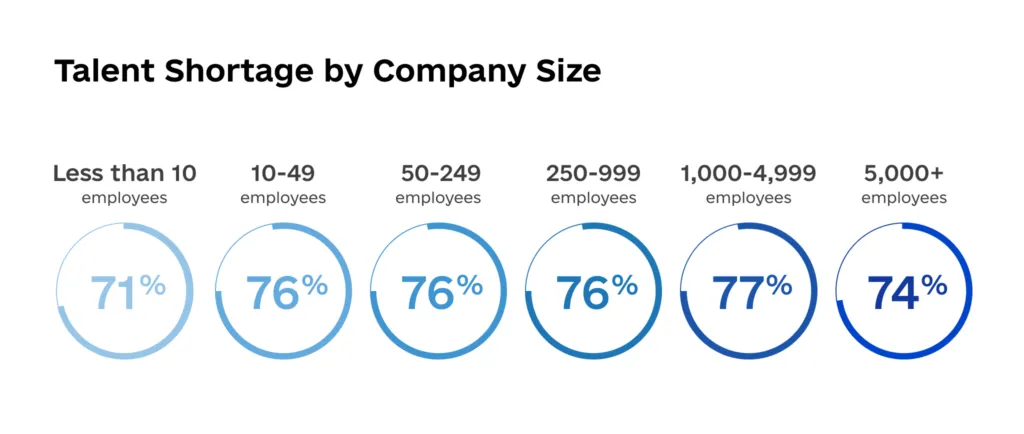
Source: ManpowerGroup Employment Outlook Q1 2024
With an almost uniform commitment to AI development, getting competent professionals has become increasingly hard, especially in mature markets. Gartner expects that the demand for tech talent will greatly outweigh the supply until at least 2026.
Over the past years, software development partnerships have become one of the key strategies for overcoming talent constraints in the local markets as we shared in our eBook.
To gain access to the required competencies and advance software development projects, 76% of businesses rely on third-party IT service providers. In 2024, this synergy will further increase.
According to Deloitte, over 60% of shared service providers (aka outsourcing partners) have increased the scope of provided services and opened new local offices in 2023, in response to greater demand.
Central and Eastern Europe (CEE), in particular, has strengthened its position as the top region for hiring software developers. Poland, Ukraine, and Romania have over 870,000 IT specialists, with over 10K of new graduates joining the industry annually.
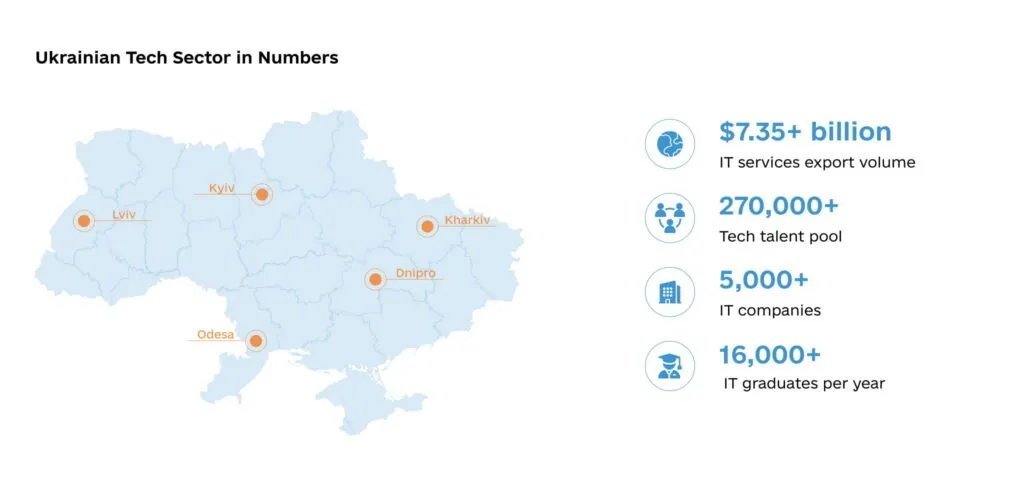
Strong tech acumen in areas such as cloud computing, big data analytics, ML, and AI among others, complemented by close cultural and geographic proximity to Western markets and improvements in the overall business climate, made CEE one the fastest-growing global tech hub.
Microsoft, Amazon, IBM, Facebook, Snapchat, and Google have already established local delivery centers in the region. Open AI expressed interest in opening a regional office in Poland, while Netflix has almost finalized the deal.
That said, the demand for tech talent in CEE is still lower than the supply, and software engineering services are more cost-effective. If you’re looking for ways to accelerate time-to-market for new software products or acquire the missing tech skill sets, look into the opportunities CEE has to offer.
Companies Will Expect to See Impact, Not Just Innovation from New Technologies
Emerging technologies carry a massive transformational potential, but business leaders are feeling more pressed to see the actual ROI. In fact, “lack of confidence due to missing ROI” has been cited as the top blocker of digital transformations among enterprises.
In 2024, we expect more leaders to focus on determining the impact of new technology trends on their business model and ability to generate more revenue. Not all new tech investments can transform the business model per se. Some may only upgrade existing capabilities (e.g., increase data storage capacity) without creating significant business impact (e.g., delivering better analytical insights).
CIOs must also recognize the gaps that exist between the expectations of business leaders and the reality of what IT departments can deliver. When your organization doesn’t have a mature data management capability, for example, developing new AI solutions will be an uphill battle. Likewise, different machine learning methods come with inherent advantages and constraints, not to mention specific skill sets AI teams require.
To avoid such scenarios, business leaders should focus on assessing new technology investments through the lens of their software engineering capabilities and the impacts these can bring to their operating models. Practices like the discovery phase in software development, technology readiness level (TRL) assessments, and capability maturity model integration (CMMI) among others can help in this area.
Engineering Your Way to Success In 2024
Business leaders face increasing demands for innovation, enterprise-wide transformation, departmental technology, and data analytics capabilities.
To meet these (often conflicting) priorities, leaders will need to focus on establishing better IT talent-sourcing strategies and improving their ability to execute the promised initiatives. To get through the backlog of corporate IT projects and accelerate new product development, leaders increasingly rely on software development partners in 2024.
Likewise, new engineering best practices like platform engineering and greater usage of AI developer tools can increase software engineering teams’ velocity and efficiency. New technology solutions like industry clouds and RAG are further easing the adoption curve of respective technologies, allowing businesses to deliver greater and faster impacts.
If you’re looking for ways to improve your software development capabilities in 2024, reach out to 8allocate. Our company provides end-to-end software engineering services with dedicated teams, as well as ad-hoc technology consulting services. Harness new market opportunities with an experienced software engineering team.
Frequently Asked Questions
Quick Guide to Common Questions
What are the key trends shaping software engineering in 2024?
Software engineering is evolving with platform engineering, industry cloud adoption, AI-driven productivity tools, and IT outsourcing. Businesses are focusing on improving software development efficiency, leveraging AI frameworks like RAG, and ensuring that emerging technologies deliver measurable impact rather than just innovation.
How is platform engineering changing the software development lifecycle (SDLC)?
Platform engineering streamlines software development by creating standardized toolchains, reusable components, and internal developer portals (IDPs). It enhances developer productivity by reducing cognitive load, improving system reliability, and promoting self-service infrastructure. Companies like Nike and Starbucks report higher efficiency and workflow standardization through platform engineering adoption.
What role does AI play in improving software development productivity?
AI-powered coding tools like GitHub Copilot and Amazon CodeWhisperer assist developers in debugging, code generation, and security scanning. By 2030, AI-assisted coding is expected to add the equivalent of 15 million new developers to the global workforce. However, AI-generated code requires rigorous validation, and organizations must adopt security measures to prevent vulnerabilities.
Why is IT outsourcing becoming more critical for software engineering?
Tech talent shortages persist, with demand for AI, cloud, and software development roles far exceeding supply. Many businesses are turning to IT outsourcing to access specialized talent quickly and scale their software development efforts. Central and Eastern Europe (CEE) has emerged as a leading hub for outsourcing, offering highly skilled developers with expertise in AI, big data, and cloud computing.