
Something interesting is happening in the startup hiring market right now, and almost nobody is talking about it.
Here’s the setup. Back in 2025, thousands of startups built their MVPs with AI coding tools. Vibe coding made it possible: Lovable, Replit, Cursor, and a dozen other platforms let non-technical founders (and small teams with one generalist developer) ship working products in days instead of months. Some of those products found real users. Some found product-market fit. Some even raised seed rounds and Series A’s.
And now? Those companies are slamming into a wall no vibe coding tool can fix. You’ve got a funded, AI-built MVP, so how do you scale it into something that makes money?
That’s what this article is about: how to scale a vibe-coded MVP. The first hire to make, the stack that gets you there, and the trap to avoid.
TL;DR: Scale Vibe Coded MVP
- Vibe coding is great at looking finished, not being finished. AI-generated code carries roughly 1.7x more major issues and up to 2.74x more security flaws than human-written code, so a funded MVP usually hides real technical debt under a working demo.
- Scaling a vibe-coded MVP isn’t a cleanup job. Post-funding, you need data pipelines, cost-controlled LLM integration, real-time processing, and an architecture that survives 10,000 users, going from demo to system.
- The standard hiring boxes don’t fit. Full-stack developers, data engineers, DevOps, and ML engineers each cover one layer. You need an AI development partner who works across all of them.
- Hire a “data-flavored full-stack engineer” first. A senior generalist who builds the whole flow (scraper → pipeline → LLM → API → infra → dashboard) and replaces a 2-3 person team at the early scaling stage.
- Sequence the team, don’t front-load it. Start with one engineer who covers the whole stack. Add a dedicated data engineer only when pipelines become a full-time job, and a frontend specialist when the UI earns its own roadmap.
- The trap to avoid: splitting into specialized roles too early. One strong full-stack generalist beats a front-end developer and a data engineer who can’t talk to each other.
- Build the “Growth Engine” stack, not the perfect data lake. Something that ships, scales to the next order of magnitude, and doesn’t catch fire at 3 AM, for $500-$5K/month in infrastructure. Perfection comes later.
The Vibe Coding Wall: Where Technical Debt Piles Up
The numbers tell the story. The vibe coding market reached an estimated $4.7 billion in 2026, with 92% of US developers using AI coding tools daily. A quarter of Y Combinator’s Winter 2025 batch had codebases that were 95% or more AI-generated. Lovable hit $100 million in annual recurring revenue in eight months. Wild growth, all of it real.
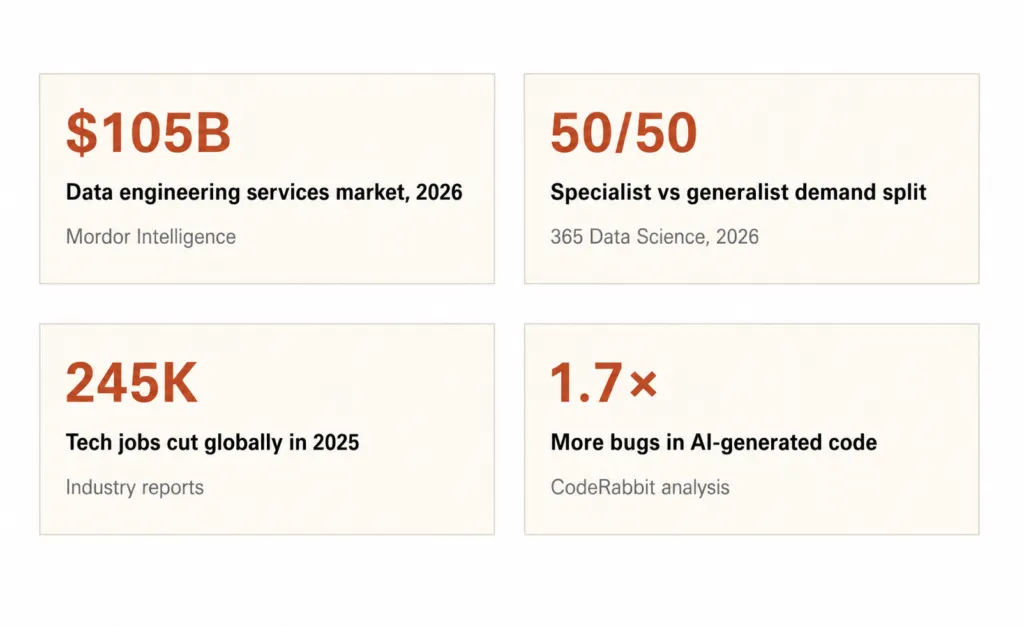
But here’s the other side of that coin. Audits of vibe-coded startups consistently reveal the same three problems – inconsistent code architecture, missing error handling, and zero testing infrastructure. A CodeRabbit analysis of 470 open-source pull requests found AI-generated code contains 1.7x more major issues and 2.74x higher security vulnerability rates than human-written code. One in ten apps built on Lovable had critical security flaws.
But here’s the other side of that coin. Audits of vibe-coded startups keep surfacing the same three problems:
- Inconsistent code architecture
- Missing error handling, and zero testing infrastructure. A CodeRabbit analysis of 470 open-source pull requests found AI-generated code contains roughly 1.7x more major issues
- Up to 2.74x higher security vulnerability rates than human-written code. And when security researchers scanned 1,645 apps built on Lovable, about one in ten shipped with a critical flaw that exposed user data to anyone on the internet.
AI is phenomenal at producing something that looks finished. But it is poor at making a finished product. AI accelerates sound engineers. But it does not replace them.
Ivanka Pop, Head of Solutions at 8allocate
Alex Turnbull, founder of Groove, predicted that “rescue engineering” would become the hottest discipline in tech in 2026. He was right, but the real story isn’t about rescuing what’s broken. It’s about what comes after the rescue.
When a vibe-coded startup gets funded and needs to scale, the problem isn’t only cleaning up spaghetti code. The company now needs data pipelines, web scraping infrastructure, LLM integration that doesn’t cost $50,000 a month in API calls, real-time processing, and an architecture that won’t collapse at 10,000 users. It needs to go from demo to system. And there’s a very specific type of engineer who can do that, one the market hasn’t named yet.
See how 8allocate’s Custom AI Solution Development Services can help you turn your AI prototype into a production-ready AI solution.
The Hiring Gap Nobody Talks About
Here’s the hiring landscape founders face:
- Traditional full-stack developers can build web apps but blink when you say “orchestrate a 15-step data pipeline with retry logic and monitoring.”
- Traditional data engineers can build world-class pipelines but won’t touch a React component or design an API that external users consume.
- DevOps/platform engineers can make anything run in production but don’t write the application logic.
- ML engineers can build models but struggle with the full-stack plumbing around them.
The data backs this up. A 2026 analysis of 1,000 data engineering job postings found an almost perfect 50/50 split between companies looking for specialists versus generalists — the highest generalist demand of any data role. Job descriptions now bundle platform engineering, DevOps integration, ML pipeline support, and governance orchestration into a single requisition. The result? Strong engineers qualify on paper but lack depth in at least one critical area. Hiring managers compromise, or restart the search.
Meanwhile, the data engineering services market hit $105 billion in 2026 and is projected to reach $213 billion by 2031. Demand for data engineers has grown over 100% between 2025 and 2030 according to the World Economic Forum. But the talent pipeline is still producing narrow specialists trained in silos.
Post-PMF (Product-Market Fit) startups don’t need a specialist. They need someone who can operate across the entire surface area of a modern data-intensive application — a specialist who can write the scraper, build the pipeline, integrate the LLM, design the API, deploy the infrastructure, and ship the dashboard. Not perfectly in every layer, but competently enough to move from MVP to full-scale AI solution without a team of eight.
The New Engineer Profile: Full-Stack Data Engineer Your Startup Needs
We, at 8allocate, started calling this role the “Data-Flavored Full-Stack Engineer” – not because it’s a catchy job title (it isn’t), but because it’s the most honest description of what post-PMF startups need.
This person isn’t a data engineer who learned React, or a frontend developer who took a Spark course. They’re a systems thinker who builds across the full stack with data as the center of gravity. They’re comfortable in Python and TypeScript. They’ve written production scrapers and production UIs. They think in data flows, not just request-response cycles.
Here’s the profile in detail:
Core identity
A senior generalist (5+ years) who builds entire data-intensive applications — from the scraper to the dashboard — with production-grade reliability. They don’t specialize in one layer; they specialize in making all layers work together.
Non-hegotiable skills
- Python (FastAPI, Scrapy, Celery)
- TypeScript (Next.js, React)
- PostgreSQL (deep – modeling, pg_cron, pgvector)
- Docker + CI/CD
- Orchestration (Dagster or Airflow)
- LLM API integration (OpenAI, Anthropic)
Strong signals in a candidate
- Has built and deployed a web scraping system that ran for months, not a weekend project
- Can explain the difference between pg_cron, Celery, and Dagster — and when to use each
- Has opinions about pgvector vs. Pinecone that come from experience, not blog posts
- Can whiteboard a system from “raw HTML on a webpage” to “clean data in a user-facing dashboard” in one session
Salary range
$150K–$200K (US) / $80K–$130K (remote international). Worth every dollar. At the early scaling stage, this one person replaces what would otherwise be a two-to-three-person team.
The crucial distinction? This person doesn’t build a perfect Airflow-orchestrated, medallion-architecture data lake. They build something that works, ships, scales to the next order of magnitude, and doesn’t catch fire at 3 AM. Perfection comes later, when you hire a dedicated data engineer.
Read also: How to Build and Structure an AI Development Team in 2026
What Data-Flavored Full-Stack Engineer Build
In practice, the data-flavored full-stack engineer assembles what we call the “Growth Engine” stack – the architecture that takes a startup from validated MVP to scalable product.
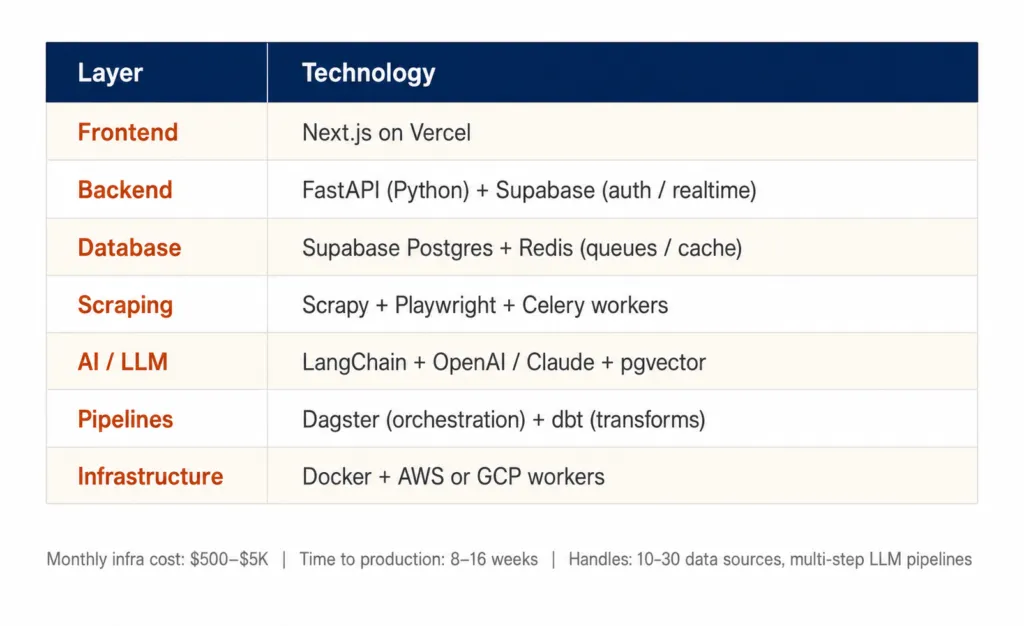
Notice what’s happening here. Supabase handles the commodity application concerns (auth, realtime, managed Postgres) so the engineer can focus on the data-intensive parts that actually differentiate the product. FastAPI handles the Python-native backend logic where scraping and LLM work naturally live. Dagster provides just enough orchestration to make pipelines reliable without the operational overhead of full Airflow.
Keep in mind: this is not the final architecture. This is the architecture that gets you from $0 to $2M ARR with one or two engineers, without piling up the kind of technical debt that later needs a rescue-engineering team to unwind.
The Two-Hire Playbook: Your First Engineering Hire After Funding
Now, let’s see what your first engineering hire must be after you get funded your AI MVP solution.
Hire 1. Immediately: data-flavored full-stack engineer
Takes over from the vibe-coded MVP. Rebuilds the critical path with production-grade code. Owns the full stack from scraping to dashboard. Gets you from “it works in the demo” to “it works for 10,000 users.”
Hire 2. When pipelines become a full-time job: dedicated data engineer
Bring this person in when you have 15+ data sources, data freshness SLAs, clients asking for audit trails, or when your first engineer is spending 70% of their time on pipeline maintenance instead of product features.
Hire 3. When the frontend needs its own roadmap: frontend / product engineer
When the UI complexity outpaces what the data-flavored full-stack engineer can handle alongside pipeline work. It’s usually when you build client-facing dashboards with real design expectations.
The most common mistake is splitting into two specialized roles too early. One excellent generalist at the scaling stage outperforms a frontend developer and a data engineer who can’t talk to each other.
Ivanka Pop, Head of Solutions at 8allocate
Where to Find Data-Flavored Full-Stack Engineer (and What to Look For)
This profile is hard to find because it doesn’t have a standard career path. In our experience, these engineers tend to emerge from one of three backgrounds:
- Full-stack developers who got pulled into data work. They built a web app that needed a scraper, then a pipeline, then an LLM integration, and discovered they were good at it. Look for: startups on their resume where they wore many hats.
- Data engineers who got frustrated with never seeing users. They built dashboards on top of their pipelines, then APIs, then full applications. Look for: side projects that have actual UIs.
- Ex-agency or consultancy engineers. Consulting forces you to build complete systems end-to-end on tight timelines. Look for: breadth of project types and comfort with ambiguity.
In interviews, the fastest signal is asking them to design a system on a whiteboard. Give them a real scenario: “We need to scrape 20 real estate listing sites daily, extract key data points with an LLM, store them in a searchable database, and display them in a dashboard where users can set alerts.” A specialist will design their piece brilliantly and hand-wave the rest. A data-flavored full-stack engineer will sketch the entire flow, including the parts they’re less confident about, and tell you where the dragons are.
The other signal: ask about failure modes. “What breaks when a scraper source changes their HTML structure?” “What happens when your LLM costs 4x what you budgeted?” “How do you handle pipeline failures at 2 AM?” Generalists who’ve run production systems have war stories. Specialists who’ve only worked on their slice often don’t.
Looking for an AI engineering partner? Check our guide “What to Look for in an AI Development Partner.”
The Bet
We’re making a prediction: within 12 months, “Data-Flavored Full-Stack Engineer” — or something like it — will be a recognized role on job boards. The market dynamics are too strong for it not to happen. Vibe coding will keep producing funded MVPs. Those MVPs will keep hitting the scaling wall. And the founders who move fastest to hire this profile will be the ones who survive the transition from demo to product.
The vibe coders built the prototype. Now it’s time for the engineers who can make it real. That’s exactly the gap 8allocate closes.
8allocate is an Estonian AI solutions development company that specializes in building AI-driven solutions across the domain, including AI solutions development services for logistics.
Here’s how you benefit from working with us:
- You deliver AI solutions faster. You get a production-ready AI solution in 8-12 weeks. We turn your existing prototype into a production-grade system, cutting timelines 60-70% with proven architecture patterns and pre-built accelerators..
- You skip the 6-month hiring search. You skip the 6-month hiring search. Get senior AI and software engineers, organized into domain-specific Industry Pods, ready in about a week and scalable on demand..
- You stay in control. Two cooperation models: AI staff augmentation with the specialists you need, or a managed dedicated AI development team. Either way, you own the code, the docs, and the knowledge transfer from day one.
We’ve delivered 200+ AI and software projects to production and are recognized by Clutch and GoodFirms among the top AI development companies . Check our case studies.
Want to scope your path from AI MVP to scalable product?Let’s get in touch. We’ll help you define the right engineering profile, scope the AI solution architecture, and move fast.
FAQ
Quick guide to common questions
What does it cost to scale a vibe-coded MVP?
The cost to scale a vibe-coded MVP runs typically $500-$5K per month at the early scaling stage. Your biggest line item is engineering. You can engage an AI development partner like 8allocate to compress the development timeline and avoid a 6-12 month hiring search.
Who should be your first engineering hire after funding?
For a data-intensive product, hire a senior generalist who can build across the full stack: scraper, pipeline, LLM integration, API, infrastructure, and dashboard. Bring in a dedicated data engineer only once pipelines become a full-time job (15+ data sources, freshness SLAs, audit trails), and a frontend specialist when UI complexity outgrows what one person can handle.
How do you fix AI-generated code quality?
We review every diff, run automated tests and security linters (SAST) on every commit, and centralize sensitive logic like credentials and authentication.
How do you take a vibe-coded AI MVP to production?
We start by auditing the three usual failure points: inconsistent architecture, missing error handling, and no testing. Then, our AI engineers rebuild the critical path with production-grade code, with proper data modeling, monitoring, evaluation, and graceful failure handling. The fastest route is cooperating with one AI development partner like 8allocate who owns the full stack from scraping to dashboard, rather than splitting the work across narrow specialists too early.