
It probably became the new norm: a freight bill audit that gets a little messier every quarter. Carrier invoices show up from a dozen places at once, land in an inbox nobody fully owns, and someone on your team has to check every single one against a real shipment, the contracted rate, and the accessorial rules before it gets paid. That manual work creates real cost.
Here’s the part worth taking with a grain of salt: AI won’t magically fix that overnight, and not every team is ready to hand AI the keys. But the cost of leaving it alone is real. U.S. companies spend $2.58 trillion a year moving freight, about 8.8% of GDP (CSCMP State of Logistics Report), and billing errors quietly skim a few percent off the top. As a company, building custom AI solutions for logistics, we see billing as the kind of leak teams point to first when they start scoping where AI can help.
In this article, we’ll cover what AI freight audit automation is, how to choose your first use case, the minimum data you need in place, and how to pick an implementation model that fits your systems.
TL;DR: AI Freight Audit Automation
- AI freight audit automation is a chain of checks that ties every carrier invoice to the right shipment, contract, and approval rule before it gets paid.
- A good first freight audit automation use case usually has four traits: it has enough volume to matter, it has clear enough data to test, it has rules or patterns that can be defined, it can run with human review before full trust is required.
- Minimum freight audit data foundation includes five layers: invoice sources, shipment context from your TMS, rate and charge logic, AP and payment context, exception examples and reviewer feedback.
- You don’t need an internal data team to start. You need accessible data and clear ownership for one workflow, not a perfect data lake, and 50-200 historical invoices are enough for a first pilot.
- Not every check needs AI. Use rules for predictable checks, document AI for messy invoices, and AI assistance for summaries, and keep a human on every decision that touches payment.
- There’s no single right tool. Off-the-shelf software, AP automation, custom AI, or a hybrid layer each fit a different situation. For most mid-market 3PLs, the hybrid layer wins.
What Is AI Freight Audit Automation?
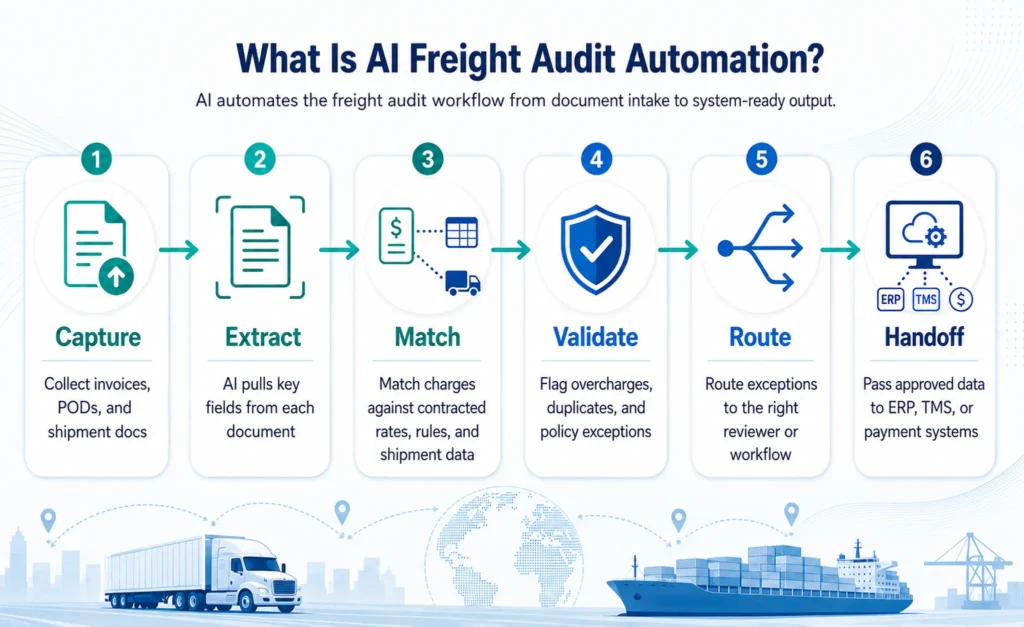
AI freight audit automation is the use of document AI, rules, workflow automation, and AI-assisted exception handling to help your team review carrier invoices before payment.
It’s not just OCR (Optical Character Recognition). OCR reads text from a document. Freight audit automation has to do more than read. It needs to connect invoice data to shipment records, rate logic, approval rules, supporting documents, and payment workflows.
In practice, freight audit process, AI-powered freight audit can help you:
- collect invoices from email inboxes, carrier portals, shared folders, EDI (Electronic Data Interchange) feeds, spreadsheets, and PDFs;
- extract invoice number, carrier name, invoice date, due date, shipment references, line items, totals, fuel charges, and payment terms;
- match invoices to TMS (Transportation Management System) shipment records using load ID, shipment ID, PRO number, BOL (Bill of Lading), carrier reference, dates, lanes, and amounts;
- identify duplicate or near-duplicate invoices;
- compare billed charges against rate cards, contracts, spot quotes, fuel tables, and accessorial rules;
- flag missing proof of delivery (POD), missing BOL, unsupported accessorials, rate mismatches, and other exceptions;
- route issues to AP (Accounts Payable), operations, pricing, finance, or management;
- generate exception summaries and draft dispute messages;
- hand approved invoice data off to ERP (Enterprise Resource Planning), accounting, or AP systems;
- preserve an audit trail for approvals, disputes, and payment decisions.
Because freight audit is a chain of checks, the value of AI-powered freight audit automation comes from connecting invoice data with your records and business rules, not from reading PDFs faster. For a lean 3PL team, that distinction is everything. You don’t start by building an AI platform or hiring data scientists. You start by figuring out which slice of the workflow can be safely and measurably automated first.
How to Validate Your First Freight Audit Automation Use Case for AI
Preparing for AI implementation, especially in a data-heavy process like freight audit, can sound heavier than the project itself: prepare ten data points, connect five systems, document three workflows, and build a small temple for data governance. At that point, going back to Excel can feel easier.
But here’s the thing: you don’t need every system, every document source, and every historical invoice cleaned before you start. You need to find one freight audit workflow that’s ready enough for a controlled first pilot.
A good first use case usually has four traits:
- It has enough volume to matter.
- It has clear enough data to test.
- It has rules or patterns you can define.
- It can run with human review before full trust is required.
In practice, a realistic first AI freight audit use case answers four questions:
Question | What it helps you understand |
| Do we have the data for this use case? | Whether you can access the invoices, shipment records, rate references, AP data, or exception examples a pilot needs. |
| Can we reach the systems where that data lives? | Whether the data can be pulled from your TMS, AP/accounting system, inboxes, carrier portals, spreadsheets, shared folders, or exports. |
| Can the current check be explained clearly? | Whether the process can be turned into rules, matching logic, confidence thresholds, or human review steps. |
| Can our team review the output safely? | Whether AP, finance, or operations can validate the results before automation affects payment decisions. |
There are more questions once you go deeper into technical discovery. But you don’t need to solve all of that alone before starting, that’s part of an AI development partner’s job.
For instance, at 8allocate we use a structured AI readiness and discovery approach to help clients move from “we need AI” to a realistic first implementation plan:
- Business discovery: clarify whether this is the right problem to solve first with AI: who owns the process, where the value is, what success looks like, and which risks could make the project hard to adopt.
- AI readiness assessment: check whether your current data, systems, processes, and team are ready enough to support a first AI-assisted workflow.
- Technical discovery: review the systems involved, available data sources, APIs or export options, security requirements, infrastructure constraints, and integration risks to define how the pilot should actually be built.
For freight audit automation, that means you don’t need to arrive with a finished plan. The discovery work identifies which invoice workflow is realistic to automate first, what data is already usable, what needs cleaning or connecting, and where human review must stay in place.
There are plenty of technical solutions you can implement today, and honestly, they’re impressive. But it all starts with the foundation ready: your data, your people, and your processes. Get those right and the technology delivers. Skip them, and even the best AI or agentic AI solutions won’t get far.
Ivanka Pop, Head of Solutions at 8allocate

What Minimum Freight Audit Data Foundation Do You Need Before AI Can Work?
Let’s be honest about something the hype skips: you don’t need perfect data to start AI freight audit automation. But you do need accessible, usable data for the first workflow.
So what does “AI foundation” mean in the context of freight audit? It’s the minimum set of invoice data, shipment context, rate logic, payment context, rules, and review controls needed to run one use case safely.
For a first pilot, your minimum freight audit data foundation usually includes five layers.
Invoice sources
You need to know where carrier invoices arrive and how a system can reach them. AI can’t extract an invoice it can’t reach. If invoices are scattered across personal inboxes and local folders, your first workstream may be intake consolidation, not model selection. The good part? You can start with one controlled source, say, invoices from your top carriers or a shared AP inbox.
Shipment context from your TMS
Freight audit lives or dies on matching invoices to real shipments. You’ll need fields like shipment ID, load ID, carrier reference, PRO number, BOL, origin/destination, pickup/delivery dates, mode, and expected cost. The matching doesn’t have to be perfect at first, but you need enough identifiers to connect an invoice to a shipment with reasonable confidence. If the invoice has a PRO number your TMS doesn’t store consistently, that’s not an AI problem yet. It’s a data-mapping problem.
Rate and charge logic
AI can extract charges, but it can’t know whether they’re correct without something to compare against. That means carrier contracts, rate cards, spot quotes, fuel surcharge tables, accessorial policies, tolerance thresholds, and customer-specific billing rules. Some of this may still live in spreadsheets, and that’s fine for a pilot, as long as it’s accessible and the rules are clear enough to encode. The mistake is assuming AI will “just understand” your pricing logic without being handed the reference material. It won’t.
Read also: “How AI Automates RFQ Processing for Freight and Logistics.”
AP and payment context
Approved invoices need somewhere to go. You’ll want to understand how invoice status flows into your AP, ERP, or accounting system. A first AI pilot doesn’t have to push payments straight into accounting. It can start with a review queue or a controlled CSV export. But the target handoff has to be clear.
Exception examples and reviewer feedback
AI-supported workflows improve fastest when they have examples of what your team considers correct, wrong, risky, or unclear, like recently disputed invoices, duplicates, unsupported accessorials, rate mismatches, missing PODs. You don’t need years of perfectly labeled data. For many first AI pilots, 50-200 historical invoices with related TMS records, rate sheets, and exception notes are enough to expose the main patterns and edge cases.
The key principle to remember? You do not need years of perfectly labeled historical data. For many first AI pilots, 50-200 historical invoices with related TMS records, rate sheets, and exception notes can be enough to expose the main patterns and edge cases.
The key is to avoid trying to clean everything before starting. Messy freight audit data does not mean “no AI.” It just means the first pilot must be narrow enough to control.
- If you are testing duplicate detection, focus on invoice number, carrier, amount, shipment reference, date, and vendor record.
- If you are testing shipment matching, focus on the identifiers that connect invoice to TMS.
- If you are testing accessorial flagging, focus on charge descriptions, approval rules, and supporting evidence.
Which Freight Audit Checks Need AI, Rules, or Human Review?
Not every freight audit problem needs AI. Yeah, it’s a worn-out line you’ve heard everywhere, but it’s true. Not every process should be AI-driven. Some problems need deterministic rules. Some need workflow automation. Some need to document AI. And some need a human reviewer, because the decision affects payment, margin, or a carrier relationship.
That’s freeing. It means you don’t have to make the whole process “AI-driven” on day one.
A practical freight audit automation design usually combines four layers:
- document AI for reading and structuring messy invoices;
- rules for predictable checks;
- matching logic for connecting invoices to shipments;
- human review for low-confidence, high-value, or payment-impacting exceptions.
So which automation layer fits which check? The table below walks through each step of the freight audit workflow and shows the best-fit automation for it.
| Freight audit step | Best-fit automation | Minimum inputs | Keep a human in the loop for |
| Invoice capture & extraction | Document AI plus inbox, portal, shared folder, or EDI intake | PDFs, images, Office files, EDI payloads, or spreadsheet invoices | First-time formats, unreadable scans, low-confidence outputs |
| Shipment matching | Exact matching first, fuzzy matching second | Invoice ID, carrier, load/shipment ID, PRO/BOL, dates, totals, TMS record | Many-to-one matches, missing references, low-confidence matches |
| Rate & accessorial validation | Rules engine using rate cards, contracts, fuel tables, tolerances | Freight amount, line items, charge descriptions, tariff references, contracted rates | Contract interpretation, unusual accessorials, discretionary exceptions |
| Duplicate detection | Exact match plus near-duplicate logic | Invoice number, carrier, amount, service date, shipment reference, vendor record | Corrected invoices, rebills, credit notes, reissued invoices |
| Exception routing & reviewer support | Rules-first routing plus optional AI summaries and dispute drafts | Exception category, confidence score, assignee map, approval threshold, supporting docs | High-value invoices, payment holds, carrier disputes |
| AP handoff & audit trail | Workflow automation, status updates, export/API handoff | Approved invoice payload, vendor master, accounting attributes, approval state | Final approval policy, exceptions over tolerance, payment release |
Now, a word on AI agents, because there’s a lot of hype here. An AI agent can eventually run a multi-step loop: retrieve the invoice, check the shipment, compare rates, classify the exception, notify a reviewer, and draft a dispute. But that only makes sense after the rules, data sources, permissions, exception categories, and review controls are defined.
In one recent project, 8allocate built an AI-powered anomaly detection and monitoring solution for manufacturing using agentic workflows. The same architectural pattern transfers directly to logistics: agents monitor operational data, detect anomalies, classify urgency, recommend an action, and escalate the cases they can’t resolve to a human operator.
A simple rule of thumb keeps you out of trouble: use rules for predictable checks, document AI for messy formats, AI assistance for summaries and drafts, and keep humans in control of payment-impacting decisions. In freight audits, AI shouldn’t bypass controls. It should make them faster, more consistent, and easier to enforce.
Read also: What Are AI Agents for Data Analysis?
How to Choose the Right Automation Approach for Your Freight Audit Process
Once you know what you want to automate and what data you can access, the next question is how to implement it. This is where a lot of teams get stuck. You compare freight audit software, AP automation, custom AI builds, and internal projects as if they’re interchangeable. They’re not. Each fits a different level of process maturity, system fragmentation, and internal technical capacity.
For one company, configuring existing TMS or AP workflows may be enough. For another, off-the-shelf freight audit software covers most needs. For a team with messy invoice sources, custom rate logic, disconnected systems, and no internal data team, a hybrid automation layer or a custom AI workflow is usually more realistic.
| Freight audit automation model | Best fit for your situation | Main upside | Main limitation | Internal burden |
| Configure existing TMS/AP workflows | Invoices are already structured, but approvals and handoffs are messy | Fastest way to cut manual routing and improve visibility | Limited help with PDFs, portals, complex matching, custom rate validation | Low |
| Off-the-shelf freight audit software | Invoice types, audit rules, and integrations are fairly standardized | Faster route to a proven baseline | May not fit custom rate logic, fragmented systems, or unusual exceptions | Low to moderate |
| AP automation + freight-specific rules | Main pain is intake, coding, approval, finance-led processing | Good when AP owns the workflow | Generic AP tools can miss shipment matching and accessorial nuance | Moderate |
| Internal custom build | You have engineering, data, integration, and support capacity in-house | Maximum control over logic and roadmap | Hard to maintain without real technical ownership and monitoring | High |
| Custom AI workflow with an integration partner | Your TMS, AP, ERP, inbox, portal, and spreadsheet data are fragmented, and you have no internal data team | Fits your existing systems without forcing full internal hiring | Needs clear scope, SME involvement, and strong partner delivery | Moderate internally, higher externally |
| Hybrid freight audit automation layer | You want to keep existing systems and add document AI, rules, matching, and routing around them | Avoids rip-and-replace; supports phased rollout | Needs disciplined scope control and process ownership | Moderate |
Here’s the honest read. If your problem is mostly standardized invoice checking, a packaged freight audit platform may genuinely be enough. Don’t talk yourself into a custom build you don’t need. If the main issue is intake and approval workflow, AP automation with freight rules can be a solid start.
But if your problem is fragmented operational context – invoices in emails and portals, shipment truth in the TMS, rate logic in spreadsheets, approvals in accounting tools, and exception handling living in people’s heads – then a custom AI workflow or hybrid approach is usually more realistic.
Some teams also compare AI freight audit automation with managed freight audit services. Managed services can be useful when you want an external provider to run invoice checks for you, while AI automation is better when you want to keep the audit logic, data, and workflows inside your own systems.
Read also: “AI Agent Development for Logistics: Use Cases and How to Start.”
For most small and mid-sized logistics providers, that hybrid layer is the sweet spot:
- keep the TMS as the shipment system of record;
- keep AP/accounting as the payment system of record;
- use document AI for extraction;
- use rules and matching logic for the audit checks;
- use workflow automation for routing and status;
- use AI assistance for summaries and dispute drafts;
- and keep humans in the loop for the risky calls.
It avoids both extremes: buying yet another disconnected tool that doesn’t fit your workflow, or launching a giant internal build your team isn’t staffed to maintain.
At 8allocate, we help clients choose the right approach through the Discovery phase. We map your current processes, data sources, system landscape, business rules, ownership, risks, and success criteria. In a freight audit context, that means looking at how standardized your invoices are, how fragmented your TMS, AP, accounting, and rate data is, how accessible your systems are, and who actually owns the audit rules.
From there, our Structured Agility framework keeps the work short, visible, and accountable: clear scope upfront, working software you can review along the way, measurable checkpoints, and a Go/No-Go decision at the end of each phase. You’re not locked into a large AI build before it proves value.
See how our Custom AI Solution Development services can help you build AI automation around your business logic, workflows, and data environment.
Your Freight Audit Readiness Checklist
Before you invest in any of this, run a simple readiness check. You don’t need perfect answers. You just need to know where the gaps are.
| AI readiness question | Why it matters |
| Do you know where all carrier invoices arrive? | Automation needs clear intake sources before it can collect anything. |
| Can you access TMS shipment records? | Invoice matching needs shipment context from the system of record. |
| Are key identifiers captured consistently? | Matching depends on invoice number, load ID, PRO/BOL, carrier, date, and amount. |
| Do you have rate cards or contracts available? | Rate validation needs reference data. |
| Are accessorial rules documented? | Extra charges need decision logic before they can be flagged. |
| Do you know your most common exception types? | Pilot scope should be built on real audit issues, not assumptions. |
| Can AP or accounting receive approved invoice data? | Automation needs a payment handoff path. |
| Is there a process owner? | Someone has to approve rules, exceptions, thresholds, and outputs. |
| Are reviewers available to validate the pilot? | AI outputs need controlled review before trust is increased. |
| Do you know what should never be auto-approved? | Payment risk needs guardrails. |
| Can you measure the result? | A pilot should track time saved, exceptions found, cycle time, and overcharges caught. |
If you can’t answer all of these questions yet, it doesn’t mean automation is impossible. It simply means the right first step is discovery and AI readiness work, the stage we usually start with at 8allocate. Full AI implementation comes after that foundation is clear.
And a realistic first pilot stays deliberately narrow:
- Choose one carrier group, invoice type, or exception category.
- Collect 50-200 recent invoices.
- Gather the matching TMS shipment records.
- Pull the relevant rate sheets, contracts, or accessorial rules.
- Define the exception categories.
- Decide which cases need human review.
- Run the AI-assisted process alongside the manual one.
- Measure results before expanding.
The goal of the first pilot is to prove that automation can extract the right data, match the right records, flag the right exceptions, and support your team without weakening payment controls.
How 8allocate Can Support Your Freight Audit Automation
8allocate is an AI solutions development company that’s been building production AI since 2015. Our team builds custom AI systems and delivers AI as standalone tools or modules inside your existing software. We start every engagement by assessing your Data Foundation and AI Readiness to decide whether the AI use case will work.
Logistics and supply chain is one of our core domains. Our Logistics and Supply Chain Pod brings senior engineers who already understand how 3PLs and shippers operate, backed by AI-native and Forward Deployed AI Engineers. Our latest logistics AI use cases include AI-powered anomaly detection and monitoring solutions for manufacturing operations, AI-powered document processing for construction teams, and AI container number recognition system for logistics teams – part of 200+ AI and software projects we’ve delivered to production.
Our core delivery team operates from the EU, with R&D hubs across Central & Eastern Europe and LATAM: 500+ AI and software engineers, European-aligned timezones, and GDPR-ready delivery.
Still Have Questions on AI Freight Audit Automation?
Quick guide to common questions
How long does it take to implement AI freight audit automation?
It takes approximately 4 to 12+ weeks to implement AI freight audit automation. A focused AI freight audit pilot usually takes 4-6 weeks to test one workflow (e.g., invoice data extraction, rate validation, or exception routing). A broader rollout typically takes 8-12+ weeks, depending on data quality, access to logistics systems, invoice formats, and integration complexity.
Do we need to replace our TMS or current freight audit software?
Usually, no. AI freight audit automation does not need to replace your TMS or existing freight audit software. It normally works as an intelligence layer on top of your current systems: reading invoices from PDFs, EDI, email, portals, or exports, validating them against contracts and rules, then sending approved data or exceptions back into your existing workflow. Replacement is only needed if your current system has no usable data access, no integration options, or cannot support the target process.
How accurate is AI invoice data extraction?
For clean digital invoices and consistent carrier formats, AI extraction can usually reach 90-95%+ accuracy on key fields after configuration and validation. The system should use confidence scoring, validation rules, and human review for exceptions.
Is AI freight audit automation secure and compliant?
Yes, AI automated freight auditing can be secured and compliant if it is designed correctly. For example, at 8allocate, we build AI systems with privacy, auditability, and compliance controls from the start, including GDPR and EU data residency requirements where needed. The AI should support your compliance process, not create a new black box.
How automation improves freight audit accuracy?
Automation improves freight audit accuracy by checking every invoice line against contracted rates, fuel surcharge rules, accessorial tables, shipment data, and payment history, instead of relying on manual review or random sampling.