
RFQ processing in freight and logistics is still one of the most manual parts of commercial operations.
At low volume, your team can manage it with experience, spreadsheets, email threads, and a few internal workarounds. But as request volume grows, the process becomes slower, less consistent, and harder to control. A missing delivery window, unclear equipment type, or outdated rate, can directly affect margin, service quality, and customer trust.
That is where AI RFQ automation starts to matter.
AI can help managers extract key data from emails and attachments, compare RFQs against contracted and historical rates, flag missing information, highlight margin risks, prepare quote drafts, and support faster pricing decisions.
But there is one important point: AI-powered RFQ automation is not simply “AI writes quotes.” It can mean very different things depending on the bottleneck: document processing, workflow automation, pricing support, system integration, or agentic orchestration. Choosing the wrong type can create more complexity than value.
Ten years in, we at 8allocate have implemented AI in Logistics, working with freight forwarders and 3PL providers. From this experience, we see that many business owners misunderstand what AI-powered RFQ automation should do. So in this article, we explain what it is, how to choose the right approach for your RFQ process, and how to start with a real example, so you don’t waste time and resources on the wrong tech.
TL;DR: AI RFQ Automation
- AI-powered RFQ automation extracts shipment data from messy emails, PDFs, portals, and spreadsheets, validates missing info, compares historical rates, and prepares draft quotes.
- AI RFQ automation isn’t one tool. It combines five capabilities, such as document intelligence, workflow automation, pricing support, AI copilots, and AI agents, assembled differently based on the bottleneck.
- Most RFQ automation falls into four types: rule-based workflow, AI-assisted document and email processing, AI copilots for pricing teams, and agentic RFQ automation. Different types fit for different operations.
- The right type of AI RFQ automation depends on three things: how structured your RFQ intake is, how complex your pricing logic is, and your monthly volume.
- AI isn’t always the answer. If you process 30-50 simple RFQs per month with stable pricing, a CRM setup or rule-based workflow often delivers value faster than AI.
- AI can’t fix a process that isn’t defined. Before adding AI, define what “complete RFQ” means, what “good-enough confidence” looks like, what “priced correctly” means per customer tier, and what requires approval.
- Start with one controlled RFQ segment, detect missing data before pricing, keep humans in the loop, and test in shadow mode. Vooma’s quoting agent cut per-quote response time by 95% at WorldWide Logistics by starting narrow.
What Is AI-Powered RFQ Automation?
AI-powered RFQ automation is a system that takes messy quote requests from emails, PDFs, portals, or spreadsheets, extracts the shipment data, validates missing info, checks rates and past quotes, flags risky or unusual cases, and prepares a draft quote response. Managers only step in for exceptions, approvals, or high-risk deals.
Here’s what matters: AI RFQ automation is not one tool or one feature. It is a combination of capabilities that can be assembled differently depending on your RFQ bottleneck.
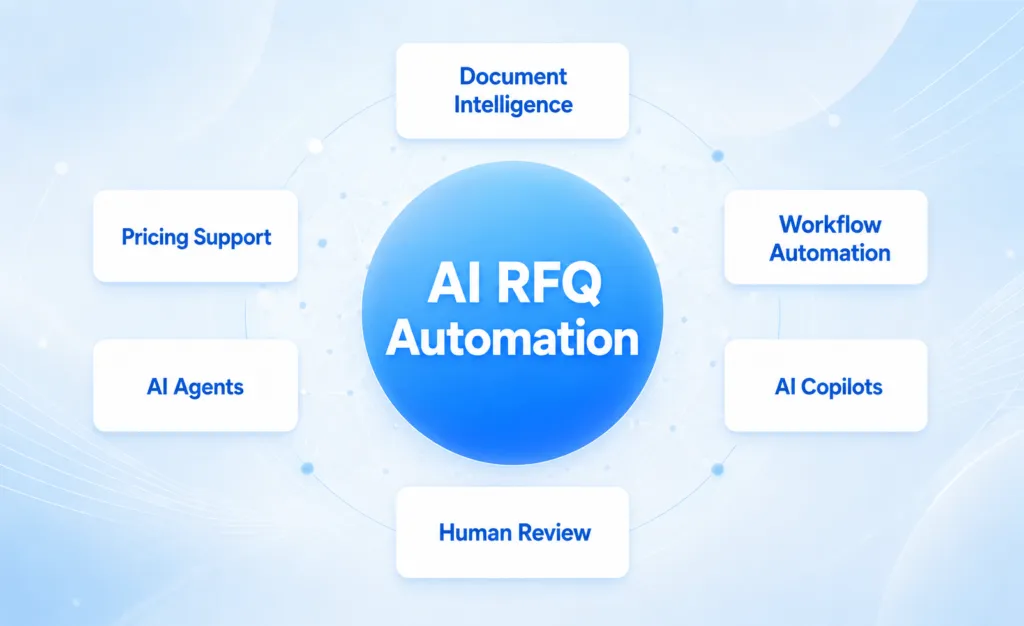
AI RFQ automation can include:
- Document intelligence to extract data from emails, PDFs, spreadsheets, and attachments.
- Workflow automation to route RFQs, manage statuses, and trigger approvals.
- Pricing support to compare rates, historical quotes, customer rules, and margin thresholds.
- AI copilots to summarize RFQs, suggest next actions, and draft customer responses.
- AI agents to run controlled multi-step workflows across connected systems.
That difference matters. If your main problem is messy intake, you do not need an agentic pricing engine. If your bottleneck is rate validation, document extraction alone will not solve it. If your pricing process still depends on commercial judgment, fully automated quoting may create more risk than value.
So before choosing a tool or building a custom AI solution, you need to understand which part of the RFQ process you need to improve.

4 Types of RFQ Automation: Which One Fits Your Business?
Most RFQ automation solutions fall into four types:
1. Rule-based workflow automation
2. AI-assisted document and email processing
3. AI copilots for pricing and quoting teams
4. Agentic RFQ automation
Note:
These four types of RFQ automation aren’t a maturity ladder you climb. They’re different fits for different operations. The mistake is choosing based on what sounds impressive instead of what fits your business reality today.
Some teams only need workflow automation. Others need to document AI. Some need a pricing copilot. A smaller group genuinely needs agentic orchestration.
The mistake is choosing based on what sounds impressive instead of what matches your business reality.
Rule-based workflow automation
This is the right answer more often than vendors admit. Rule-based automation structures RFQ events using forms, routing logic, validation rules, bid management, and approvals.
- Best fit: standardized portals, repeatable sourcing events, fixed SOPs, and clean fields.
- Where it breaks: mixed inputs from email and attachments, high customer variability, and pricing details hidden in unstructured conversations.
AI-assisted document and email processing
This is often the most practical AI-powered layer for freight teams. It extracts shipment details from semi-structured and unstructured inputs: emails, PDFs, Excel files, attachments, and customer messages.
- Best fit: inbox-heavy teams that spend too much time copying data manually.
- Where it breaks: poor scans, unusual document layouts, hidden business logic, and weak fallback paths.
In one 8allocate case, an AI-powered document processing solution helped a construction team reduce document retrieval time by 50% and search interactions by 30%, replacing much of their manual spreadsheet-based workflow.
AI copilots for pricing and quoting
This is the middle ground when pricing is too nuanced for full autonomy but too repetitive for fully manual work. The copilot prepares the context, compares similar RFQs, drafts responses, and supports pricing decisions.
- Best fit: teams where margin decisions, customer nuance, and exception handling still need human judgment.
- Where it breaks: fragmented pricing context, unclear approval logic, or missing customer constraints. If the copilot does not have reliable context, it can sound confident while being commercially wrong.
Interested in AI agents for Logistics and Freight? See our guide “AI Agent Development for Logistics: Top 5 Use Cases and How to Start in 2026?”
Agentic RFQ automation
This is the most advanced type. It can orchestrate RFQ work across systems, make tool calls, maintain state, and move requests through defined steps.
- Best fit: high-volume environments with clear business rules, integrated systems, measurable exception categories, and a real need for end-to-end orchestration.
- Where it breaks: chaotic intake, undefined approvals, no exception taxonomy, fragile integrations, or unclear ownership.
For example, project44’s procurement agent shows the strategic version: detecting market changes, recommending sourcing actions, triggering mini-bids inside a TMS. Other examples include Maersk using Pactum’s AI negotiation agents to achieve 15% savings in freight rate negotiations, and Boeing × Fairmarkit eliminating 115,000 hours of cycle time annually across indirect spend RFQs.
Here’s quick comparison of RFQ automation types
| Types of RFQ automation | What it automates | Best fit when | Main dependency | Main failure mode |
| Rule-based workflow automation | Structured RFQ intake, routing, tendering, validation, bidding, approvals | Standardized forms, portals, repeatable sourcing events | Clean fields, fixed SOPs, explicit rules | Mixed inputs and customer-specific exceptions overwhelm the rules |
| AI-assisted document and email processing | Parsing emails, PDFs, spreadsheets, extracting shipment details, missing-data follow-up | Manual inbox-heavy teams dealing with semi-structured requests | Representative documents, confidence thresholds, TMS/inbox connectivity | Poor scans, unusual layouts, hidden business logic, weak fallback paths |
| AI copilot for pricing and quoting teams | Summaries, rate lookups, historical context, reply drafting, recommendations | Teams that still want an expert to own final pricing | Accessible pricing context, good UX, clear approval boundaries | Incomplete context produces plausible but commercially weak output |
| Agentic RFQ automation | Multi-step intake-to-response orchestration across tools and systems | High-volume environments with clear guardrails and integrated systems | APIs, permissions, observability, approvals, exception taxonomy | Over-automation without governance, brittle integrations, unclear ownership |
How to Understand Which Type of AI RFQ Automation You Need?
The right type of AI RFQ automation depends on three things: your current bottleneck, your data and system maturity, and how much human control your quoting process still needs.
- How structured your RFQ intake is
- How complex your pricing logic gets
- How much volume you’re processing.
Most logistics teams overshoot. They assume they need agentic AI when rule-based workflow would solve 80% of their problem in a quarter of the time.
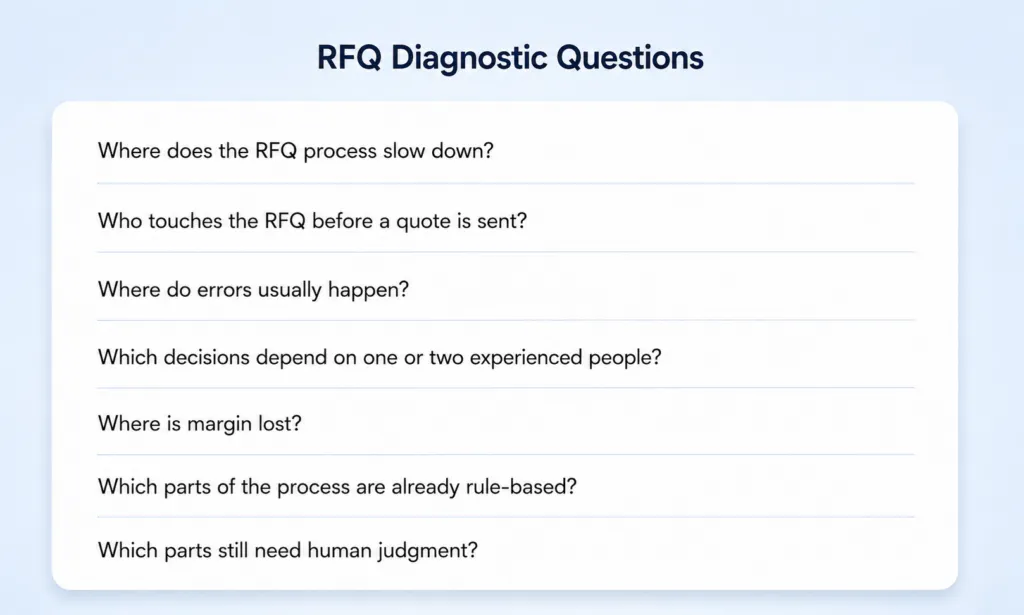
At 8allocate, we help companies clarify this before development starts. Depending on the situation, we use three discovery approaches:
Business discovery: Are we solving the right problem?
We use BACCM, the Business Analysis Core Concept Model and IIBA industry standard, to understand whether AI is really the right solution. 8allocate examines your business needs, stakeholders, value, context, and change. This usually takes 2-3 weeks.
SCaiLE-8: Are you ready to operate AI in production?
Next, we use SCaiLE-8, 8allocate’s AI maturity assessment. The goal is to understand if your company is ready to operate AI safely in production. This usually takes around 3 weeks.
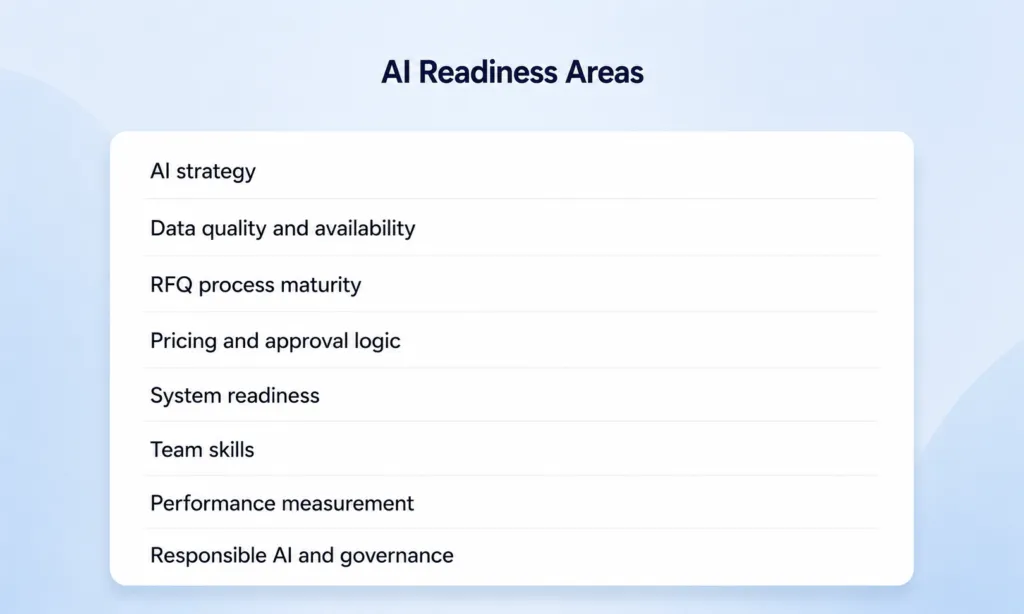
For example, if you have thousands of RFQs but poor historical data, disconnected pricing sources, and unclear approval rules, you may need to start with AI-assisted document and email processing to structure intake first. Or, if you already have clean data, strong pricing rules, and integrated systems, you may be ready for AI copilot or even a controlled agentic workflow.
The output of SCaiLE-8 is a practical roadmap that shows which RFQ automation type fits your company’s current readiness, what gaps must be fixed, and what business value can realistically be achieved.
FLASH-8: How would the RFQ automation system work inside your environment?
Once we understand the business problem and AI readiness, we move to FLASH-8, 8allocate’s technical discovery framework. FLASH-8 stands for: Foundations, Landscape, Architecture, Solution scoping, Hypothesis validation + 8 Decision Records. This usually takes 1-3 weeks, depending on the complexity of the RFQ environment.
We map the TMS, CRM, email, pricing tools, data sources, integrations, constraints, and approval workflows. Then we validate the riskiest technical assumption with a proof of concept.
Note:
By the end of the discovery phase, you have a clear answer which type of RFQ automation you need.
Should you start with document processing, build a pricing support tool, automate workflow routing, move toward agentic orchestration, or fix system integration before adding AI?
The goal is to choose the type of RFQ automation that solves your current bottleneck without creating new operational risk.
Read also: How to Choose AI Development Partner: 7 Criteria to Assess
When AI Is Not the Answer for RFQ Automation
Ivanka Pop, 8allocate’s Head of Solutions, shares a useful example:
“A client came to us wanting to automate their RFQ process. First thing they said: “We probably need AI, right?”
I asked them how many quotes they process a month. Fifty. With a pretty stable flow. Same product types, same pricing logic, same team handling it for years.
We set up a CRM. Configure it to their process. Done in a week.
They were almost disappointed, like the solution wasn’t exciting enough. But three months later? Their team was spending half the time on quotes and twice the time on actual relationships.”
The takeaway is that the right automation solution is the one that fits your business today, not the one that sounds impressive on a slide.
If you seek efficiency or automation, that doesn’t automatically mean you need AI, a custom build, or 6 months of engineering. A CRM setup, templates, structured workflow, or better system integration may deliver value faster.
But if you process thousands of complex, multi-variable quotes per day, you genuinely need AI copilots or agentic workflow.
See how our Custom AI Solution Development Services can help you build AI solution for RFQ processing around your business logic, workflows, and data environment
How to Start AI RFQ Automation in 6 Steps
The better starting point is your current RFQ decision process. You’ll benefit AI only if it understands how your team receives requests, checks missing data, compares historical rates, calculates risk, and decides which quote is safe to send.
Here are six practical steps to start AI-powered RFQ automation.
1. Start with one RFQ type, not the whole process
Do not try to automate every RFQ from day one. Start with a controlled RFQ segment: existing customers, repeat lanes, standard cargo, known equipment types, clear historical pricing, and low compliance risk.
A good first scope could be:
- Existing customers
- Repeat lanes
- Standard cargo
- Known equipment types
- Clear historical pricing
- Low compliance risk
For example, Vooma’s quoting agent helped Whitewater Freight bring load build time from 5 minutes down to 30 seconds on standard repeat-lane RFQs. They didn’t try to automate the whole process, the company started with a specific, controlled segment.
2. Define what a complete RFQ means for your business
Before AI can help, your team needs to agree on what information is required to prepare a reliable quote.
This sounds basic, but in many logistics teams, RFQ quality depends on the individual operator. One person checks dimensions. Another focuses on pickup windows. Another remembers that a specific customer often forgets accessorial charges.
AI needs one clear structure.
For example, every RFQ should be converted into a standard record:
- Customer
- Origin
- Destination
- Pickup date
- Delivery date, etc.
AI should not just summarize an email. It should convert an unstructured request into a clean, usable RFQ record.
3. Use AI to detect missing information before pricing
Missing-data detection is one of the highest-value RFQ use cases.
Instead of only summarizing the request, AI should identify what is present, what is missing, and what action is needed.
For example: pickup date available, cargo weight available, equipment type missing, delivery window missing, insurance value not mentioned.
Recommended action: ask the customer for the missing delivery window and equipment details before pricing. For example: ‘Thanks for the request. Before we confirm pricing, could you please confirm the unloading window and required equipment type?’
This is a small automation, but it removes a lot of back-and-forth from daily RFQ work.
4. Let AI prepare pricing context, not invent the price
This is where many freight companies get it wrong.
AI should not freely decide the price. Pricing logic should come from controlled sources: rate cards, contracted rates, historical quotes, TMS data, carrier costs, customer agreements, margin rules, and approval policies.
AI can show similar RFQs, historical accepted ranges, average margins, carrier cost ranges, accessorial patterns, risk flags, and suggested quote ranges.
The final decision should remain controlled.
A practical AI output could look like this:
- Similar historical shipments: 14
- Average accepted quote: $2,180
- Average gross margin: 14%
- Carrier cost range: $1,820-$1,950
- Recommended quote range: $2,180-$2,260
- Risk: medium because the unloading window is missing
- Approval required: yes, because the customer requested a same-day response
AI can recommend. Pricing logic must still be controlled.
5. Keep humans in the loop
A good RFQ automation workflow should give the reviewer everything needed in one place: extracted details, missing fields, similar historical quotes, suggested price range, margin estimate, risk flags, draft response, and approve/edit/escalate options.
The important part is to track every human edit.
- If your team often changes the suggested price, your pricing logic needs improvement.
- If they often correct the same extracted field, your data extraction needs improvement.
- If they often escalate the same type of RFQ, your workflow rules need improvement.
This is how the system gets better without becoming uncontrolled.
6. Test in shadow mode before going live
Before AI sends anything to customers or updates TMS, CRM, or email workflows, test it in shadow mode.
Your team continues processing RFQs as usual while AI processes the same RFQs separately. You compare outputs: extraction accuracy, missing-data detection, risk flags, suggested quote range, escalation logic, and final human decision.
Once the workflow is reliable, then connect AI to business systems and automate low-risk steps.
The sequence matters:
- First, prove the workflow.
- Then, connect AI to business systems.
- Then, automate low-risk steps.
Fix the Process First, Then Add AI
AI can’t fix a process that isn’t defined.
So, before adding AI to RFQ processing, define four things:
- what a complete RFQ means in your operation
- what “good-enough confidence” looks like for each decision type
- what ‘priced correctly’ means for each customer tier
- what requires approval or escalation.
AWS recommends confidence thresholds of 90% or higher for business processes involving financial decisions. Microsoft suggests auto-accepting high-confidence extractions and flagging lower-confidence ones for human review. ABI Research’s 2025 supply chain survey adds the operational angle: 80%+ of teams plan AI deployment, but less than half have built the analytical capability today, ambition outpaces readiness.
Get these wrong, and AI accelerates the wrong process. Get them right, and every week of AI use makes the team faster and easier to scale.
If your RFQ process is slowed down by fragmented data, read our guide on AI in Data Management for Logistics: Solutions for a Fragmented Ecosystem. It explains why data architecture decisions before AI implementation determine 80% of success.
Why Hire 8allocate for AI-Powered RFQ Automation
Building AI RFQ automation that works in production requires more than adding an LLM to an inbox. It requires domain understanding, software engineering, system integration, data architecture, approval logic, and responsible AI controls. Here are a few reasons why 8allocate can be that AI development partner for you:
1. Seasoned experts in AI and software development
We’ve been building AI since 2015. Combining deep software engineering expertise with enterprise AI delivery, we help companies build reliable AI systems.
2. AI engineers who understand logistics domain
We understand how logistics teams use AI for RFQ automation, carrier scoring, freight audit, rate management, document processing, and workflow orchestration. That means less back-and-forth and fewer false starts.
3. Custom AI development around your process
8allocate brings proven AI engineering patterns and domain experience and builds custom AI solutions around your workflow, data, and compliance requirements.
4. AI agent development services
For companies ready for advanced automation, 8allocate can build AI agents using proven agent frameworks, RAG pipelines, integration patterns, and industry-specific templates. You get your first AI agent MVP live in 4-6 weeks.
Looking for a team of AI-focused developers to help implement AI into your RFQ processing? Drop us a line!

Still Got Questions on AI RFQ Automation?
Quick guide to common questions
How much RFQ volume do we need before AI makes sense?
If your team processes 30-50 simple RFQs per month with stable pricing logic, a CRM setup, templates, or rule-based workflow may be enough. AI-based solutions start to make more sense when your team deals with high RFQ volume, messy emails and attachments.
Do we need clean data before starting?
You do not need perfect data, but you need enough representative RFQs to understand the patterns. A good starting point is a sample of past RFQs: emails, PDFs, Excel files, final quoted prices, win/loss outcomes, and notes on exceptions.
How do we prevent AI from making pricing mistakes?
Do not let the LLM invent the price. Pricing logic should come from controlled sources: rate cards, contracted rates, historical quotes, TMS data, customer agreements, margin rules, and approval policies. AI should prepare the pricing context and recommend a range.
Should we buy an RFQ automation tool or build a custom solution?
It depends on where your process is broken. If your RFQs are standardized and your process is simple, an off-the-shelf workflow or document automation tool may be enough. If your pricing logic, customer rules, integrations, or exception handling are specific to your business, a custom AI solution may be a better fit.