Technology, especially artificial intelligence (AI), has become the focal point of modern innovation. Every industry is accelerating digitization efforts and AI-driven innovation to stay competitive. However, given the current economic conditions, technology leaders must also maintain lean budgets. Almost half of the global business leaders are focusing on operational efficiencies while at the same time investing in innovation and growth.
To effectively balance the costs and gains of new technology adoption, leaders now require efficient processes for successful project delivery and competent engineering talent. Yet, global talent shortages hinder businesses’ ability to accelerate time-to-market for new products—especially when implementing advanced solutions like AI—while ensuring the effective delivery of core services, as detailed in how to find AI talent.
Over 60% of tech leaders name talent shortage as the most significant adoption barrier of emerging technologies including compute infrastructure and platform services, network, security, digital workplace, IT automation, storage and database solutions. Low maturity in these areas poses a threat to future competitiveness. The challenge is especially pronounced in AI-related fields—globally, 78% of companies struggle to hire AI scientists and 75% have difficulty finding machine learning engineers.
As talent becomes increasingly hard to find locally, smart tech leaders size up the alternative solution: dedicated team services from software development partners.
What Is a Dedicated Team?
An AI dedicated development team is a cross-functional unit composed primarily of AI engineers, data scientists, machine learning experts, and supporting developers—assembled to deliver AI-centric products or enhance existing solutions with artificial intelligence.
An AI dedicated development team model, in turn, is a scoped service, which covers team staffing, onboarding, and ongoing management. Effectively, you acquire a competent team that can be scaled or modified on short notice to meet your business demands.
Unlike a general-purpose dedicated team, the AI Dedicated Team is specifically tailored for projects where artificial intelligence is the core capability—from building machine learning pipelines to deploying production-grade models and integrating AI into business workflows.
As Deloitte highlights: the earlier third-party delivery models have traditionally fallen into two categories:
- Traditional outsourcing: Cost containment via farming out non-core tasks.
- Managed services: Volume-driven deals with performance service levels
However, the third delivery model has now come to the fore, which is characterized by a high degree of collaboration, skills focus, technology enablement, and outcome-oriented delivery. The dedicated delivery model fits the above definition.
How Does a Dedicated Development Team Service Work?
A dedicated development team model is a strategic partnership between a software development vendor (the supplier) and a business seeking specific tech competencies (the client).
Jointly, both parties establish an optimal collaboration framework, defining shared and individual areas of responsibility. The development partner commits to ongoing talent sourcing based on the roles needed (from front-end developers to AI/machine learning engineers) and the qualification requirements provided by the client. There may also be specific commitments around candidate replacement, team performance, and talent retention.
The client, in turn, manages day-to-day operations: incorporating the dedicated team into its software development life cycle (SDLC) and product plans, allocating daily work, and steering the project. Depending on the arrangement, the software development partner may also assist with operational alignment, team infrastructure setup, and process optimization. For instance, at 8allocate we help clients adopt Agile project management practices and establish effective CI/CD processes for faster, waste-free engineering; for AI-focused projects, we additionally guide on setting up data pipelines and MLOps practices to seamlessly integrate AI workflows.
To better understand how the dedicated team model works, check the table below, outlining the key areas of responsibilities on each side.

Why Global Leaders Choose to Partner with Dedicated Development Teams
Two races are underway: the race for talent and the race for digital dominance. According to various sources, anywhere between 52% and 93% of organizations plan to increase their spending on technology in 2023. Yet, bigger budgets don’t always translate to better outcomes.
Although 92% of CIOs expect digital innovation to drive new revenues this year, 72% also admit that they’re behind on their digital transformation plans due to technical debt. At the same time, talent shortages — particularly in cutting-edge areas like AI — are holding companies back. Local head-hunting and conventional hiring strategies no longer yield results amidst this talent crunch.
Local head-hunting and conventional talent acquisition strategies no longer produce desired results amidst the ongoing talent crunch. Historically low unemployment rates in most developed regions, the low amount of new tech graduates, and the rapidly compounding demand for engineering talent will drive ongoing shortages.
To overcome these constraints, 60% of engineering executives plan to increase outsourcing over the next three years, according to BCG.
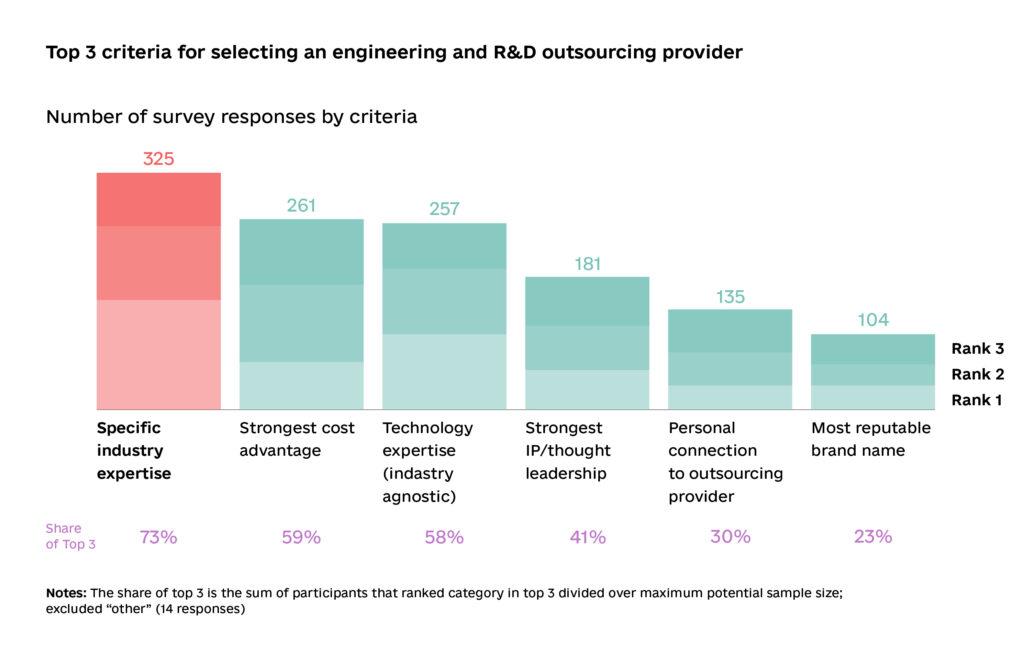
The key driver for such partnerships isn’t cost containment, but expertise: 73% of BCG respondents noted that industry or technology expertise is the most influential factor in selecting a software development partner.
Industry expertise is the most important factor for engineering and R&D executives when choosing an outsourcing provider
An equal number (60%) of engineering executives are also switching from traditional staff augmentation to service models, where development partners contribute to project management and risk minimization, aligning with best practices for building a top-notch AI software development team.
Collaborative service models such as dedicated software development teams allow companies to access a pool of software engineering talent in locations with fewer talent shortages. Moreover, software development partners help mitigate developer turnover by taking responsibility to quickly replace lost talent. That’s a substantial benefit, given that 73% of global CIOs are worried about IT talent attrition amidst the ongoing “Great Resignation” and “Quite Quitting”.
Learn more about scaling fast with global talent.
Download a free whitepaper.
Challenges Solved by Dedicated Development Teams
With the recession looming in the background, businesses need to walk a fine line between cost optimization and investments for innovation and growth.
The key to balancing these juxtaposing priorities is greater operational agility, which the dedicated development team model provides. If the above challenges sound familiar to your organization, strongly consider this option:
1. Understaffed Development Teams Or Projects
Understaffed IT departments often have limited capacity beyond “back-office” tasks like system maintenance and basic IT services. This means innovative initiatives — such as implementing new AI-driven features or other strategic projects — may get sidelined as employees are stretched thin. At the same time, market pressure urges businesses to accomplish less with more, with the burden of doing so falling on the employees.
Among software engineers surveyed by SolarWinds, 50% say they feel that they’re doing two jobs at a time. Overstretched talent eventually chooses to quit, which further exacerbates the staffing issues.
With a dedicated development team model, businesses can staff teams faster while sharing the burden of talent retention with a partner. Your company can respond to demand surges more quickly, access missing capabilities (for example, bringing in a data scientist for an AI prototype), and free up in-house talent to focus on core, complex tasks.
2. Slow Time-to-Market for Digital Products
Ongoing talent shortages also limit the ability to pursue Research & Development. Projects get reprioritized, new product releases are delayed, and market opportunities are lost. This is especially true for AI innovation—if you lack machine learning engineers or data engineers, AI product initiatives can stall.
New service models enable leaders to deliver competitive products at the cadence the market demands. Tech leaders are increasingly outsourcing end-to-end product design and development to seize the market opportunity before the competition.
For example, Dopay wanted to secure its position as the leading payroll services provider in the Egyptian market. With clients like Mcdonald’s and SWVL in their roster, Dopay couldn’t compromise on the system’s efficiency, security, and convenience. With a dedicated development team from 8allocate, Dopay managed to successfully deploy a new on-premises core system for 24/7 payment processing, a seamless user account opening process, and a convenient UI for employee management in record-setting time.
3. Absent Software Development Capabilities
Lack of experience with modern microservices-based architectures, cloud-native application design, and emerging technologies (AI/ML, big data analytics, IoT) often stand in the way of digital transformations.
Yet, the talent you need to deliver an ambitious project is either unavailable or unaffordable, but mostly both. As the digitization race continues, every business in the market is after similar tech employee profiles. Skills shortfalls are further exacerbated by the recent entry of a bigger tech employer to the region, as well as all-time low unemployment rates.
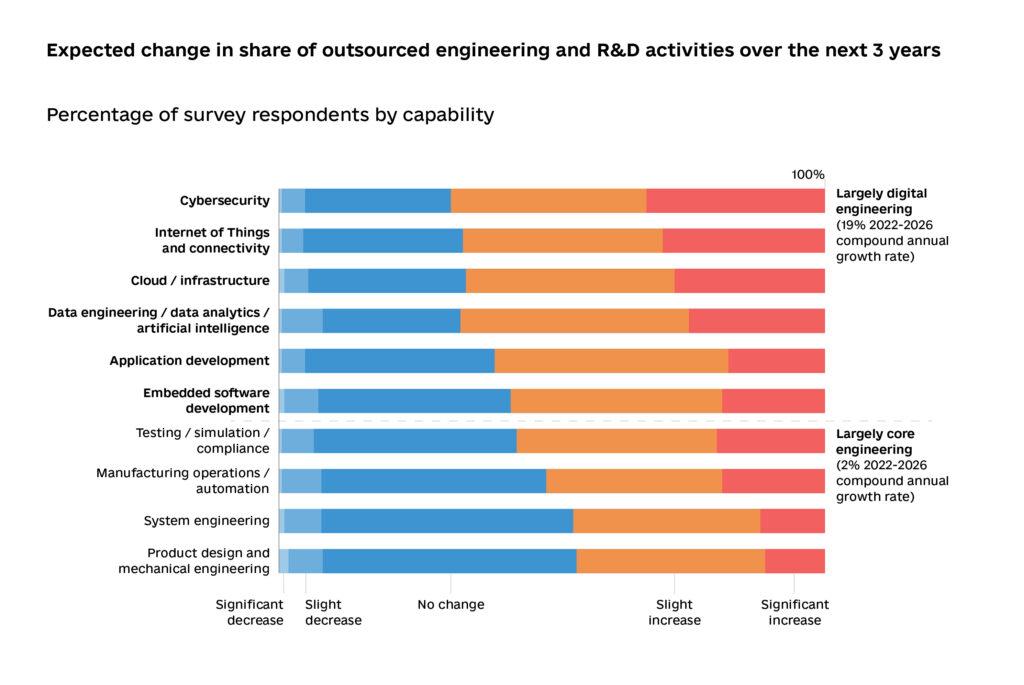
To acquire the missing skill sets, tech executives are choosing to collaborate with external vendors, especially in the areas of embedded software development, application development, data engineering, cloud, AI/ML development (including AI architecture design, model training, and deployment), and cybersecurity.
Engineering and R&D leaders anticipate the sharpest outsourcing growth in cybersecurity, Internet of Things, and cloud activities
4. Constrained Project Expansion
Payroll is a significant expense, and few companies can afford extra engineering staff “just in case.” So when a project enters a new stage — say, moving from an MVP to a feature-rich product or modernizing a legacy system — progress often stalls due to prolonged hiring timelines or a lack of suitable candidates. For instance, scaling up an AI MVP into a full-fledged production solution might be delayed if you cannot quickly onboard experienced machine learning engineers.
AI software development partners, in turn, can assemble an AI dedicated project team at 2X-4X speeds by leveraging its bench of staff and internal talent pool. Moreover, you can create a combination of full-time and part-time team staffers, hired for specific project segments only (e.g., front-end development and design) or mobile app development. This way you don’t have to invest in a large-scale hiring campaign and retain multiple talents on payroll to move forward with your initiative.
For example, GoIT faced unprecedented demand for its eLearning services during the pandemic. The team needed to upgrade its learning management system (LMS), however, the effort was stalled by engineering talent shortages. 8allocate rapidly staffed the project team and took over platform development. Within several months, GoIT released a new learning experience system (LXP), packed with competitive personalization and gamification features.

Service Models Comparison: Dedicated Team vs Team Augmentation
For those familiar with outsourcing, traditional staff augmentation is a well-known model. It’s a time-tested approach but often comes with constraints: new team members can be hard to integrate into existing workflows, information may not flow seamlessly between in-house and augmented staff, and the service is typically short-term by design.
For AI projects, these limitations can be even more pronounced. Simply adding one data scientist to your team might not result in a successful AI initiative, because a single specialist cannot cover all aspects of an AI solution. In contrast, an AI dedicated team provides a cohesive unit of experts (data engineers, ML engineers, etc.) who collaborate from data preparation to model deployment. Still, both service models have their merits, as the comparison table below illustrates.

Pros of The Dedicated Team Model
Having dedicated project teams working alongside in-house staff brings substantial benefits: scalability, faster delivery, and increased productivity. Global leaders also gain the ability to engage extra experts (e.g., for consulting or advisory in specialized areas like AI) and secure exactly the right skill sets for their projects.

1. Access to Hard-to-Source Software Development Skills
Access to in-demand AI/ML talent such as AI scientists, machine learning engineers, NLP specialists, and data engineers is often limited. An AI dedicated team helps you bypass this constraint by giving you direct access to these scarce resources.
Despite the recent headlines about massive layoffs, organizations still face critical talent shortages.
Globally, 69% of companies struggle to hire data engineers, 78% — AI scientists, and 75% — machine learning engineers, according to a McKinsey survey. The overall demand for software engineers and quality assurance (QA) specialists is expected to increase by another 25% during this decade.
Globally, tech worker shortages can reach up to 85 million people by 2030, which can result in over $8 trillion in lost revenue annually.
The IMF
The dedicated team model enables businesses to source, hire, and retain engineering talent in by-pass of local market constraints. A faster cycle time for talent acquisition, in turn, translates to higher product development speeds, faster market expansion, and ultimately revenue growth.
2. Strong Business Orientation
Unlike traditional service models, dedicated team services are more centered on collaboration. Apart from merely acquiring skill sets and competencies, businesses can also benefit from the partner’s extra expertise in:
- Specific industries
- Technology domains
- Project management
- Development processes
- Risk management
Successful dedicated team partnerships are synergistic. Rather than merely “renting” talent, the development partner takes a proactive role in shaping project plans, ensuring cost-effective delivery, and optimizing processes. (For example, they might introduce AI-driven tools for automation or analytics to improve efficiency.)
At 8allocate, we routinely help clients enhance their CI/CD pipelines and advise on modern development toolkits (including AI-enabled automation) to manage technical debt and infrastructure costs.
3. Faster Hiring and Flexible Team Composition
On average, companies spend 61 days on hiring for tech roles and that’s without factoring in new employee onboarding, which further extends time-to-productivity. Moreover, companies report that on average they have to replace 20% of newly recruited software engineers within the same year. With multiple new roles required for the project, companies can lose substantial time due to hiring friction.
Software development partners share the burden of sourcing the right talent for the project at hand. Based on the selected roles and recruitment profiles, 8allocate can staff your dedicated team in one week’s time.
Moreover, you can retain talent on a part-time or full-time basis, for as long as you need them.
This means you might farm out an auxiliary function to a full-time dedicated team, while also retaining part-time access to mobile app developers, front-end engineers, or data scientists for an AI proof-of-concept. The ability to scale the team’s size and makeup on demand is cited by CTOs as a key benefit.
4. Consistent, Predictable Software Delivery
An AI dedicated team model involves a shared commitment to project outcomes: whether it’s delivering a digital product or an AI-powered service, the work is done in line with set quality requirements and budget considerations. In other words, the delivery partner commits to certain KPIs and works towards maintaining them, which is unlike staff augmentation services, where employee management and project outcomes are only controlled by the client.
Such joint levels of commitment and shared focus on talent engagement result in ongoing improvements in the client’s software delivery processes and project management function. Top software development partners can also progressively introduce new operational best practices and technology-led innovation (e.g., automated quality assurance) to further increase the pace, quality, and consistency of software product delivery.
5. Accelerated Innovation
Ultimately, sufficiently stuffed and empowered software engineering teams become capable of releasing more competitive products at a faster pace. With on-demand access to specialized skills and emerging competencies, companies can also plan and successfully execute more ambitious R&D projects to enter new market verticals, tap into extra revenue pools, and recapture market share from competitors.
Cons of the Dedicated Team Model
Although the dedicated team model has ample advantages, there are also several downsides leaders must account for:
1. Not an Ideal Solution for Short-Term Projects
If you’re hiring an entire team rather than a few individuals, using it for a very short-term project may not be cost-effective. Assembling a team involves time and onboarding overhead (though less than in-house hiring), and vendors may hesitate to assign their top talent to a brief engagement due to morale and satisfaction concerns. For exploratory or short-lived initiatives (like building a quick AI MVP or running a pilot project), it can be more practical to start with an AI consulting engagement or a targeted AI MVP development service to validate the concept before committing to a full dedicated team.
2. Requires Strong Operational Alignment
As with any strategic partnership, strong internal alignment is essential. Key stakeholders need to buy into the idea of involving a third-party team and be willing to collaborate closely. For example, you should provide a consistent product vision and an initial backlog for planning, rather than constantly changing scope.
Change management is possible with a dedicated team, but it must follow a formal process to re-evaluate plans and commitments (as sudden shifts can slow the team’s velocity and extend timelines). For AI projects, it’s additionally important to align on data governance policies, AI ethics, and project objectives upfront, ensuring the external team works within the same guidelines as your in-house team.
3. Possible Compliance Risks
Almost 40% of CTOs name “compliance risks” as their biggest concern when using software development partners. Indeed, certain industries like healthcare and finance among others have stringent regulations around data storage and cross-border sharing, as well as wider technology governance.
Regulatory bodies such as the Federal Financial Institutions Examination Council (FFIEC), the National Institute of Standards and Technology (NIST), the Payment Card Industry Data Security Standard (PCI DSS), and the Cloud Security Alliance (CSA) among others provide extensive guidelines both for managing internal processes with compliance, as well as handling processes handouts.
To reduce compliance concerns, conduct appropriate due diligence when selecting a software development partner. You can directly inquire about their internal guidelines for handling data, security, and information government, plus ask them to implement appropriate measures to comply with applicable regulatory requirements.
AI Dedicated Team Service at 8allocate
A dedicated team is a Swiss-army-knife solution. You quickly gain the talent needed to accelerate new product releases (including those with AI-driven features), pursue R&D activities for future differentiation (e.g. experimenting with AI innovations), or support an auxiliary IT function.
With our dedicated team service, you get both the skilled people and the operational support necessary for a successful project kick-off and delivery—whether you’re building a standard digital product or an AI-powered platform.
We handle SDLC setup, project infrastructure, product backlog prioritization, and integrated quality assurance as part of the service. For AI projects, our teams also help establish robust data pipelines and MLOps (Machine Learning Ops) frameworks during the setup phase, ensuring your AI components are built on solid foundations.
We strive to automate most of the release process with mature CI/CD pipelines that support automated quality checks, incremental code updates, rapid infrastructure provisioning, and containerized deployments. To ensure quality-by-design, our dedicated teams implement automated QA frameworks (including AI-assisted testing tools where applicable) at key stages of the SDLC.
By combining lean processes with deep technical expertise, 8allocate’s dedicated teams help global brands deliver competitive products with compelling user experiences and uncompromised quality. In addition to our team services, we offer AI Consulting to define your AI strategy and AI MVP Development to quickly prototype your ideas. These services ensure you have expert guidance from the start—validating concepts through an AI MVP or roadmap—so that when our dedicated team engages, the project is set up for success.
Final Thoughts
Talent shortages will remain an ongoing reality (particularly in specialized areas like AI), even as market demands accelerate. The digital divide between organizations that have completed digital transformations (including AI adoption) and those falling behind will only widen.
AI dedicated development team services enable businesses to develop a scalable, innovation-driven operating model, by combining flexibility, capabilities, and cost advantages. Smart leaders already realize that the speed at which capability gaps are closed in-house is nowhere near the efficiency gains, obtained via software development partnerships.
The 8allocate team would be delighted to explain the scope and structure of the AI dedicated development team model in more detail. Contact us for a no-strings-attached consultation on how we can help accelerate your AI and software initiatives!

Frequently Asked Questions
Quick Guide to Common Questions
What is a dedicated development team, and how does it work?
A dedicated development team is an external, cross-functional unit that works exclusively on a client’s project, integrating with the client’s workflows and objectives. This model ensures long-term collaboration, ongoing knowledge retention, and scalability. It also allows businesses to tap into specialized expertise (for example, hiring data engineers or AI developers) without the overhead of recruiting and managing those experts in-house.
When should businesses choose a dedicated development team over staff augmentation?
A dedicated team is best for long-term, strategic projects — especially those involving complex new technologies or significant innovation (like developing an AI-driven product or implementing enterprise-wide automation). In such cases, you need a closely aligned, end-to-end team that can grow with the project and deeply understand your business goals. Staff augmentation, by contrast, is better suited for short-term needs or filling a specific talent gap within an existing team. If your initiative (say, an AI-powered analytics platform) is core to your business and will evolve over time, a dedicated team provides continuity and comprehensive skill coverage, whereas staff aug simply provides extra hands on a temporary basis.
What are the key advantages of using a dedicated development team?
- Access to specialized AI and software development expertise across multiple industries.
- Faster hiring and onboarding, reducing project delays.
- Seamless integration with business operations, ensuring predictable and consistent delivery.
- Scalability allows businesses to adjust team size and composition based on project needs.
- Stronger retention and engagement, reducing turnover risks and maintaining continuity.
What challenges can arise with the dedicated team model, and how can they be mitigated?
Challenges include operational alignment, compliance risks, and the need for strong collaboration. These can be mitigated by:
8allocate provides dedicated AI engineering teams for companies aiming to build AI-powered solutions, streamline operations with automation, or drive innovation. Our teams specialize in areas like machine learning, agentic AI (autonomous AI agents), data management, cloud architecture, and digital product development, ensuring they integrate seamlessly with your existing workflows and systems.
With deep expertise in AI architecture, model training, advanced analytics, and AI-specific security compliance, we help businesses:
- Scale AI initiatives efficiently with top-tier AI talent.
- Accelerate AI-driven transformation while ensuring operational efficiency.
- Maintain compliance and security for responsible AI adoption.