One thing remains constant in the current unpredictable business climate: The need for more tech talent. Cloud architects, data engineers, AI developers — companies face talent shortages in almost every tech role.
The solution? Expanding your search to new geographies.
Ukraine, Poland, and Romania have emerged as promising tech hotspots over the years, offering a dynamic landscape of new opportunities for talent sourcing, R&D center establishment, and sometimes even strategic company acquisition.
Learn why Ukraine, Poland, and Romania are the best countries for hiring software engineers from our deep-level analysis.
Tech Talent Landscape in Central and Eastern Europe (CEE)
A strong focus on STEM education, cultural proximity to Western markets, and competitive salaries are among the reasons why global companies choose to hire software engineers in Central and Eastern Europe (CEE).
Three countries, in particular, stand out as attractive hiring destinations — Ukraine, Romania, and Poland.
Combined, Ukraine, Romania, and Poland are home to over 870,000 tech specialists, and more talents are joining the workforce each year.
School students in CEE countries (including Poland, Ukraine, and Romania) have higher maximum scores for mathematics, reading, and science, compared to their peers from the Big 5 Countries (France, Germany, Italy, Spain, and the United Kingdom). In other words: they enter universities with a stronger background. Poland has around 70,000 students enrolled in various information and communication (ICT) programs. Ukraine has 16.8 thousand bachelor graduates in IT each year.
A solid educational system results in an ample, proficient workforce, who are also growing more productive year-on-year. McKinsey found that labor productivity in CEE increased by 4.7% between 2010-2019, outpacing the Big 5 countries.
The [CEE] talent is quite strong not just in software as a service, but in other applications of technology. When we think about these leapfrogging technologies, and we see the capabilities of early-stage fund managers to detect good founders, to partner with good research, to match with universities, it creates a unique opportunity […] to develop out of these markets.
William Sonneborn, Global Director, IFC – International Finance Corporation
Global tech leaders are already well aware of the region’s high-tech talent potential. Google, IBM, and Microsoft among others operate R&D centers in these countries. While the likes of Amazon and Snapchat completed successful team and product acquisitions, namely Ukrainian-founded Ring and LOOKSERY.
The growing number of successful startups and scale-ups has earned CEE the nickname of the next Silicon Valley. Poland has 10 unicorn companies, Ukraine — 9, and Romania — 3, according to a joint report by Dealroom and Google Atomic. Collectively, established digital companies in these three countries now have an estimated ecosystem value of $68.2 billion, growing at rapid speeds.
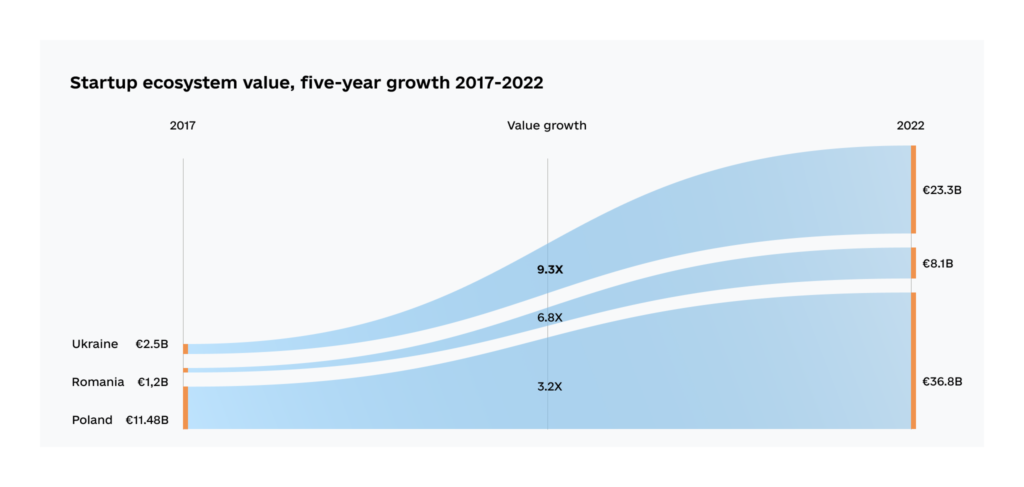
Source: Dealroom
Local governments are also making targeted efforts to increase the levels of foreign direct investment (FDI) into the countries and improve the ease of doing business. Favorable tax regimes for foreign corporations, government services digitization, modernized legislation — each country has made steady progress in improving the business climate. Over the past year, Ukraine has moved from the lower half of the Ease of Doing Business Index to the 64th position, while Poland sits on the 40th and Romania – on the 55th.
Due to improved bureaucracy, higher government integrity, and better infrastructure, Central and Eastern Europe offers better business conditions than Asia Pacific and Latin America. CEE countries also have more competitive labor costs, compared to Western Europe or North America, with almost as high graduate education attainment rates and technology proficiency levels.
Ukraine

Ukraine has a strong IT sector, which has grown by nearly 40 times over the last 15 years, according to the local Ministry for Development of Economy, Trade and Agriculture. The busy tech hubs of Kyiv, Lviv, Kharkiv, and Dnipro are home to over 20 IT clusters — strategic coalitions of local IT service companies, focused on developing the regional technology industry together with representatives of government and education. The total number of IT companies in Ukraine is over 5,000.
Since the mid-1990s, Ukraine’s IT sector has been growing at double digits almost every year, reaching 58% annually at its peak. Outstaffing has driven much of this growth in the early days, but the value proposition has then shifted.
Today, Ukrainian IT companies sit higher up the value chain, offering comprehensive value-added services, ranging from technology consulting and cloud system design to proof-of-concept (POS) solution development, using emerging technologies (ML, DL, AI). Assuming the role of strategic technology advisors, Ukrainian IT services providers are helping global leaders become more competitive in the digital world.
As an example, the 8allocate team helped a UK-based provider of financial analytics services deploy high-performing machine learning algorithms on its data intelligence platform. We also helped Dopay modernize its payment platform architecture to support 24/7 payment processing and self-service features for users, which led to them landing McDonald’s and SWVL as their customers.
Overall, Ukrainian IT companies serve a variety of industries, with data management, telecom, cloud, gaming, and ecommerce being among the top service sectors, according to the local Ministry for Development of Economy.
High levels of proficiency, operational resilience, and unwavering commitment to results, have also helped Ukrainian IT companies to sail through the turbulent times. Despite the global pandemic, IT exports grew by 20.4% in 2020 and remained in the double digits until late 2021.
Similarly, Ukraine’s IT industry continued to show strong performance after the full-scale invasion began. In 2022, the IT sector generated $7.34 billion in foreign exchange earnings for the Ukrainian economy.
Ukraine IT workers have shown remarkable levels of personal resilience in the face of ongoing calamities. Reporters on the ground from Wired, BBC, and The New York Times were deeply inspired by the tech sectors’ commitment to maintaining business continuity and thriving against all odds.
During the 12 months following the start of Russia’s full-scale invasion, Ukraine’s tech sector had generated $7.34 billion in export revenues, 5% more than the previous year, and maintained jobs for the 270,000+ specialists employed in the industry. This is a remarkable reflection of Ukrainian talent, resilience, and innovation.
The U.S. Agency for International Development (USAID)
In anticipation of the inevitable, Ukrainian business leaders have successfully introduced business continuity programs (BCP), aimed at ensuring undisrupted operations. New security policies have been introduced to ensure the safety of the staff and corporate data, with many leaders activating secondary cloud data centers, testing disaster recovery (DR) practices, and ensuring undisrupted access to communication with Startlinks. After the first few challenging months, Ukrainian IT companies found a new cadence of delivering the same levels of services as in the usual time, showing high commitment to maintaining customer SLAs.
Ukrainian product companies and startups also continued business as almost usual throughout 2022-2023. In fact, seven new Ukrainian FinTech companies were launched in 2023, bringing the total number of FinTechs operating in the country to 246, of which 33% operate in the international market. An end-of-year report by Startupbridge further found that 64% of all Ukrainian startups that still operate in the country successfully base their business on the global market.
Ukrainians continue to demonstrate extraordinary resilience, cooperation, and back-of-the-office creativity to power through the turbulent market. Strong work ethic, global outlook, and top-notch technical expertise make Ukraine one of the most attractive sectors for hiring tech workers.
Ukrainian Software Development Companies’ Specializations
IT companies in Ukraine boast a wide range of competencies, ranging from emerging technologies (like AI development or IoT) to more general service lines like web application development, application testing, and legacy software modernization.
Thus, making Ukraine an ideal destination for businesses in high-value-added industries such as DeepTech, e-commerce, and data science.

Average Software Engineer Salary in Ukraine
A high price-to-value ratio is one of the main reasons why businesses choose to hire Ukrainian software engineers.
Despite having high proficiency levels in multiple programming languages and modern software engineering principles, Ukrainian tech talents can still be hired for competitive rates.
Sample median salaries of Ukrainian software engineers (gross/monthly):
- Software Architect – $6,700
- Team Lead – $5,800
- Senior Software Engineer – $4,900
- Middle Software Engineer – $3,300
- Junior Software Engineer – $1,000

Poland

Poland has also maintained a positive growth track since the 1990s, with its domestic economy rapidly expanding in the first decade of the 21st century. The country has a strong business services sector (BSS), with a host of in-house shared service centers and outsourcing business processing centers. Poland now houses over 70% of all BSS centers in the CEE region.
IT services providers are a major part of Poland’s booming BSS sector. The country has over 60,000 registered IT companies, which include external services providers, research and development (R&D) centers from multinationals, as well as a growing cohort of startups and scale-ups. The top 50 largest IT companies, operating in Poland, include Capgemini, Amazon, Sii, Accenture, IBM, Comarch, Epam, and Atos among others.
The Polish IT market also further expanded in early 2022 as Ukrainian IT companies relocated some of their operations to the country and established new development centers. In 2022, Ukrainians accounted for 45% of all new foreign companies, according to the Polish Economic Institute. Of these over 50% were registered to continue operating the business established in Ukraine.
According to the Polish Agency for Enterprise Development, the total value of Polish IT services exports increased by almost 90% since 2021, reaching €9.6 billion (approx $10,3 billion) in 2021 (the latest year measured at the time of publishing). Poland has also a substantial market of ITC equipment manufacturers, growing year to year by 7.31%, according to the same report. The largest categories of exported products include machines and automatic data processing devices, plus telecommunication equipment, primarily sold to Germany, Sweden, Netherlands, and Italy.
Much of the ITC market growth comes from Poland’s strong workforce. Poland has a tight network of higher-educational institutions, with 40 state-owned universities and 20 public institutes of technology that produce 20,000 IT graduates per year. About 43% of Poles aged 25-34 hold a bachelor’s degree or higher in technology or software development.
A well-educated, young population and attractive cost of doing business have made Poland an attractive destination for multinationals. Global players such as Google, Amazon, and Microsoft have regional offices and plan to expand their investment in technical infrastructure in the region. Poland expects to become the leading data center hub in the CEE region by 2026 as new facilities will be opened.
Poland also has a dynamic digital economy, driven by the gaming market. The local video game and esports market stood at $664 million in 2019 and is expected to reach $850 million by 2024. Combined, the top 5% of Polish startups from various sectors have created $2.7 billion in value since 2013 and continue to grow rapidly. These include HealthTech startup DocPlanner, educational platform Brainly, and a beauty appointment booking platform Booksy.
Generally, Poland’s excellence in software engineering is reflected in its startup industry segmentation. Compared to Europe in general, Poland has more startups in Enterprise Software, Marketing, FinTech, and HealthTech.
With a 13th place on the Global Services Location Index (GSLI) index by AT Kearney and a sizable tech workforce, Poland is an appealing destination for tech services acquisition. With Microsoft’s first regional data center, arriving in the country, the market is expected to see further growth.
Microsoft’s investment in Poland will accelerate our country’s transformation into a technology hub for the Central and Eastern European region. Thanks to the development of the Polish Digital Valley, hundreds of engineers and developers will be able to play a key role in the global economy without leaving the country.
Mateusz Morawiecki, the Prime Minister of Poland
The flipside of Poland’s rapid digital market growth, however, is emerging tech talent shortages. With multinationals expanding their presence in the market, hiring efforts become more constrained. And salary growth increases. Over 40% of local companies find it hard to fill in IT vacancies as Poland’s share of IT professionals in the workforce remains slightly under the ideal workforce threshold of 3.65% of the workforce. An extra 25,000 IT professionals are needed to fill in all the market demands.
Polish Software Development Companies’ Specializations
Polish has a thriving tech ecosystem, fueled by knowledge sharing, industry collaboration, and global partnerships. The local IT vendors have a range of general tech competencies (web and mobile development, cloud consulting, application testing), as well as more specialized tech skills.

Average Software Engineer Salary in Poland
Despite the country’s rapid economic growth, Poland still maintains a relatively affordable cost of living. Although well-remunerated, local tech talent remains on the more affordable side, with the average ICT sector employee salary being 2,148 euros as of 2021.
Sample median salaries of Polish software engineers (gross/monthly):
- Software Architect – $9,500
- Team Lead – $8,400
- Senior Software Engineer – $6,600
- Middle Software Engineer – $4,400
- Junior Software Engineer – $1,800
Romania

Romania is another CEE country that has shown remarkable levels of economic transformation at the beginning of the 21st century. After joining the EU in 2007, Romania implemented progressive reforms to improve its business climate, digitize government services, and modernize its educational system.
The country’s ITC sector emerged in the early 2000s and since then maintained a positive growth streak. The IT services market volume stood at a “modest” €4.6 billion in 2015, but doubled by 2022, to €9 billion (approx $9.4 billion).
Today, Romania houses R&D centers of multinational tech companies (Amazon, HP, IBM, Microsoft, and Oracle among others), with 50 of the largest tech employers in the market quadrupling the size of their operations in the country over the past several years. Overall, Romania has over 7,900 registered IT companies.
The Romanian IT&C industry has also been recently credited with bringing Romania’s GDP “close to pre-cris is level” in Q1 of 2021.
The US International Trade Organization
Over 200,000 specialists are employed in the ICT sector, with more talents joining the industry each year. In 2021, over 40,000 students were enrolled in STEM programs across Romania with 9,300 graduates entering the workforce. Romania ranks 6th in the EU in terms of total number of ITC graduates per year. A refreshing 24% of ITC graduates are female, allowing the country to maintain gender-balanced workplaces.
Romania has a strong cyber-security services market, with Bucharest being considered one of the main European cyber centers. The country’s universities offer over 15 prolific programs in cybersecurity, with others offering courses on cryptography, digital investigations, and network security.
Romania presently ranks first in the European Cybersecurity Challenge (ECSC) and has been hosting the Cybercrime Programme Office of the Council of Europe (C-PROC). The Office works on strengthening legislation on cybercrime and data protection standards, as well as operates specialized cybercrime and forensic units. On the commercial side, the Romanian cybersecurity market is expected to bring $166.50 million in revenue by the end of 2023.
Romania also has an actively growing startup ecosystem, which expanded by 6.8X over the past five years. Robotic process automation (RPA) platform UiPath became the country’s first unicorn company to successfully go public in 2022. UiPath is now valued at $20 billion. Ecommerce marketplace eMag and cryptocurrency startup Elrond also boast billion-dollar valuations, with FinTech company FintechOS, cybersecurity vendor Bitdefender, and preventive maintenance software platform MaintainX aiming to join the club next.
Overall, Romania has an actively developing ITC market, focused on both IT services exports and supply for locally established businesses. However, it’s still a relatively small talent pool, mostly concentrated in the four hub cities. The workforce is also getting quite saturated as more multinationals enter the region.
Romanian Software Development Companies’ Specializations
Romania is a popular IT outsourcing destination for businesses seeking developers with experience in multiple programming languages (Java, Python, JavaScript) and front-end development frameworks (React, Angular, etc.). Local IT vendors are also well-known for offering high-quality managed IT services, especially in cybersecurity, infrastructure monitoring, and technical support among others.

Average Software Engineer Salary in Romania
Known for high-tech qualifications, multi-language skills, and dedication, Romanian tech talent has a strong reputation. Yet, labor costs remain on the more affordable side. The average gross salary in the ICT sector is $2,141, which is substantially higher than median salaries in other industries.
Sample median salaries of Romanian software engineers (gross/monthly):
- Software Architect – $8,700
- Team Lead – $7,600
- Senior Software Engineer – $5,800
- Middle Software Engineer – $3,900
- Junior Software Engineer – $1,500
Reasons To Work with Central and Eastern European Software Development Companies
Eastern Europe offers a cost-to-value ratio, with a highly competent, productive, and motivated IT task force.
Here are four reasons why startups, scale-ups, and enterprises alike commission IT services from this region.
Strong Cultural Fit
Eastern Europeans share similar values to their Western European and North American counterparts. Strong work ethic, professionalism, and transparent communication are among the key qualities of local talent. The progressive economic and political integration with the European Union also encourages similar economic practices and legal frameworks.
CEE tech sector workers are predominantly young (under 35 years on average), meaning they have lived most of their lives in post-Soviet societies, enjoying free access to foreign travel and international cultural exchanges. Most of your team members can quote “Friends” and share banter on the latest pop-culture trends.
A good command of the English language, paired with time-zone proximity, also helps Eastern European software engineers easily integrate into globally distributed teams.
High Talent Availability
Globally, the demand for tech talent will continue to outweigh the supply until at least 2026, according to Gartner. Central and Eastern Europe remains one of the few regions, shielded from talent shortages.
East Europe remains untapped for tech talent, as the region has fewer multinationals than Western Europe. The startup ecosystems are still young, with many professionals choosing to join IT services companies instead for better job stability prospects and higher pay.
The local labor market also gains a steady influx of new minds every year. The share of STEM graduate students in Romania stands at 29%, which is above the EU average rates. Ukraine expects the total number of tech students graduating yearly in Ukraine to increase by 23% in the next few years.
Careers in the tech sector are well-paid and thus deemed prestigious by many youngsters in Ukraine, Poland, and Romania. Moreover, local IT companies are actively partnering with higher educational institutions to create better curriculums, launch new programs, and recruit more students into the ITC field.
Learn how to scale teams with global tech talents.
Optimal Cost-to-Value
Despite the current economic conditions, rates in Eastern and Central Europe have remained steady. Although the labor costs won’t be as low as in South-East Asia, the returns on investments are much higher.
As Debi Hamill, CEO of the International Association of Outsourcing Professionals (IAOP), noted: “Unlike other leading delivery destinations such as India and the Philippines, the emerging European countries have typically been awarded contracts on a smaller scale but consisting of higher value transactional work”.
Eastern European businesses are supporting digital projects for global leaders, ranging from Alphabet and Amazon to JP Morgan Chase and Visa Inc. The most innovative companies are also sizing up expansion into the region as it boasts a high concentration of AI, data engineering, and blockchain talent.
OpenAI CEO recently broached the subject of opening a regional office in Poland, while Samsung and Rakuten continue to operate AI R&D centers in Ukraine. A recent public data analysis found that Ukraine and Poland have a higher number of AI service providers, than Western European countries. On LinkedIn, over 5,300 software engineers from these countries have “AI” listed among their skills.
High experience with various technologies, coupled with competitive salaries and lower tax burden, is another strong reason to partner with software development vendors in CEE.
Flexible Partnership Models
With over three decades in the making, the regional IT export services market is in its prime shape. Regional software development vendors have already established effective frameworks for international collaboration, both on the processes and legislative levels.
While South-East Asia is mostly a destination for outstaffing, Eastern European vendors offer more synergetic partnership models, aimed at establishing ongoing strategic collaboration. For example, through a dedicated software development team model — a service offering, which allows businesses to assemble and operate a flexible, external IT team, hired to support a specific business initiative.
CEE IT partners can support other businesses with:
- End-to-end product new engineering
- Externalization of various IT functions
- Ad-hoc IT strategy and technology consulting
- Joint R&D center establishment
In other words: They propose an outcome-oriented service delivery model, where the external partner takes greater ownership of the project and commits to delivering specific results.
Eastern European software development partners can not only help complete complex engineering projects, but also deliver positive changes upstream by improving organizational processes, IT portfolio management practices, and overall business strategy.
Get the Best Tech Talent with 8allocate
Since 2015, 8allocate has been at the forefront of the software development service market. Our mission is to help global businesses with technology at the core of their operations. With development centers located in Poland, Ukraine, and Romania, we can help you partner with multi-skilled and experienced engineering teams.
If you’re looking to fill specific software engineering roles or looking for a cross-functional team to spreadhead a new project, we’d be delighted to help you. Contact us for a personalized presentation on our service lines and areas of expertise.
Frequently Asked Questions
Quick Guide to Common Questions
Why do companies choose Ukraine, Poland, and Romania for hiring software engineers?
These countries offer top-tier technical expertise, strong engineering education, and competitive costs. With a combined tech workforce of over 870,000 specialists, businesses can access skilled engineers in AI, cloud, cybersecurity, and enterprise software development at a better cost-to-value ratio than Western Europe or the U.S.
What are the key advantages of hiring developers from Central and Eastern Europe (CEE)?
- High technical skills: Strong STEM education and expertise in AI, cloud, and advanced software development.
- Cultural alignment: Similar work ethic, Agile adoption, and fluent English communication.
- Time zone overlap: Ideal for real-time collaboration with European and North American teams.
- Cost efficiency: Competitive salaries compared to Western Europe while maintaining high quality.
How does 8allocate help companies leverage AI engineering talent from Central and Eastern Europe?
8allocate specializes in AI solutions development, providing dedicated AI engineering teams, team augmentation, and full-cycle AI project delivery. We manage hiring, contracts, security compliance, and operational oversight, ensuring seamless collaboration. Our approach enables:
- Access to top-tier AI engineers with deep expertise in ML, NLP, and data-driven solutions.
- Seamless integration with your existing engineering teams and workflows.
- Focus on AI innovation—delivering high-impact, scalable AI-driven solutions.