
In an ideal world, hiring software developers in-house is a good way to gain the competencies you need to accelerate digital transformations and build competitive software products. However, in the real world, you must weigh the benefits of having the right people on payroll against the ongoing costs.
Global tech talent shortages have caused salary acceleration and increased time-to-fill for in-demand roles to over six months. Prolonged hiring times, in turn, limit your ability to adapt to the market dynamics and ensure effective business scaling. Large hiring volumes can also create bottlenecks in other business areas — onboarding, project management, and infrastructure management — causing a ripple chain of disruption. Lastly, budget constraints also hinder your ability to attract the best talents with specialized skill sets.
Learn how much it costs to hire software developers internally — and how you can optimize this cost (and maximize the value) with an alternative talent sourcing strategy.
How Much Does it Cost to Hire a Software Developer In-House?
The total costs to hire one software engineer can be as high as $248,000 for the first year, after factoring in recruitment costs, salary, bonuses, taxes, benefits, personal equipment, software licenses, onboarding, and training costs. Other costs, apart from recruitment expenses and onboarding, are recurring (data sourced from open sources in the US).

Recruitment Costs
Recruitment costs are on the rise due to global tech talent shortages. Despite layoffs remaining in the news headlines, most businesses still retain a substantial tech workforce. Among the 2024 Tech Talent Survey respondents, 34% plan to maintain the same headcount, and 37% plan to hire more tech specialists this year.
High competition for tech talent extends hiring time. Organizations spend an average of 5.4 months on technical recruitment, according to the Linux Foundation. Over 64% of companies need more than 4 months to fill one open technical position.
Understandably, time-to-fill for senior positions and in-demand technical skill sets is even longer. Hiring an Al/ML Engineer takes 6.1 months on average, a Data Analyst / Data Scientist — 5.9 months, and a Cloud Architect / Engineer — 5.8 months on average.
Prolonged time to fill drives up talent acquisition costs as your company needs to spend more on job advertising, employer branding, and sign-on bonuses. In some cases, you may also need to pay extra in employee referral bonuses or relocation costs to secure the ideal match.
However, extensive recruitment marketing still doesn’t guarantee the best technical hires as you also need to spend extra on pre-employment assessments. Interviewing for new technical roles is challenging as you may not have internal staff to properly assess the candidate’s credentials.
In fact, recent research in the UK found that 74% of businesses don’t use any candidate testing, and 32% use non-technical professionals to interview tech talent. As a result, 24% of hired candidates don’t have the appropriate technical skills for their role.
The Cost of a Bad Hire is Steep
The cost of a bad hire is steep: 15%-21% of the employee’s salary, depending on seniority. This can significantly impact a company’s budget and productivity, as a bad hire fails to deliver the expected performance and necessitates additional recruitment and training expenses. Using a technology service partner to source, interview, and onboard new tech talent can substantially reduce the risks of poor fits. These partners typically have specialized expertise and a more efficient recruitment process, leading to better hiring outcomes. Moreover, you can recuperate some HR costs. On average, recruiting process outsourcing (RPO) is 1.6x cheaper ($311,220 vs $525,480 annually) than having an internal recruitment team. This cost efficiency can make a significant difference, especially for companies looking to optimize their hiring processes and reduce financial risks associated with hiring errors.
Employee Salary and Benefits
Pent-up talent supply steers salary growth. In 2024, 62% of hiring managers increased starting salaries for cybersecurity, cloud, AI and machine learning, and general software engineering roles to attract better talent.
The average base tech salary across the US stands at $111,193 annually, per Dice. That excludes extra benefits, overtime pay, employer taxes, and any profit-sharing schemes. Although some roles also have even higher salary brackets:

Source: BridgeView
Emerging pay transparency laws across states also force employers to disclose salary ranges in all job postings. According to Indeed’s Hiring Lab, more than half of all jobs on the platform in August 2023 included salary range disclosures. This definitely favors the candidates who want to “shop around”, but puts employers with more limited budgets at a disadvantage.
Still, despite salary growth, only 49% of tech professionals are satisfied with their current compensation, which forces HR teams to offer extra perks to attract and retain tech staff. And employees expect a good mix of primary (health insurance, paid time off, pension plans) and secondary benefits (remote or flexible schedules, training and education, work-from-home stipend).

Source: Dice
The high bar, set by big tech firms and venture-funded scale-ups makes it challenging for other firms to keep up. In the UK, 44% of businesses have difficulties matching competitors’ packages (pay and benefits) and thus attracting the best talent.
Expanding your tech talent search to new geographies may help. Three Central Eastern European countries — Poland, Romania, and Ukraine — have a combined tech talent pool of over 870,000 professionals. Still not as heavily heavy-handed by Big Tech players (although some do have regional offices), CEE countries have a burgeoning tech ecosystem and ample, multi-skilled tech talent.
The salaries are also on the more moderate end of the spectrum. Gross annual salaries for senior engineering talent are in the $60-85K range, while mid-level specialists can be hired for $40-$55K annually.
Equipment and Software
To get an accurate cost of hiring a new software developer, you should also factor in all the extra spending on their tools of trade: hardware, software, and office space in case you’re hiring for on-site or hybrid positions. At the same time, over half of remote tech workers also expect a work-from-home stipend or extra allowances for covering coworking fees.
Although hybrid or fully remote work helps companies save on facility costs, it also drives spending in other areas, namely business software. An average company now runs between 100 to 1,000 SaaS applications on their network, with spending on software set to increase by another 13.9% through 2024.
Overall, office space, equipment, and software costs can add another $10K-$12K in annual costs per hire, on top of what you’ll be spending in terms of salary, benefits, and employer taxes.
HR training and development
A new hire becomes fully productive in their role within 8 to 26 weeks. People in senior positions usually need more time to get settled, while junior staff may require extra training to get into full grove. Effectively, organizations are losing money during the onboarding period because the new employee costs more than they generate with their work.
Onboarding also requires extra labor efforts from your HR team and the new employee’s peers and managers, who’d be guiding them in their work. This can lead to further reductions in productivity, especially if you bring several new team members at around the same time.
New tech employees may also require extra training on corporate workflows and policies and perhaps even upskilling programs. To address talent shortages, 43% of IT leaders choose to hire inexperienced staff and invest in upskilling them. This, however, further increases the costs of new hires and extends their onboarding time, which creates another overlooked cost center — opportunity cost.
Bonus: Opportunity Costs
Talent shortages and prolonged hiring time create operational inefficiencies: 38% of organizations say that recruitment issues have delayed new IT projects. Delays, in turn, can cause revenue losses, jeopardize your market share, or affect investor interest.
According to the law of increasing opportunity cost, the opportunity cost will increase for other projects with every resource allocation decision toward your primary objective. When one software engineering project requires more effort and oversight, this will come at the expense of other initiatives. For example, when your core teams are already busy dealing with legacy systems and maintaining existing infrastructure, you cannot prioritize new product development initiatives to accelerate revenue growth.
Short-staffed software engineering teams are also forced to plow through the growing mountain of work, which may lead to some “corner-cutting” and accelerate technical debt accumulation and product quality issues, further increasing opportunity costs.
The Alternative to Hiring Software Developers In-House: Strategic Talent Partnerships
Given the steep costs and long timelines of hiring full-time tech talent, many leaders are choosing an alternative approach: technology services partnerships.
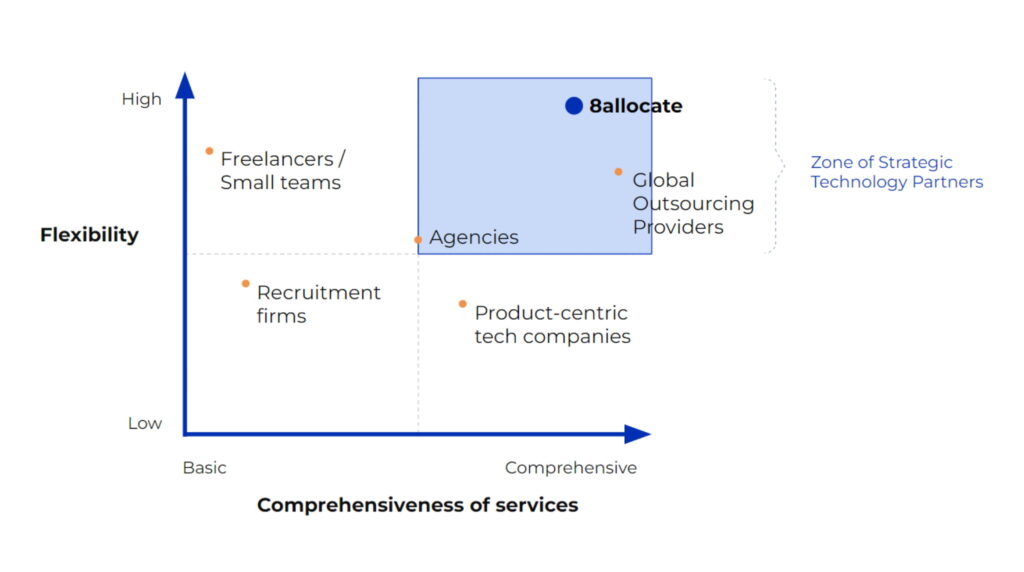
At 8allocate, we’ve created a client-centered partnership model, rooted in a strategic alignment between your business goals and our capabilities in delivering stellar technology solutions. Our goal is to support you at every stage of your journey — whether you’re just starting with an MVP or looking to scale existing solutions and build stronger software engineering processes. Our services solve challenges, help our clients unlock new revenue enablement models, and incorporate the latest tech innovations into their businesses.
Our cross-sectoral expertise and strong ties with educational institutions across CEE allow us to match your operational needs with value-based offers tailored to your objectives and budgets. When you need specific expertise or want to expand into new markets, we support scaling your workforce.
As a strategic ally, we’re also committed to driving improvements at process and technology levels through knowledge exchanges, process guidance, and collaborative innovation, which assumes co-investment in new promising ideas. This way, you gain access to missing organizational competencies and address skills gaps, without shouldering high overhead hiring costs.
Here’s a comparison of in-house vs partner-based hiring costs of a senior software engineer:

Extra Benefits of Strategic Technology Partnerships
Beyond ensuring access to mission-critical tech talent, strategic partners also add value in other business areas. 8allocate team can help you align your technology roadmap with your business goals and provide process guidance, designed to enhance your teams’ capabilities.
So that your organization gains the following benefits.
Cross-Functional Skill Sets
The technology landscape is changing at breakneck speed, and with it, the IT roles linked to them are evolving too. For businesses, this translates to the constant need to either upskill/re-skill existing talent or hire specialists with new/niche skill sets (cue the above-mentioned recruitment expenses).
At 8allocate, we’re not facing the same constraints thanks to a large talent pool and the teams’ cross-functional experience. Our staff has shown their mettle on projects in a variety of industries — ranging from EdTech and FinTech to logistics and ESG — and different programming languages. Apart from retaining qualified staff with knowledge of different tech stacks and technologies, we also invest in their training (so that you don’t have to).
At any project stage, we can supply the missing expertise and provide resources to scale your teams effectively to respond to new market opportunities and accelerate growth with advanced technologies. We believe in true partnership, where each side has a vested interest in solving problems, maximizing value, and establishing new avenues for innovation.
Process Efficiency
While having the right people in the right role is crucial, so are the right engineering processes. Poor backlog prioritization, manual deployments, and lack of streamlined cloud infrastructure management create operating issues down the road and diminish the value your tech teams can break.
Since we’ve been in the IT business for over a decade (and have had unique opportunities to look at software engineering processes at Fortune 500 enterprises and nimble scale-ups), we understand the common barriers and drivers among different businesses.
As part of every client engagement, we offer proactive process guidance, aimed at improving your software engineering culture and productivity. This may include help with continuous integration (CI) and continuous delivery (CD) pipeline setup or assistance with the implementation of automated quality assurance (QA) processes. On a higher level, we also offer assistance with building effective data management and governance processes, implementing cloud infrastructure monitoring, and robust cybersecurity programs.
Our goal is to help you prevent project delays, infrastructure cost overruns, and rework volumes to hit the plateau of software development productivity.
Ad-Hoc Consulting
IT professionals are not the only ones affected by the lack of understanding of emerging technologies. Over 57% of CEOs admit that their leadership teams lack AI skills and knowledge. Another survey found that 67% of senior executives aren’t comfortable using advanced analytics tools and choose to go with their ‘gut feeling’ instead.
Lack of confidence and awareness at the helm makes it harder to promote digital and data literacy at the grassroots. This factor also complicates ongoing digital transformations as leaders struggle to identify the best areas for investment and thus capture ROI.
We help companies overcome these challenges by embedding technology consulting into our services. Our senior partners can assume an interim CIO/CTO role to help your business deal with the more strategic issues of aligning your technology roadmap with your business goals, emerging technology use cases evaluation and implementation, as well as digital transformation planning and execution.
Our end-to-end technology services are engineered to optimize your current IT operations while strategically aligning your organization for future growth and innovation.
Conclusion
Lack of experience with emerging technologies, unfamiliar market landscape, complex system integrations — a lot of factors can intensify the costs of new software development. Many of these cannot be effectively addressed by merely hiring more people. They require more profound process changes and strategic technology guidance.
Investing in the right areas and making changes in the right areas are the keys to achieving your long-term vision sustainably. 8allocate operates in your orbit and ensures that you receive the right support at every stage of your business growth.
Contact us to learn more about our approach to building value-driven technology partnerships.

Frequently Asked Questions
Quick Guide to Common Questions
How much does it really cost to hire an in-house software developer?
Hiring an in-house software developer involves multiple hidden costs beyond salary. These include recruitment fees, onboarding expenses, benefits, equipment, software licenses, and ongoing training. Additionally, a bad hire can cost up to 21% of the employee’s salary, making in-house hiring a high-risk investment.
What are the main challenges of recruiting software developers internally?
Companies struggle with long hiring cycles (5-6 months on average for senior roles), rising salaries, and talent shortages. Many businesses also lack internal expertise to properly assess candidates, leading to mis-hires and productivity loss. These delays can cause project setbacks and missed market opportunities.
How do opportunity costs impact business when hiring in-house?
Long hiring cycles and skill gaps delay IT projects, slow product launches, and increase technical debt, impacting revenue and competitiveness. Over 38% of organizations report that recruitment bottlenecks have delayed critical digital transformation projects.
What are the alternatives to in-house hiring for software development?
Many companies partner with AI solution development companies to access top-tier AI engineering talent, specialized expertise, and scalable development teams. This reduces hiring risks, accelerates project delivery, and ensures seamless access to AI, data, and cloud expertise without long recruitment cycles.