Generative AI. Metaverse. Advanced robotics. Blockchain — every year, all of us get bombarded with futuristic tech trends and predictions of yet another “big thing” making a disruptive impact over every industry.
What many lists forget to address, however, are the implications of new technologies on business operations: the use cases, ROI, and tangible impacts they can make today and tomorrow — and that’s exactly what we want to focus on in our analysis.
Main Tech Themes for 2024: Trending Technology and Their Real-World Impact
For several consecutive years, innovation has been the central theme for businesses, with 80% naming it a “top-tier” priority. Emerging technologies, in turn, have become the key tenet for business model transformation, new product development, operational process improvements, and innovation in other business areas.
Based on the market analysis and conversations with our clients, the 8allocate team expects that the following themes will shape the technology landscape in 2024 and beyond.

Digital Identities Will Become a Strategic Area of Interest
A digital identity is a combination of unique attributes and credentials associated with a person’s virtual presence. A unique username, an email address, an IP address, or a combination of authentication methods can be used to identify users (or more recently — assets) online.

Source: World Economic Forum.
In 2024, the digital identity landscape will evolve in response to new privacy regulations and growing concerns about cybersecurity.
By mid-2024, Google promises to sunset third-party cookies. Advertisers will no longer be able to track conversions and identify users across domains. In response, the AdTech industry doubled down on developing new first-party data infrastructure, creating proprietary solutions for user identity resolution (e.g., Liveramp ID) or shared user identity graphs (e.g. Unified ID 2.0 solution).
Brands, in turn, also double down on collecting first-party audience data (like purchase history and demographics data) to stitch together unique customer identities for advertising and marketing purposes. Both of these trends are increasing the demand for new data infrastructure, including customer data platforms (CDPs) and data clean rooms (DCRs) as an alternative to “walled data gardens”, created by Big Tech players like Google and Facebook.
On a wider scale, governments worldwide call for greater digitization of people’s identification documents. The European Union plans to roll out a digital identity system powered by biometrics, which would allow users to open bank accounts, make payments, and hold digital ID documents. The system provides businesses with more reliable data for KYC and AML purposes, resulting in greater digitization of healthcare and financial services.
In countries, where the governments aren’t as active on digital identities, private companies take the lead. Capital One, Wells Fargo, Chase, and Bank of America, for example, launched Authentify — a joint identity verification product, that allows all participating businesses to perform KYC and securely exchange sensitive banking data.
New digital identity solutions can also address the cybersecurity shortcomings of traditional authentication methods like passwords (which aren’t effective and hinder UX). Passwordless authentication and identity-based single sign-on (SSO) solutions will be the next evolutionary step for cybersecurity.
Microsoft, for example, already launched Entra Verified ID — a security product, based on decentralized identity standards. Instead of having identity data distributed across countless apps and platforms, Microsoft wants to build an environment, where people and organizations are more empowered to control how, when, and from whom their data is accessed.
Fundamentally, 85% of global executives agree that digital identity is no longer just a “technical issue”; but a “strategic business imperative” for their organizations.
First, there’s an opportunity to create new value pools and innovate applications of digital identities. Secondly, digital IDs will soon be central to every business’s operations. Some companies will experiment with developing their digital identity solutions, while others may be looking for ways to integrate existing solutions into their products. For example, to bolster security or embed their offers into adjacent products (e.g., offer financial services to independent contractors, working on gig platforms).
Strong Sustainable Agenda for Technology
Environmental, social, and corporate governance (ESG) are the three pillars, shaping future business models, and more lately — technology investments.
Gartner predicts that by 2027, 25% of CIOs will see their compensation linked to their sustainable technology impact. Many leaders are exploring the applications of emerging technology for ESG to evaluate the benefits and estimate the ROI.
By applying AI to corporate sustainability, organizations can generate $1.3 trillion to $2.6 trillion in value through extra revenues and cost savings by 2030.
BCG
Virgin Atlantic, for example, developed a new coaching application, teaching pilots to fly more effectively from a fuel burn perspective. Powered by historical and real-time insights, the application helps optimize routes for different airplane models and assists the captains in making the most sustainable choices. In 2019, Virgin already reduced CO2 emission rates by 17% per revenue tonne kilometer (RTK) and aims for another 15% gross CO2 reduction per RTK by 2026.
Siemens, in turn, developed a proprietary supply chain management (SCM) sustainability platform, which collects operational data on carbon reduction initiatives, corporate responsibility self-assessments (CRSA), on-site audit results, and other sources to inform decision-making. Thanks to greater visibility into their supply chain and advanced big data analytics, Siemens achieved major progress in ESG:
- Ensures ethical goods and service purchases from 140 countries, while maintaining full supplier compliance with the internal code of conduct.
- Reduced supply chain emissions by 1% in 2023, compared to a 2020 benchmark, despite increasing the purchase volumes by 33%.
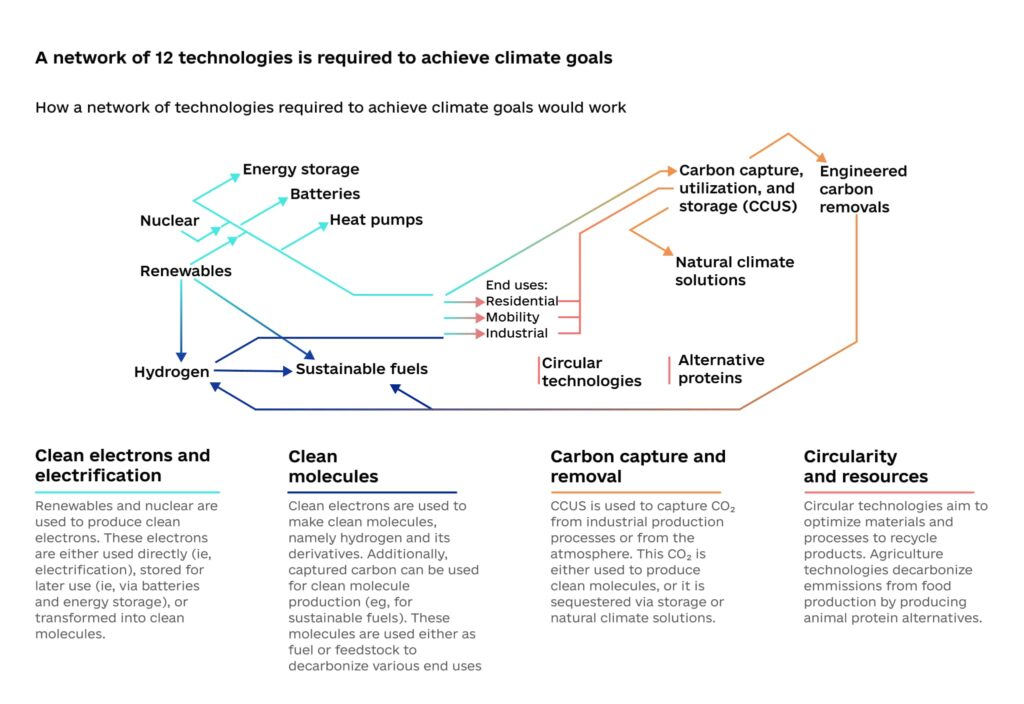
Apart from investing in ESG solutions development, we also expect accelerated investments in climate tech. According to McKinsey, 12 sets of climate technologies will enable around 90% of the total carbon abatement needed by 2050, but only 10% of these are commercially mature.
Source: McKinsey
In other words: there are plenty of promising opportunities for new product development in the climate sector, especially in the domain of carbon capture, circular economies, and renewable energy infrastructure management. As we also wrote, in our previous post many of the new climate tech products and ESG initiatives will be enabled by AI.

AI Trust, Risk, and Security Management (AI TRISM) Enters the Spotlight
Artificial intelligence had a breakthrough year. Generative AI apps demonstrated a new degree of speed, efficiency, and “intelligence” we can expect from software.
However, with more AI applications entering the production stage, concerns about AI trust, risk, and security increase. According to Gartner, 66% of business leaders worry about the risks of mass Gen AI availability carriers, especially regarding data privacy, information validity, and breacher opportunities.
AI trust, risk, and security management (AI TRiSM) emerged as a new framework for managing these risks. By combining governance principles and better techniques for model development, AI TRiSM promotes the creation of fairer, more reliable, and robust AI systems.
The goal of AI TRiSM is to provide AI development teams with better tools for model explainability, risk management, and security orchestration — and many players are already working in this domain.
Google released a Secure AI Framework (SAIF) in 2023, offering best practices for mitigating risks specific to AI systems such as data poisoning, prompt injection, and backdoor extraction of confidential information from the training data.
Startups like Fiddler and Aquarium, in turn, launched observability platforms for AI models, offering out-of-the-box access to model monitoring, performance analytics, data quality, and bias assessment tools.
As new AI regulations emerge, we also expect a stronger focus on AI explainability and greater growth of explainable AI (XAI) solutions. The demand for XAI is already high for AI products in finance and education, where regulators demand greater model transparency.
Amsterdam-based Deeploy, for example, offers access to an integrated development environment (IDE) for responsible AI development and deployment. CitrusX, in turn, just closed a $4.5 million seed funding round to build out its end-to-end AI explainability platform.
Looking ahead, we expect more frameworks and products to emerge in the XAI and responsible AI spaces, especially as the regulatory pressure increases.
New AI Regulations Will Shape the Competitive Landscape
At the end of 2023, the EU approved the first legal framework for AI: the AI Act. The policies have received a mixed response from the development community, with many commenting on its limiting policies for Gen AI apps (and foundation models in general). Mistral AI and Open AI both said that the AI Act could push their companies out of the EU markets.
On the other side of the globe, the Biden Administration issued an Executive Order on AI, with some 150 requirements federal agencies must meet to advance safe, secure, and trustworthy AI.
Overview of the main AI regulations around the world

Source: BCG
The federal US regulations on AI are less stringent. But individual states have the power to change the stakes. In 2024, California and Colorado plan to adopt new regulations for automated decision-making in the context of consumer privacy. These will apply to AI systems, trained on consumers’ personal information, or those that collect it. They also give users an option to opt out of AI usage, which can affect AI products for insurance or hiring, for example.
Industry analysts expect more AI regulations to emerge globally in 2024, with some arguing for the need for a “global AI agency” — an independent, neutral entity to oversee AI implementation similar to how International Civil Aviation Organisation (ICAO) manages the aviation industry or CERN — nuclear research.
But before that happens, AI companies will have to face a disjointed world of regional regulations, varying a lot between the US, the EU, the UK, and counties in other regions. For multinationals, this can be a period of heightened compliance risks, while AI startups in markets with favorable regulations will grow much faster than their bureaucracy-ridden peers.
Stronger Focus on Data Management
In 2020, over 47 zettabytes of data were created — by 2035, data generation volume will increase to 2,142 zettabytes per annum.
The rapid growth of data volumes, variety, and velocity presents a unique challenge. Rather than being a cause for concern, however, it’s an opportunity to revamp data management practices.
95% of global executives agree new data architectures and strategies are required to manage the dramatic changes to their organizations’ data landscapes.
Accenture
Over the past years, we’ve seen innovative companies transitioning to cloud-native data storage locations (data warehouses and data lakes) and building up orchestrated data pipelines for processing data in near real-time.
Data mesh architectures now emerge as the next evolutionary step, with companies implementing decentralized, domain-oriented, self-serve designs to streamline data transformation, improve data accessibility, and improve cyber-resilience by eliminating the single point of failure from data systems designs.
Similarly to microservices architecture, data mesh combines lightweight services to expose more data to consumers or business applications. Data gets separated by functional domains and treated as a product, which enables new data analytics use cases.
Apart from greater data accessibility, new data architectures also promote better data governance. Over 90% of business leaders agree data transparency is becoming a competitive differentiator for their organizations. The Open Banking movement paved the way for a new generation of personal finance management products and digital banks, for example.
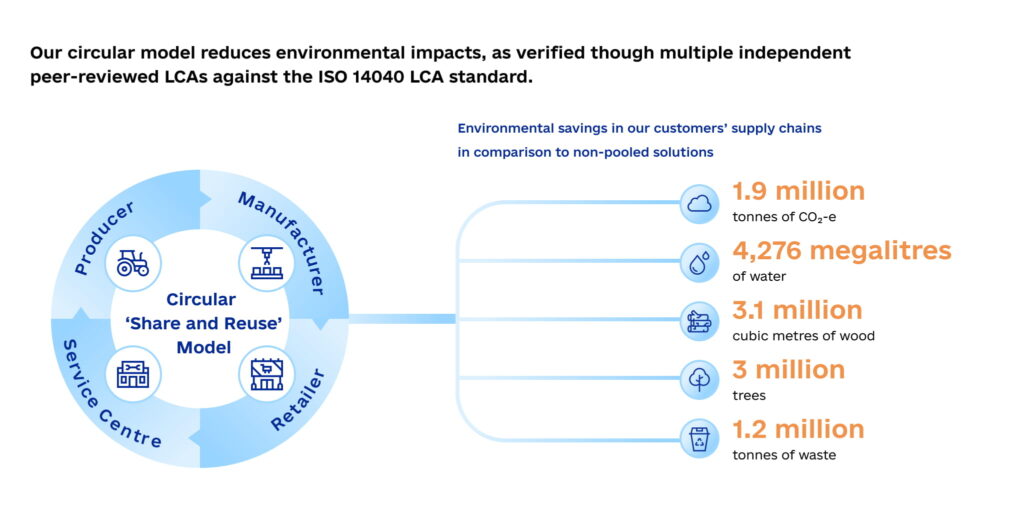
Improved data transparency can also inform innovative product development. Australian manufacturer Brambles, for example, used its supply chain data to create a new range of circular products for logistic companies. Thanks to robust analytics, the company can also estimate over 80% of its product’s environmental impact at the design stage. Not only did Brambles improve its sustainability, but it also helped its customers reduce carbon footprints.
Source: Brambles
In 2024 and onward, we expect a greater focus from business leaders on their data management infrastructure, especially if they plan to launch new ML/AI solutions. By prioritizing good data governance, leaders will also face less regulatory pressure and reduce their exposure to cyber risks.
In other words: investing in data management infrastructure is not just a necessity but also an opportunity to gain a competitive advantage in the market.
Quantum Computing is Changing Cybersecurity
Quantum computing is a longer-term tech trend, as the technology is still far from being mainstream in most domains. But its earliest impacts will likely be seen in cybersecurity.
Industry experts predict that within the next five to thirty years, quantum computers may be able to break all current encryption standards like RSA and ECC. Most think there’s even a 50%-70% chance of this happening in the next five years.
To ensure data privacy and security in the future, we’ll need to develop quantum-resistant security algorithms today. The US National Institute of Standards and Technology (NIST) plans to issue the first standard for “post-quantum cryptography” (PQC) in 2024.
On the other hand, quantum systems will also need new security mechanisms. Quantum processing can’t be monitored in the same ways as classical computers. Hence, we’ll need new tools for assessing the accuracy, safety, and security of quantum workloads. Also, we’ll need to create new mechanisms for protecting multi-tenant and distributed quantum computers as the technology scales — and this will be an existing new frontier for cyber sec companies.
Translating Technology Innovation to Business Impact
In 2024, technologies like digital identities, big data analytics, and AI will be further commoditized and embedded into more business products and corporate workflows. Greater access to data and analytics, in turn, will help leading businesses accelerate new product development, improve ESG metrics, address regulatory concerns, and stave off cybersecurity risks.
If you’re trying to determine the optimal role of emerging technologies in your business and identify the key benefits, reach out to 8allocate. Our company offers a full cycle of technology implementation services — from initial ideation and consulting to use case validation through product discovery and software engineering with dedicated teams. Make more informed decisions with our strategic support and cross-domain technology expertise.