
Companies are pressed to release new software faster to navigate the markets’ ebbs and flows. However, time pressure can adversely affect software quality and create major operational risks. So can development teams be more productive and deliver better software at the same time? The new paradigm of platform engineering aims to make that happen.
Platform engineering is one of the hottest software engineering trends this year focused on one precise goal: helping developers build better code. In this post, you’ll learn what exactly platform engineering is and why 80% of larger software development teams plan to adopt it by 2026.
What is Platform Engineering?
Platform engineering is an operational practice of creating and maintaining standardized workflows and toolchains to improve developer experience and productivity. It borrows DevOps principles — automation, collaboration, and continuous improvements — and aims to scale it across the entire organization.
The best software engineering happens in the flow state — a streak of deep work. But it’s hard to dive into work when bombarded with ancillary tasks. Developers spend only 32% of their time writing or improving existing code and roughly 70% on maintenance, testing, management, and operational tasks.
The goal of platform engineering is to eliminate blockers and interruptions in development through a combination of cultural, operational, and tech practices.
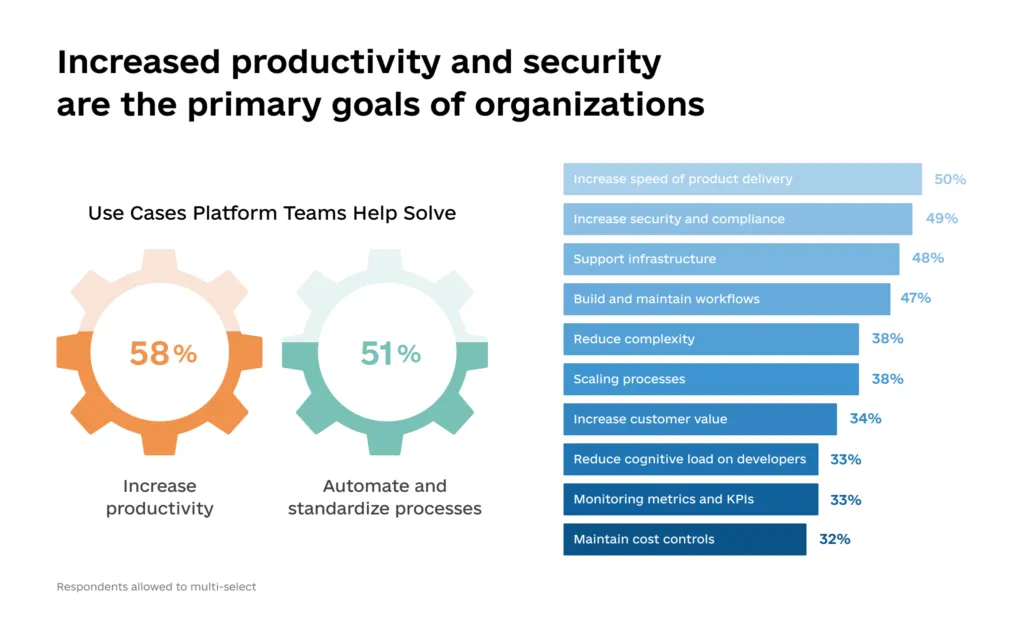
Source: 2024 State of DevOps Report.
Platform engineering teams aim to create a better developer experience (DX) — an environment where everyone is empowered to do their best work with minimal disruption and maximum efficiency.
Responsibilities of a platform engineering team:
- Create and maintain internal development portals (IDPs)
- Build and support developer toolchains (custom scripts, reusable APIs, etc.)
- Handle container runtimes and deployment
- Maintain continuous integration (CI) and continuous deployment (CD) pipelines
- Configure and monitor infrastructure as code (IaC) platforms
- Create Golden Paths for performing standard coding tasks
- Produce and maintain engineering documentation
- Help establish secure engineering practices
- Evaluate and experiment with new technologies
Fundamentally, product engineering teams focus on creating better guardrails and tenets for software engineering teams, constantly seeking ways to improve team velocity, productivity, and happiness. Numerous studies prove that happy teams are more productive, work harder, and deliver more value for business.
Platform Engineering vs DevOps: The Differences
Platform engineering and DevOps are connected at the hip. DevOps practices like CI/CD, IaC, test automation, and observability are the baseline frameworks for platform engineering.
Platform engineering aims to scale DevOps by providing developers with self-service access to approved toolchains, homogenizing workflows across teams, and bringing a greater degree of efficiency and automation to existing practices.
Perhaps one of your development teams already ranks high in DevOps maturity, but you struggle to replicate their setup to other teams due to skills gaps and talent shortages. Or you have several engineering teams at different stages of DevOps adoption, each using a slightly different CI/CD setup, custom scripts for infrastructure configuration and deployment, and a personalized toolkit. This results in technology sprawl, poor handover processes, and extra complexity in IT infrastructure monitoring, observability, and security, as there are no unified policies.
Effectively, platform engineering aims to scale and standardize DevOps practices and deliver systems engineering as an internal product capability.
Problems Solved with Platform Engineering
Fundamentally, platform engineering teams aim to accelerate software development productivity by resolving the common technological and organizational blockers that lead to long release times, compliance and security hurdles, low talent morale, and, ultimately, high attrition.
Long Cycles for New Projects
To get ahead, you need to get started, and that’s often one of the hardest tasks. Platform engineering reduces the cognitive load software engineers experience when picking a new user story from the backlog by providing Golden Paths.
Spotify, which coined the concept back in 2020, defines Golden Paths as an “opinionated and supported’ path to ‘build something’ (for example, build a backend service, put up a website, create a data pipeline). The Golden Path tutorial is a step-by-step tutorial that walks you through this opinionated and supported path.”
A Golden Path is a template, plus a set of recommended tools and technologies, for completing a coding task stored in the internal developer portal. The template can include:
- Skeleton source code
- CI/CD pipeline template
- Recommended Cloud IaC configurations
- Kubernetes YAML files
- Security policy guardrails
- Logging and monitoring tools
- Reference technical documentation
Thanks to Golden Paths and mature CI/CD practices, Spotify improved the average time required to setup a framework for building a website from 14 days to less than 5 minutes. The music service also onboards new developers 50% faster.
Apart from faster task execution, Golden Paths also promotes code uniformity with existing quality, security, and compliance standards, leading to faster deployment times and fewer errors in production. As Samantha Coffman, senior product manager, Engineering Experience at HelloFresh, explains:
Engineers look to Platform like they look at the technology radar. They look to Platform for what they should do next, and they really respect and admire the platform engineers as the gold standard for how they should be doing things.
Tech Stack Sprawl
Developer tools are plentiful, but haphazard adoption magnifies operating costs and creates extra operational complexities. Instead of shipping new features, 40% of software engineers spend a quarter to half of their time on toolchain integration.
Tool fragmentation across teams also creates integration issues and limits your ability to re-assign people from one project to another without spending extra time showing them the ropes.
On the other hand, long approvals for new tool purchases or lax security policies promote shadow IT — usage of unauthorized development tools or non-approved open-source frameworks in projects. Left out of the monitoring perimeter, shadow IT components often become security liabilities. In 2022 over 5 billion malicious requests were targeted at unknown, unmanaged, and unprotected corporate APIs (and many of these were likely successful).
Platform engineering aims to streamline access to technologies via self-service portals: Pre-approved, pre-made, and readily available scripts, frameworks, toolchains, and OSS components engineers can use in all projects.
Gaps in System Security
Cyber actors try to leverage every loophole to break into the corporate perimeter. According to the Data Theorem, 91% of organizations experienced a software supply chain incident last year. Specifically, 41% were targeted by zero-day exploits of vulnerabilities within third-party code, 40% faced an issue due to misconfigured cloud services, and 40% were targeted via vulnerabilities in open-source software and container images.
These issues arise due to lax security policies, lack of monitoring, and security testing in the developer process. Platform engineering teams help improve built-in security and compliance in the software development lifecycle (SDLC) by introducing automated security as code policy enforcement, automated security testing, and pre-vetted code components, available via developer portals.
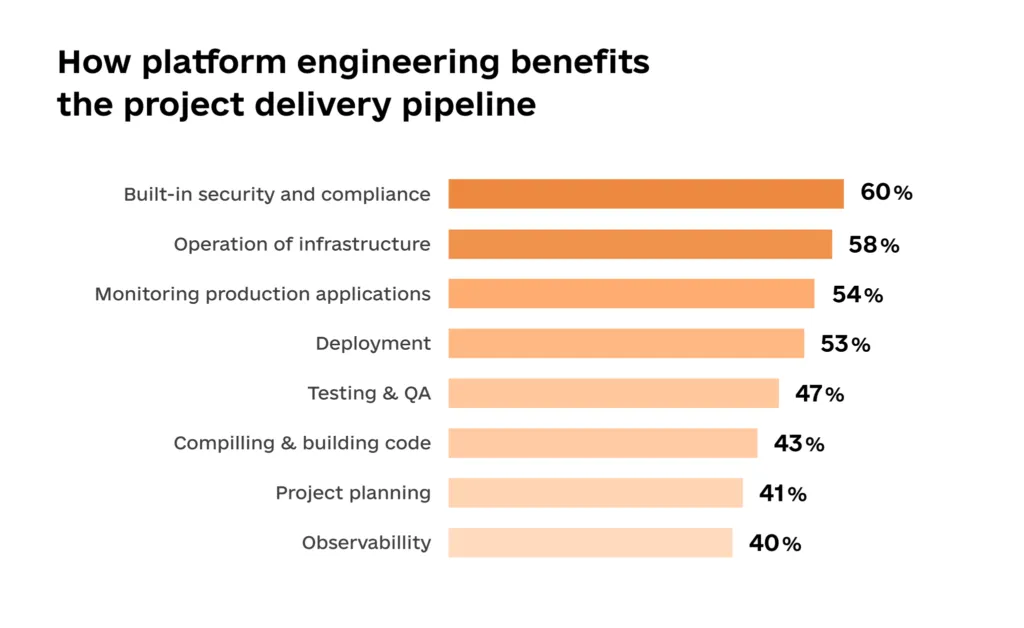
Source: 2024 State of DevOps Report.
Frequent Deployment Failures
Frequent code deployments are almost synonymous with high product competitiveness. Users want frequent updates, fast bug fixes, and excellent application performance. Yet, software engineers struggle to keep up, especially if each code deployment requires extensive manual oversight and tinkering with infrastructure configuration.
Mature DevOps teams maintain a change failure rate of below 15% and need less than a day to recover from a failed deployment. While low-performing teams experience change failure in 64 out of 100 deployments.
Platform engineers help automate deployment and configuration management processes like compute runtime management and container orchestration. Many also handle infrastructure monitoring and maintenance tasks like load balancing, cloud resources provisioning, caching, and horizontal scaling to ensure high infrastructure availability and resilient system operations.
Combining “shift left” practices (towards more secure, standardized coding) with automatic infrastructure provisioning, platform engineering teams substantially reduce the odds of failed deployments. To minimize failed deployment rates, Microsoft integrated policy fundamentals in its continuous integration pipelines. With this setup, all production releases, including bug fixes, are built from the main branch of source code and have consistent compliance steps. Effectively, teams must ensure that all pull requests have a successful build to keep the main branch always production-ready. Although this approach slows the time-to-production, it minimizes build failure rates, leading to greater end-product quality.
Communication Silos
Communication silo is inevitable in larger organizations with sprawling engineering team structures. Several operation units responsible for API management, network operations, and cloud infrastructure provisioning may only interact with one another through ticketing systems and manual processes.
Multiple cross-functional teams run their version of DevOps — using different practices, security policies, and toolchains to power their CI/CDs. Although there are occasional experience exchanges, each team effectively runs as a “DevOps island,” causing friction in collaboration.
Platform engineering aims to bring different teams into a shared ‘headspace,’ promoting a greater exchange of knowledge, standards, documentation, and operational policies, curated and disseminated via an internal developer portal.
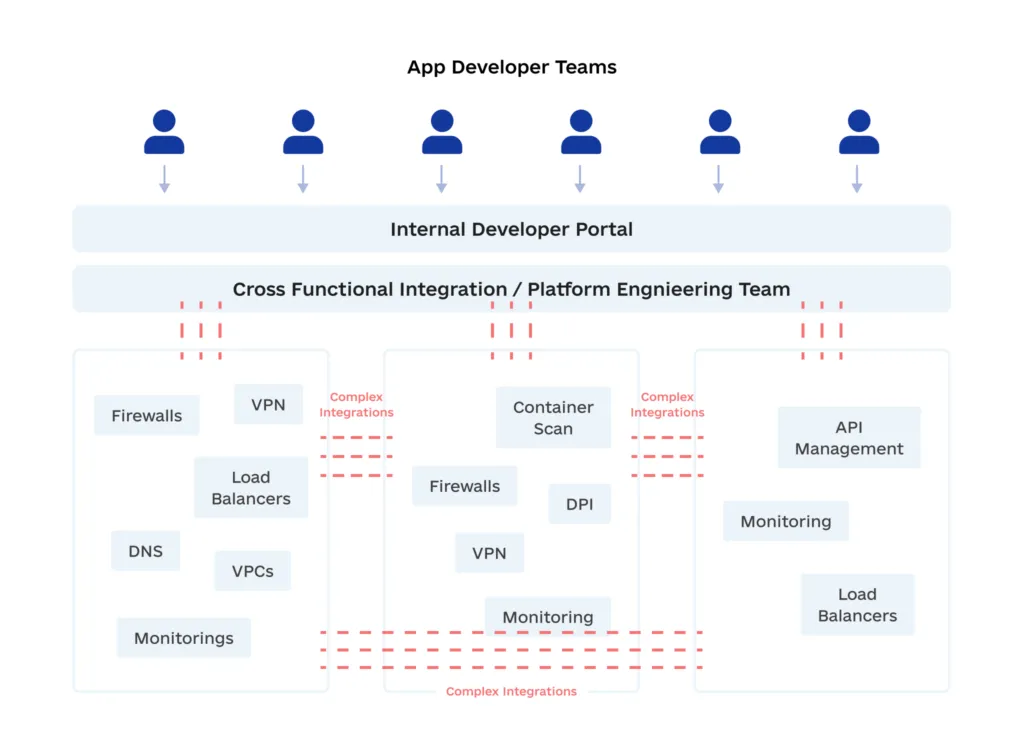
Source: Christian Posta
The best-performing platform teams don’t just standardize IT infrastructure but aim to create a stronger alignment between all units — engineering, infosec, DevOps, DevSecOps, networking, API teams, etc — to improve developer workflows and software delivery speeds.
High Talent Attrition
Over a quarter of developers quit their jobs due to poor engineering culture. Many are frustrated by toil — manual, repetitive, devoid of enduring value work, and that scales linearly as a service grows. Others are disappointed by poor collaboration, lack of knowledge exchanges, and minimal support from the management.
No matter the reasons, the outcome stays the same: Your tech talent grows disengaged, becomes less productive, and eventually throws the hat.
The end goal of platform engineering is to improve developer experience, aka make it easier and faster to perform regular tasks, access new knowledge, and collaborate with colleagues. Over half of internal developer portal adopters say it eliminates redundant work. Other frequently cited benefits include reduced cognitive load and better cross-functional collaboration.
How to Establish Platform Engineering Practices
Platform engineering aims to productize your approach to building and maintaining engineering infrastructure. Effectively, it meshes the principles of product engineering — building with the end user in mind — with DevOps practices of continuous automation and toil elimination.
To start building your platform engineering capabilities, we recommend the following practices:
Develop a Developer Journey Map
Platform engineering builds and maintains products for developers — internal developer portal, effective CI/CD process, and ancillary workflows for infrastructure provisioning and management.
The best products fulfill specific needs and address common frustrations. So your first goal is to create a developer journey map to understand better which bottlenecks they experience. Generally, developers want to see the following features in an IDP:
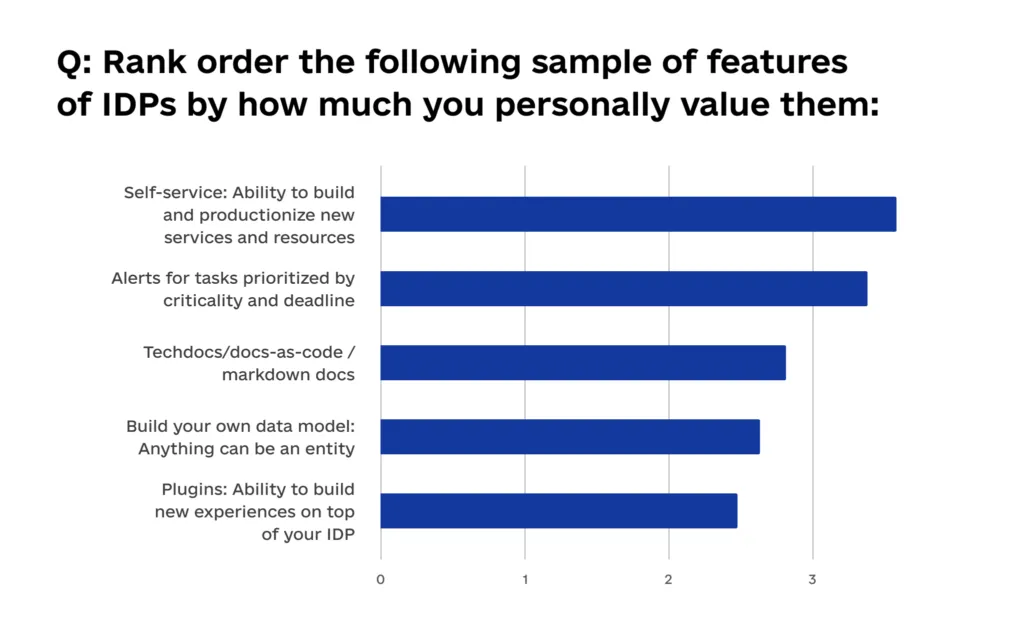
Source: Cortex
Talk to different teams and managers about common frustrations. Document these as user stories and evaluate the best ways to address these (e.g., with Golden Paths, via targeted upgrades to CI/CD, etc). Appoint a platform owner (an equivalent of a product owner) to set the vision and manage the roadmap.
Start With an MVP Version
Great products aren’t built with the first interaction, and neither are developer platforms. Prioritize a minimal viable set of features to launch an MVP internal portal and then progressively populate it with extra goodies based on the users’ feedback.
To release faster, identify and leverage existing solutions (tools, scripts, reference architectures, etc) teams are already familiar with and enjoy using. Opt for flexible technologies that can be adapted to different development processes and automation scenarios to avoid unnecessary sprawl. Review well-known, open-source components with a good degree of customization and look into more purpose-built tools during later interactions.
This way, you can start the initiative with a lean budget and demonstrate value early to secure user buy-in and justify a larger initiative budget.
Analyze and Scale Your Platform
Collect user feedback after the MVP release to understand what’s working and what’s not. Ask open-ended questions to learn how engineers are using the platform, what features they like, and what they are missing the most.
Build an internal public roadmap and solicit feature submissions and upvotes to prioritize new features for development. Platform engineering adopters who practice user-centrism have 40% higher organizational performance and 20% higher job satisfaction rates. Measure the early impact and benefits by tracking metrics like sprint burnout rates, velocity, change failure rates, and failed deployment rates to demonstrate the value of the initiative.
Final Thoughts
Platform engineering aims to reduce project cycle times and deployment failure rates by addressing common stressors in the software engineering processes. Rather than directly contributing to new software development, platform engineers focus on creating an environment where others can do their best work. They use feedback from developers to add new features and toolkits to self-service portals, improve CI/CD pipelines, optimize IaC platforms, and ensure proper application performance in production.
Scale DevOps and establish platform engineering best practices with 8allocate. As part of our technology consulting service, we’re helping our clients improve their engineering practices, make progress on the maturity scale, and get in the green on tracked software development productivity metrics. Contact us to learn more.

Frequently Asked Questions
Quick Guide to Common Questions
What is platform engineering, and how does it differ from DevOps?
Platform engineering is the practice of creating standardized workflows, toolchains, and internal platforms to improve developer experience and productivity. Unlike DevOps, which focuses on CI/CD, automation, and operations, platform engineering aims to scale these practices across teams, providing self-service tools and reducing operational friction.
Why are companies adopting platform engineering?
Organizations are embracing platform engineering to streamline development, reduce bottlenecks, and improve collaboration. It minimizes redundant work, eliminates tool fragmentation, enhances security, and boosts deployment success rates, enabling teams to ship software faster and more efficiently.
What common problems does platform engineering solve?
Platform engineering addresses several recurring challenges:
- Long project setup times: Standardized templates (Golden Paths) help developers start projects in minutes instead of days.
- Tech stack sprawl: Self-service portals ensure developers use pre-approved tools, reducing shadow IT risks.
- Security gaps: Automated policy enforcement and security monitoring prevent vulnerabilities in code and infrastructure.
- Deployment failures: Standardized CI/CD pipelines and infrastructure automation improve release success rates.
- Communication silos: Internal developer portals centralize workflows, documentation, and cross-team collaboration.
- High attrition rates: A better developer experience reduces frustration and improves retention.
How does platform engineering improve deployment efficiency?
By integrating automation into software delivery pipelines, platform engineering eliminates manual configurations, reduces human errors, and enforces security and compliance standards. This results in fewer failed deployments, lower downtime, and faster product iteration cycles.
How do Golden Paths help development teams?
Golden Paths provide predefined workflows, toolchains, and templates for common engineering tasks. Developers can quickly set up projects with standardized infrastructure, security policies, and best practices, reducing time spent on repetitive setup tasks.
How does platform engineering enhance security?
Security is built into the development lifecycle through automated security testing, pre-vetted code components, and policy enforcement at every stage. This minimizes software supply chain risks, prevents misconfigurations, and ensures compliance with industry regulations.
What role do internal developer portals (IDPs) play in platform engineering?
IDPs act as a one-stop shop for developers, offering self-service access to approved tools, reusable scripts, infrastructure templates, and documentation. They improve workflow consistency, enable faster onboarding, and provide visibility into best practices.
How can companies start adopting platform engineering?
Successful implementation begins with:
- Mapping the developer journey: Identifying bottlenecks and prioritizing improvements.
- Launching an MVP platform: Starting with a minimal version and expanding based on feedback.
- Scaling gradually: Monitoring adoption, refining processes, and automating repetitive tasks.
How does platform engineering impact developer productivity?
By reducing cognitive load and operational distractions, platform engineering enables developers to focus on building high-quality software. Companies using internal developer platforms report faster onboarding, fewer errors, and higher job satisfaction.