FinTech companies just emerged from an interesting year. Funding volume and deal count have declined since Q3 2022.
In the first nine months of 2023, FinTech companies raised $29 billion in 1,655 funding rounds, compared with 2,684 rounds worth $54 billion a year ago. Increasing capital costs forced FinTech companies to adopt more profitable practices and explore new revenue streams.

Source: S&P Global.
But better times are ahead for FinTech companies, benefiting from the banking industry transformation, digital adoption, and ecommerce growth. Despite short-term economic pressures, many achieved growth in new markets. In Q3 2023, Brazilian Nubank posted a net profit of $300 million and is close to hitting $1 billion in profits in 2024.
McKinsey predicts FinTech industry revenues will grow almost three times faster than the traditional banking sector until 2028. But to make that happen, FinTech companies need to mature and evolve their products to reach wider audiences and improve revenue growth rates and EBITDA (as many investors pressure them).
6 Areas of Innovation in FinTech
Mature FinTech companies went through user acquisition sprees. Many are shifting from growth at all costs to profitability and revenue diversification. How will they do it?
Our team identified six areas of innovation that will mark this year and shape a more profitable future for FinTech.
Expansion of Embedded Finance Segment
Payment is one of the fastest-growing FinTech sectors, and embedded finance transactions are the niche to watch. In 2023, the embedded finance market reached $83 billion. By 2026, Bain predicts that the embedded banking, lending, and insurance market will be worth $7 trillion.
Platform businesses are fueling the growth of embedded finance products. They aim to sustain customer experience by providing seamless checkout, payment, and lending experiences at the point of sale. However, they lose customers due to unsupported payment methods, incompatible bank accounts, or limited lending options.
From ecommerce to ride-sharing apps, businesses partner with payment and banking infrastructure providers. FinTech companies, aiming to offer new services to consumers faster with less regulatory red tape, team up with traditional players and infrastructure providers.

Source: Bain.
Sunrise Banks helped Self Credit Builder and TrueConnect launch new lending products using its underwriting and loan approval infrastructure. For TrueConnect, Sunrise processed over 6,000 loans totaling $14.7 million.
Tide Bank partnered with Liberis, an embedded lending platform, to get innovative, personalized products and offer flexible repayment plans. Swiss supermarket chain Coop presented Coop Finance+ in late 2023 — a branded bank account and debit card — launched in collaboration with FinTech orchestrator provider Additiv. Investment and insurance products may follow.
Overall, 75% of FinTech companies expect that most financial products will be offered outside traditional channels in the next three years, according to the Global Embedded Finance Market Report 2024 from FinTech Futures. Consumer retail, telecom, and healthcare will attract the most interest. In Europe, embedded finance growth is expected to approach EUR 150 billion by 2028, while the APAC market will exceed $300 billion by 2024.
Success depends on FinTech companies effectively externalizing their offerings to become ‘embedded’ partners. This requires strong expertise in scalable, secure cloud architecture development and API management.
We expect more embedded AI lenders to enter the market, providing hyper-personalized customer rates using analytics and ensuring a low rate of non-performing loans. Lendica offers an embedded product for upfront sales invoice payments for SMBs, with lending decisions made in seconds through machine learning analytics. Lama offers a fully automated underwriting experience in its embedded lending platform. Both help financial companies bring new digital products to the market faster.
Generative AI Has Profitable Use Cases
Generative AI has sparked interest in finance. According to EY, 75% of European finance leaders plan to increase Gen AI spending in 2024. However, some view Gen AI as a ‘gimmick’ with unproven ROI, especially compared to more established machine learning models.
Our take? Gen AI will not replace existing algorithms for credit scoring, underwriting, risk management, or financial market analysis. Instead, it will complement them by making the data more accessible to the average business user.
Thanks to retrieval augmented generation (RAG), companies can fine-tune open-source large language models (like GPT-3/4) to analyze and synthesize knowledge from private sources (e.g., a corporate policy database). Morgan Stanley prompt-tuned OpenAI’s GPT-4 model on its investment, business, and process documents to supply analysts with context-relevant replies. Morningstar fine-tuned the GPT-3.5 version of its library of investment research, editorial, and ratings. So, instead of opening a myriad of PDFs, the firm’s customers can send a quick question to the model and get a concise, precise response.
Foundation models can also improve customer service and engagement. Ally Bank piloted an AI-powered app to transcribe and summarize customer calls, saving hundreds of productive hours yearly. The information can also be used for sentiment analysis and service improvements.
Gen AI isn’t just about full automation. Many mid-office and back-office workflows in the financial sector will always need human oversight. But Gen AI apps can do much of the ‘heavy lifting,’ assisting humans with information-intensive jobs. Lucinity, a FinCrime prevention platform, released an AI copilot for financial fraud case investigation. SymphonyAI has a similar gen AI assistant for KYC, CDD, and AML investigations.
In the next few years, we expect more gen AI products at the ‘front,’ offering a fully conversational product interaction. This is appealing in personal finance and wealth management, where consumers seek personalized advice but can’t always afford a human consultant (or have one available 24/7). LTX, a bond trading platform, launched BondGPT — a conversational assistant suggesting optimal corporate bonds based on the user’s real-time liquidity needs and other criteria.
Gen AI has potential for the finance sector, but it’s challenging to implement. Over 40% of financial leaders, surveyed by EY, say they lack the proper data infrastructure, and 35% lack technology infrastructure. Moreover, AI systems come with a new range of cyber security and operational risks. If you’re unsure where to start, 8allocate can advise in AI & ML model development.

Smarter Automation For Compliance and Security
High compliance costs undercut FinTechs’ path to profitability. Last year, 60% reported paying at least $250k in compliance fines and penalties, one-third — $500,000, according to Alloy.
The same survey shows that larger companies (1,000+ employees) were more likely to face $500K fines. Scaling compliance is difficult as data volume, diversity, and use cases multiply — and when entering new markets or product verticals.
Compliance doesn’t have to increase your budget when intelligent automation solutions are available for AML, KYC, fraud detection, and risk management.
Revolut developed a scalable machine-learning model to monitor real-time payment transactions and flag suspicious ones for manual investigation. The company also uses the AI-powered CUBE platform to receive real-time notifications on new regulatory announcements, enforcement actions, speeches, and other updates.
A slew of FinTech infrastructure providers offer modern, scalable, and competitively priced solutions for automatic risk and security management: Alloy, Middesk, Sila, Sardine, and others. Most of them rely on advanced data analytics models and AI. Pagos uses machine learning models to identify anomalies in payment data and determine the likelihood of fraud.
ML has proven its efficiency to the extent that the European Financial Action Task Force (FATF) actively encourages financial companies to use machine learning and data analytics for anti-money laundering and anti-terrorist financing (AML/CFT) monitoring. That said, even the most advanced models will fall short if your company lacks an appropriate data management strategy, so that’s the area to prioritize.
Point of Sale (POS) Lending Expands into New Verticals
Since 2020, BNPL platforms have proliferated fast, now valued at $25.4 billion globally and set to grow at a CAGR of 20%. The industry aims to expand offline to convert in-person transactions and new product/service categories.
Some 40% of US consumers are interested in BNPL offers for travel, home remodeling, medicine, and prescription services. ZeeFi, an Australian FinTech, launched a ‘Study Now, Pay Later’ product for educational services providers last year. Booking.com partnered with Affirm in September 2023 to offer a BNPL option in several markets. Neobank Upgrade acquired Uplift, a BNPL provider for travel companies, and plans to integrate the offer into its platform.
Leaders are eyeing the B2B payments sector, which is twice the size of the B2C payments sector. There are opportunities in NPD, such as advanced invoice payments and instant financing for inventory purchases. Mondu, for example, provides infrastructure for setting up digital trade accounts and receivable cash advances.
New BNPL regulations are coming this year. The UK plans to regulate BNPL products like traditional lending products, and the EU plans to add BNPL under the existing credit umbrella regulation (the Consumer Credit Directive). The US doesn’t have direct regulations yet, but the Consumer Financial Protection Bureau (CFPB) has been looking into the market.
BNPL lenders will need to demonstrate fair, ethical, and compliant operations. Strong data analytics and proactive monitoring help ensure equitable credit extension and a low rate of non-performing loans.
Smarter CFO Tech Stacks Wanted
Financial teams lack efficiency, especially in small businesses. Many still rely on paper checks and manually run accounts receivable (AR) and accounts payable (AP) workflows. Overall, 46% of SMBs say they’re too dependent on non-automated processes for financial tasks, according to 451 Research. Another 41% also admit managing cash flow is a challenge.
In larger companies, matters are marginally better. While a larger fraction of financial workflows are automated, CFOs struggle with other issues: 55% plan to take a proactive approach to revenue compliance checks and audits, and 71% want to increase the use of digital (planning) tools to make their supply chains more resilient, according to a 2023 CFO survey by Deloitte.
Below is the typical job description of a CFO: strategic decision-making at the top and transactional and financial reporting at the bottom.
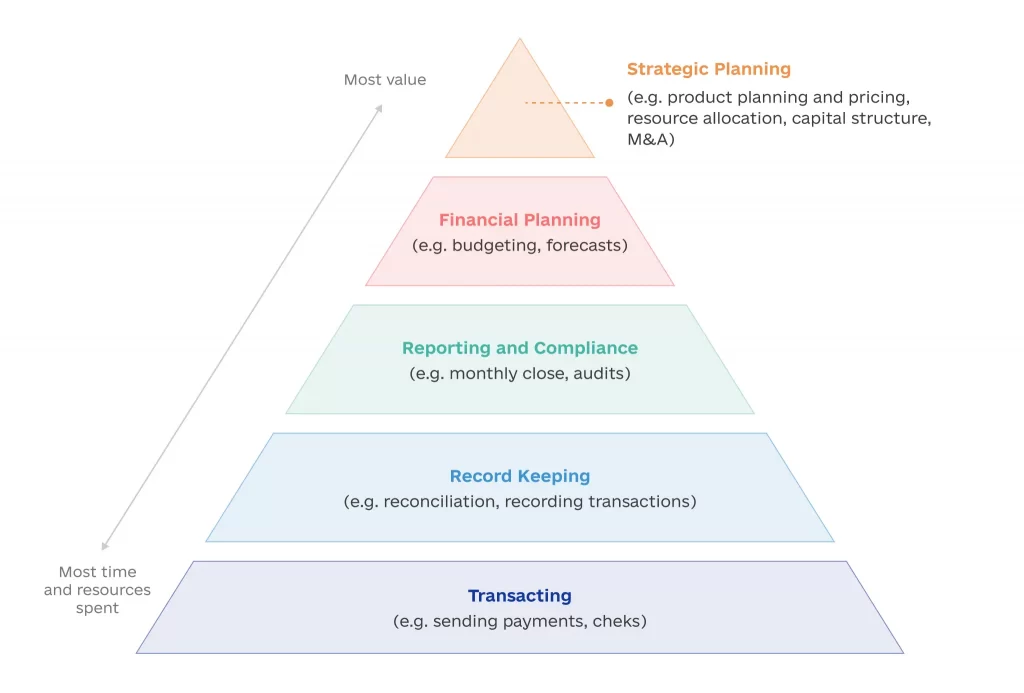
Source: Andreessen Horowitz
At every level, CFOs could benefit from extra tools, especially those that promise to eliminate manual, repetitive (and often — error-prone) tasks. UK-based Teya (former SaltPay), for example, built out an integrated stack of payment, financial analytics, recordkeeping, and cash flow management tools for SMEs. The platform serves over 300,000 customers globally and boasts an impressive $9 billion valuation as of 2022.
Pleo, once known as an expense management platform, substantially updated its product this year to become a one-stop-shop provider for mid to enterprise clients in Europe. The platform now has a direct integration with Oracle NetSuite ERP, plus new invoice management tools, virtual cards for vendor payments, and instant access to overdraft.
Plenty of other gaps still exist in the FinOps stack, namely in tax and treasury management, stock options administration, and advanced financial analytics. Thanks to the rise of FinTech infrastructure, companies can now easily venture into adjacent niches. Expense management companies can create virtual cards and digital bank accounts to profit from interchange fees on all expenses. Software companies can provide better data for loan underwriting. As the ecosystem grows, more revenue sources emerge.
FinTech Companies Diversify Revenue with Subscription Models
Investors press for revenue growth and profitability. Subscription business models have proven effective in other industries and banking (where account-holding fees are still common).
The era of no-fee debit cards/current accounts isn’t over, as many companies seek recurring revenue from subscriptions. Cleo, a sassy PFM app, launched a Cleo Plus subscription in 2018. By 2019, it was the fastest-growing FInTech app globally. In 2022, the app reported $45 million in ARR and a 2.4X growth of the Cleo subscriber base.
Klarna kicked off 2024 with the launch of a subscription offer in the US. Klarna Plus lets users use Klarna’s One Time Card product with no fees, get double rewards points, and access special deals with popular brands. Affirm is also working on a subscription service to diversify its revenues.
Subscriptions are an extra revenue stream that delights existing consumers with added-value services and drives retention. They are less affected by market volatility (e.g., interest rates) and have fewer constraints (e.g., low upfront capital investment).
Conclusions
For years, FinTech companies had a technology edge over incumbents, offering digital account opening, faster payment processing, and lower fees. That’s changing. Over 94% of banks plan to invest in new payment infrastructure for cross-border and real-time payments. Many are partnering with BaaS platforms and FinTech infrastructure providers to improve customer experience. FinTech companies must continue to innovate and experiment with new revenue sources to retain and attract users.
Want to sharpen your product strategy for 2024 and beyond? 8allocate helps global companies level-set technical feasibility and user needs as part of our product discovery service and transform your vision into life with dedicated project teams. Contact us to learn how we help FinTech companies grow profitable and stay competitive.
Frequently Asked Questions
Quick Guide to Common Questions
What are the most significant FinTech trends shaping the industry in 2024?
FinTech is evolving with embedded finance, generative AI, smarter compliance automation, expanded POS lending, advanced CFO tech stacks, and subscription-based revenue models. Companies are focusing on profitability, improving operational efficiency, and expanding into new verticals while integrating AI and automation into financial workflows.
How is embedded finance transforming financial services?
Embedded finance is allowing businesses to integrate financial products into non-financial platforms, enabling seamless payments, lending, and insurance at the point of sale. Companies like Tide Bank and Coop Finance+ are partnering with FinTech providers to offer financial services without traditional banking infrastructure. Success in this space depends on strong API management, cloud scalability, and security.
What are the most promising applications of generative AI in FinTech?
Generative AI is enhancing financial workflows rather than replacing existing machine learning models. It is being used for customer support automation, investment research, regulatory compliance monitoring, and fraud detection. Financial institutions like Morgan Stanley and Morningstar have fine-tuned LLMs to provide real-time insights, while companies like Lucinity and SymphonyAI are applying AI to financial crime prevention and compliance operations.
How is AI improving financial compliance and security?
AI-driven compliance automation is helping financial institutions reduce operational risks, streamline KYC/AML processes, and minimize fraud. Companies are leveraging machine learning to monitor transactions in real-time, analyze behavioral patterns, and proactively detect suspicious activity. Regulatory bodies are increasingly recommending AI for compliance, but effective implementation requires a strong data management strategy.
How does 8allocate support FinTech companies in AI and digital transformation?
8allocate provides AI and ML implementation, data-driven financial software solutions, and compliance-driven AI solutions tailored for FinTech businesses. With expertise in AI-powered automation, predictive analytics, and digital transformation strategies, 8allocate helps FinTech companies improve operational efficiency, optimize risk management, and scale their technology infrastructure.