In a perfect world, tech leaders have unnerving board support, unlimited budgets, and a bountiful talent pool. But in reality, it’s the opposite.
Although 93% of IT leaders expect budget increases this year, 83% also believe they will need to achieve more with less, a CIO Pulse survey found. A significant portion of budgets are tied to supporting legacy technologies and rising cloud bills. Tech talent scarcity, lingering economic uncertainty, and limited VC funding mean CIOs must squeeze every ounce of value out of the available resources.
However, constraints aren’t bad for innovation. On the contrary, research suggests organizations benefit from a healthy dose of limitations, challenging them to be more creative. As former Googler and Yahoo CEO Marissa Mayer said in 2006: “Creativity loves constraints,” citing an example of adapting the Google Search engine to have a memory footprint of less than 8 megabytes to run on 90% of computer models at that time.
Instead of bemoaning the inconvenience, innovative companies reframe adversity as an opportunity. In this guide, we’ll discuss the main constraints tech leaders face and strategies to overcome them.
Slow Response to Market Changes
Markets move faster than most businesses. Prolonged decision-making, lack of clear leadership, siloed communication, and suboptimal business processes prevent companies from delivering new products faster and capitalizing on market momentum.
Incumbent financial institutions often sit out on the emerging FinTech trends. Buy now, pay later (BNPL) companies like Klarna and Affirm took advantage of consumers’ decreasing interest in credit cards by offering a simpler, more convenient, and transparent alternative. It’s unlikely that banks didn’t notice the 30-50% decrease in auto loans, mortgages, and credit card applications happening at that time. Rather, they were slow to act.
If companies don’t move fast enough, they get outcompeted by more Agile players. Almost 65% of banking leaders admit that slow digital transformation has resulted in losing new customers.
Businesses need to rewire legacy operating processes and org charts to become more efficient. A Gartner survey found that 55% of CIOs have embraced an operator mindset, where they handle digital delivery responsibilities and engage other C-roles as sponsors in other areas of business. Thanks to this approach, CIOs achieve better digital initiative outcomes and perform better in general IT management.
Leaders also focus on improving software development productivity through:
- Cross-functional collaboration
- Adoption of Agile project management
- CI/CD pipeline implementation
- Fast feedback loop setup
- Use of coding copilots and automation technologies
JP Morgan Chase builds new products with engineering, support, legal, and marketing working together. Each contributes ideas, market observations, and operational insights, recorded as technical requirements and user stories. This change in ideation had a big impact on the speed and flexibility of the product development cycle, according to the company. By introducing Agile project management, the bank also decreased the time-to-market for new product features from over a year to under six months on average.
Pressure to Deliver ROI From Tech Investments
New tech trends emerge yearly and are greeted with initial stakeholder excitement. But in a tight economic market, many also demand a demonstration of profitability before authorizing bigger budgets.
CIOs are being tasked with an increased demand in delivering business value from technology initiatives without additional resources
Gartner 2024 CIO Agenda
This puts extra pressure on CIOs as quantifying the impacts of digital transformations isn’t always straightforward. Traditional metrics don’t always reflect an accurate picture, especially if success criteria weren’t level-set with the business case. It’s not always easy to anticipate a market response to an innovative product released 12+ months after the initial market and user research.
Doing product discovery before committing resources is a good strategy for acquiring market and customer knowledge, formalizing product requirements, and avoiding technical feasibility gaps. At 8allocate, we’ve developed a product discovery framework to validate product-market fit, prioritize product features for the first release, define project timelines, and estimate budgets with high accuracy.
To minimize risks, start with a minimal viable product (MVP) to quickly collect market insights. MVPs validate commercial viability, market demand, customer willingness to pay, and product usage frequency. It helps demonstrate early value and secure extra financial support.
Also, an MVP helps collect product metrics to guide strategy and determine revenue-boosting features and areas for optimization to improve product performance and adoption rates.
For greater accountability, set a North Star Metric — a top-level guiding metric to optimize — to better direct your efforts and report on the outcomes. Lenny Rachitsky, an author and former product lead at Airbnb, points out that most companies choose to focus on one or two of the following North Star Metrics:
- Revenue: The total money generated, measured through KPIs like ARR and GMV. A focus metric for ~50% of companies, including Airtable, Coda, Coinbase, Github, and Shopify.
- Customer growth: The total number of paid users, measured through KPIs like marketshare, paid enabled users, monthly transacting users, etc. A focus metric for ~35% of companies, primarily using a marketplaces or platform business model, e.g. JIRA, Slack, Spotify, and Webflow.
- Consumption growth: Intensity of product usage, measured through ‘number of orders’, ‘messages sent’, ‘content viewed’, etc. A focus metric for ~30% of paid-growth driven businesses like Lyft, Airbnb, and Plaid.
- Engagement growth: Total active product users measured through MAU and DAU. A focus metric for ~30% of companies with premium products or relying on ads, e.g., Instagram, X, Strava, Coda, and Hubspot. Also used to measure the success of internal products.
- Growth efficiency: Cost-to-profit efficiency, measured through LTV, CAC, or profit margin. A focus metric for ~10% of companies like Calm, Casper, and Hims.
- User experience: The degree of customer satisfaction with the product, measured through NPS or customer health scores. A focus metric for ~10% of companies, differentiating through UX like Superhuman, Slack, and Robinhood. Used as a supplementary metric to optimize customer retention.
A strong focus on a North Star Metric adds ‘creative constraints’ to your product strategy. It forces everyone to assess decisions through the prism of “Will this really help improve our GMV or number of DAUs?”.
Lenny Rachitsky recounted that when working at Airbnb, the North Star Metric was “nights booked.” It was a broad metric for shaping the product roadmap, but it forced the team to come up with different ideas for ancillary measures that help optimize the North Start. For example, increasing the conversion rate increases the amount of nights booked, and so does adding more home listings, or improving the search experience.

Diminishing IT Budgets Due to Technology Sprawl
IT budgets increase yearly, but the spending is mostly on operations rather than innovation. The main reasons for the 2024 increase are security improvements and rising technology and services costs. Investment in emerging technologies comes afterward.

Source: Foundry
Tech leaders now manage extra-large IT estates. The average enterprise has over 1,000 apps in the portfolio, a 25% increase from 2021. All of the applications require regular maintenance — patching, updates, vulnerability scans, and cybersecurity proofing.
Ongoing technology sprawl limits companies’ visibility. The majority (63%) of companies aren’t sure where their data resides. Moreover, 41% of employees use shadow IT — to acquire and/or create technology outside of the IT department’s control.
Lack of visibility is problematic as “forgotten” assets become hidden cost centers. Over half of businesses say aging technology and technical debt waste IT budgets, while 42% say redundant applications are also a problem. Invisible assets become breeding grounds for security vulnerabilities as they’re not regularly patched and updated. After five years in production, 70% of applications have at least one security flaw. Left unaddressed, it can become a gateway for hackers.
To reclaim budgets, refresh your IT asset inventory. Collect data about servers, VMs, and apps with modern asset management solutions like AWS Systems Manager Inventory. The tool also helps implement unified cloud resource configuration and usage policies and locate assets to reduce overspending and under-utilized resources. A detailed inventory of hosted applications can help locate redundant products or licenses and harmonize usage.
Once you have a detailed tally of your assets, assess the portfolio’s cost performance and security status. Run a vulnerability scan to locate unpatched applications and unprotected endpoints. Analyze existing security controls and tools, then consider additional cybersecurity measures. Assess the TCO of new security investments against the costs of a breach or containing the risks.
Expanded Cybersecurity Radar
From 2022 to 2023, data breaches increased by 20%, and by 2027, the global cost of cybercrime can reach $23.84 trillion. In the meantime, CIOs continue to experience cybersecurity talent shortages, get pressed by new regulatory demands, and are thus oftentimes forced to resort to reactive rather than proactive cybersecurity measures.
The better news is that despite the constraints, CIOs can come up with better solutions for cyber-security. A research group from MIT Sloan found three key reasons for heightened cyber risks:
- Cloud misconfigurations
- New ransomware attacks
- Increased vendor system exploitation
Misconfigurations happen due to unfamiliarity with cloud technologies. Engineers lack knowledge of the product ecosystem and keep permissive ‘default’ security settings. To avoid extra costs, some companies skip purchasing extra cloud security tools (a common oversight). To avoid such scenarios, partner with an experienced cloud engineering team to help you configure secure architectures, implement appropriate controls, and set up security monitoring.
Ransomware attacks are increasing and proving effective. Unmitigated application vulnerabilities create an easy attack path. Employees remain susceptible to phishing and malware attacks. Many attacks are automated, allowing hackers to stage ‘spray and pray’ campaigns for a low cost. Better security monitoring, improved access and identity management (IAM) practices, and regular data backups can minimize ransomware attack risks.
When hackers can’t directly breach your security perimeter, they try going through a ‘backdoor’ — a vendor system with lower security protection connected to your infrastructure (e.g., a payment processor or an accounting app). To avoid this, carefully assess all your IT purchases.
Lastly, AI systems pose novel cybersecurity threats and need new protection mechanisms. To avoid data disclosures or poisoning attacks, audit your toolchains, enforce strong security policies, and apply data anonymization techniques.
Ongoing Workforce Challenges
The tech job market remains in turmoil. Layoffs continue in the US, yet most CIOs still struggle to find the talent they need. In a Deloitte survey, 90% of tech leaders said recruiting and retaining talent was a moderate or major challenge.
An CIO survey, conducted at the end of 2023, by Evanata also found that 49% of leaders feel it’s harder to fill open roles than last year. In both cases, the overarching issue is that companies struggle to hire for senior and specialized positions.
“We aren’t getting people coming in with backgrounds in AI, ML, automation, cloud security, cloud infrastructure, etc. In fact, we really want to improve our security and take it to the next level, but we aren’t getting enough talent,” one executive mentioned.
That’s hardly surprising since most businesses prioritize AI adoption, security improvements, and cloud adoption. Everyone is after a narrow segment of the tech workforce, exhausting local talent pools.
In such cases, it pays to borrow a principle from Blue Ocean Strategies: Stop trying to beat the competition and make it irrelevant instead. Expand your hiring strategy to untapped regions like Central and Eastern Europe (CEE). Ukraine, Poland, and Romania have an 870K+ tech workforce, growing year-on-year. Over 60 Ukrainian tech companies are registered as active in the field of artificial intelligence — and an even wider number operate in adjacent areas of big data analytics and data science. Over 200 vendors in Poland offer cloud consulting services, and Romania recently became the host country for the EU’s new Cybersecurity Competence Centre (ECCC).
Strategic IT partnerships with software engineering partners can help businesses close skill gaps and ensure an ongoing supply of the right talents through joint workforce planning initiatives. Moreover, leaders can gain a wider range of support with engineering process optimization, product development, and new technology investment assessments, among other areas.
Participation in ESG Strategy
ESG reporting is now a regulatory requirement in 30+ countries and territories, including the US, the UK, and the European Union. CIOs are now expected to drive these initiatives. A Deloitte survey found that 27% of CIOs are expected to provide the necessary data and 31% to contribute new tools.
While environmental, social, and governance (ESG) initiatives add value to the business, their implementation is challenging to orchestrate. Data silos, in particular, are a major constraint. ESG insights are often trapped in multiple business systems, making it hard for compliance officers to fulfill disclosure obligations or quantify the impacts of recent initiatives. Moreover, data collection and analysis for ESG reporting is often ad-hoc and done manually. In fact, most barriers ESG practitioners face are related to data in one way or another.
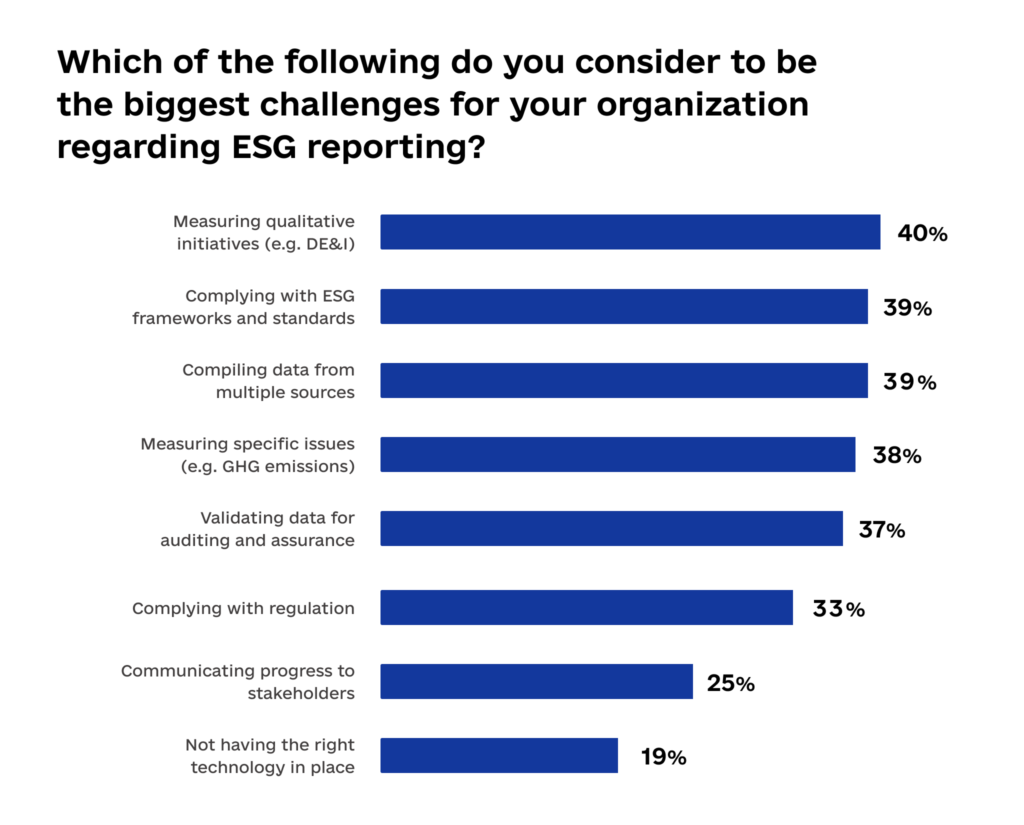
Source: Workiva
Tech leaders can help advance ESG initiatives by driving more resources toward improving data management processes to have a single source of truth for all data and establish audit-proof reporting processes. Then implement ESG analytics and reporting platforms to digitize and automate the reporting process.
Beyond that, CIOs can contribute to reaching ESG targets by identifying new investment and improvement areas. AI opens ample opportunities for improving ESG metrics through optimized energy management, predictive maintenance, and real-time risk intelligence. Tech leaders can inspire sustainable business practices and advance ESG goals.
Final Thoughts
As the adage goes: “If you wait for perfect conditions, you’ll never get anything done.” Smart tech leaders know how to work with what they have (or how to change their circumstances effectively). The above tactics provide a good starting point for strategizing.
For personalized help, contact us. At 8allocate, we help leaders build better engineering processes, refine product ideas, and commercialize emerging technologies through advisory and hands-on engineering services.
Frequently Asked Questions
Quick Guide to Common Questions
How can tech leaders drive innovation with limited budgets?
Tech leaders can optimize budgets by focusing on high-impact initiatives, leveraging automation, and eliminating redundant technologies. A detailed IT asset audit can reveal cost-saving opportunities. Shifting to cloud-native and AI-powered automation can also help streamline operations while reducing overhead.
Why do companies struggle to respond quickly to market shifts?
Slow response times stem from rigid decision-making, siloed operations, and legacy technology. To stay competitive, organizations should embrace Agile methodologies, cross-functional collaboration, and real-time analytics to speed up decision-making and execution.
How can companies ensure a high ROI on tech investments?
Tech investments should align with a clear North Star Metric—whether it’s revenue growth, customer acquisition, or operational efficiency. Leaders should prioritize projects with measurable impact and use MVPs (Minimum Viable Products) to validate demand before scaling.
How can IT teams manage growing technology sprawl?
The average enterprise has over 1,000 applications, leading to inefficiencies and security risks. Tech leaders should conduct regular IT asset reviews, eliminate underutilized tools, and consolidate redundant applications to reduce maintenance costs and enhance security.
What strategies help organizations strengthen cybersecurity under budget constraints?
Focus on proactive threat detection, security automation, and strong identity and access management (IAM) practices. Investing in cloud security tools, zero-trust architecture, and AI-powered anomaly detection can enhance security while optimizing resources.
How can companies overcome tech talent shortages?
Instead of competing for the same limited talent pool, companies should expand their hiring strategies to global markets like Central and Eastern Europe (CEE). Partnering with software development firms for dedicated engineering teams can also provide access to niche expertise on demand.
What role does AI play in optimizing enterprise IT operations?
AI can automate IT workflows, improve data-driven decision-making, and enhance predictive analytics. It helps organizations optimize cloud costs, streamline DevOps processes, and strengthen cybersecurity through intelligent threat detection.
How can CIOs contribute to ESG initiatives?
CIOs play a key role in ESG (Environmental, Social, and Governance) compliance by implementing real-time ESG tracking, optimizing energy consumption with AI, and ensuring ethical AI deployment. Data-driven sustainability reporting tools can also streamline compliance efforts.
How does 8allocate help businesses innovate despite constraints?
8allocate is an AI solutions development company. We help businesses accelerate growth, streamline operations, and enhance decision-making through AI-driven solutions for high-growth industries like FinTech, EdTech, and Construction Technology.