The artificial intelligence race is on with almost every industry doubling down on investments in machine learning (ML) and deep learning (DL). That’s no surprise given the estimated economic benefits AI apps in production can deliver.
By 2030, AI could generate over $13 trillion in extra economic output, boosting the global GDP by 1.2% per year, according to McKinsey. PwC gives an even more optimistic estimate of a global GDP increase of up to 14% by the same year from accelerated AI development.
Companies that will establish themselves as AI leaders, in turn, could capture an extra 20%-25% in economic benefits compared with today’s performance. So the race is on!
The AI Development Boom in Numbers
AI use cases are moving from research labs into the mainstream across sectors. Until 2014, the most impactful machine learning models were released by the academic sector, according to the Artificial Intelligence Index Report 2023 by Stanford. In 2022, however, 32 most acclaimed ML models were produced by commercial market players including OpenAI, Google, and Microsoft among others.
Intelligent algorithms can dramatically change how the economy works. Computer vision and reinforcement learning gave progress to (semi)autonomous cars and a new generation of industrial robotics. AI-powered predictive analytics is making strong impacts across logistics, supply chain management, and financial sectors. Large language models transform the way we interact with interfaces and present ample opportunities in marketing, sales, and customer support among other functions. All of these AI use cases can substantially improve operational efficiency, optimize costs, and create new revenue pools for businesses.
Today, 50% of global companies rely on AI technologies in at least one business area, McKinsey estimated. In addition, the average number of AI capabilities organizations now use has increased from 1.9 in 2018 to 3.8 in 2022.
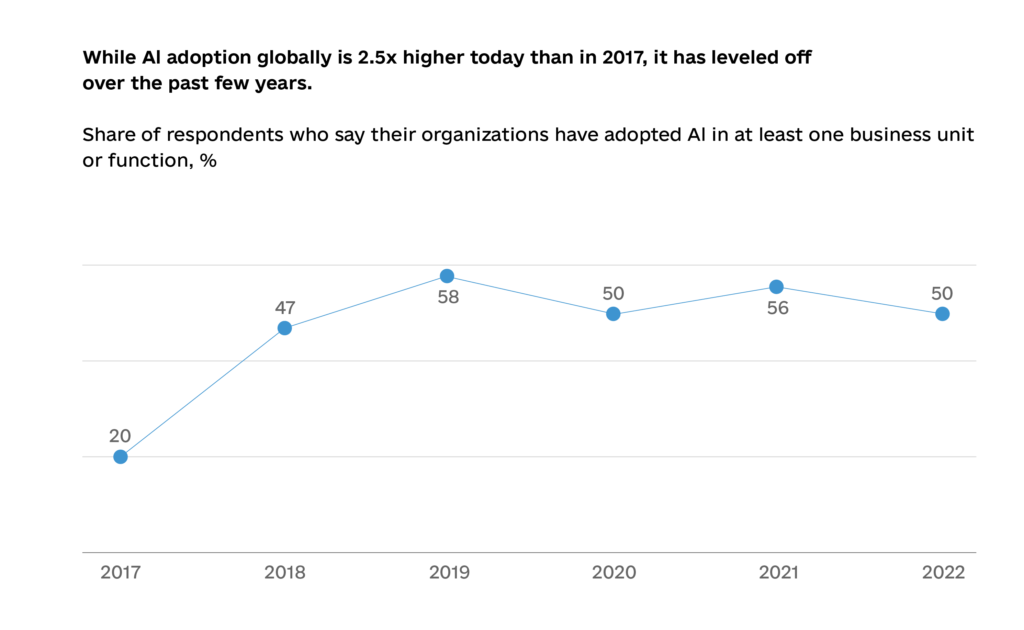
Source: McKinsey
Deloitte shared a similar analysis of the latest AI trends: 50% of global companies have deployed AI in the IT function, followed by production, manufacturing, engineering, and product development. More than 25% had also achieved full-scale deployment of at least five AI applications.
Businesses are gradually moving from proof-of-concept (POC) AI deployments to scaled adoption across functions. Competitive pressure also prompts leaders to allocate bigger budgets for AI initiatives.
Generative AI pushed adoption rates higher in 2023, with 37% of US-based professionals in marketing and 35% in the technology sector, saying to have used AI tools for work-related tasks.
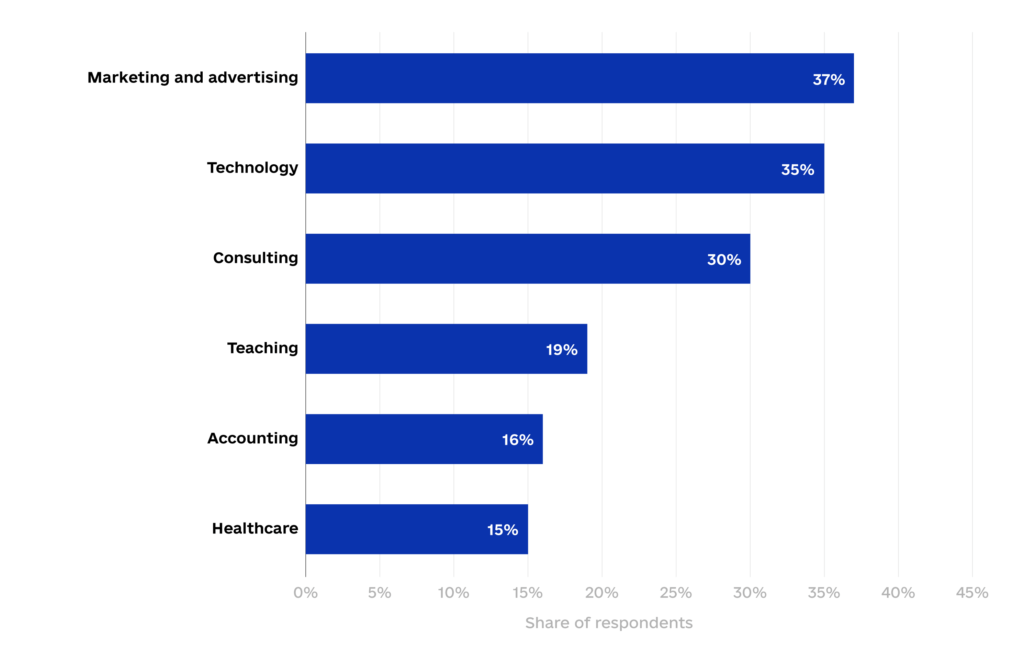
Source: Statista
UBS expects the global AI hardware and services market to be worth $90 billion by 2025, which is a “conservative estimate”, according to the company, as more industries develop and adopt AI applications.
Given the future impact potential, nearly every industry – FinTech, EdTech, manufacturing, and healthcare among others – rush to bring AI models into production, focusing on AI solutions that drive business growth. What stalls their progress though, is missing talentThe AI Talent Crisis: A Global Dilemma
Almost every industry sees the benefits of AI adoption. Yet, staunch growth ambitions get constrained by poor access to AI engineers and tech talent in general.
With the most qualified AI talent happily employed and/or actively poached, other market players are left with fewer options. What’s more, AI talent shortages aren’t limited to one region, they’re equally acute in the US, UK, Western Europe, and APAC.
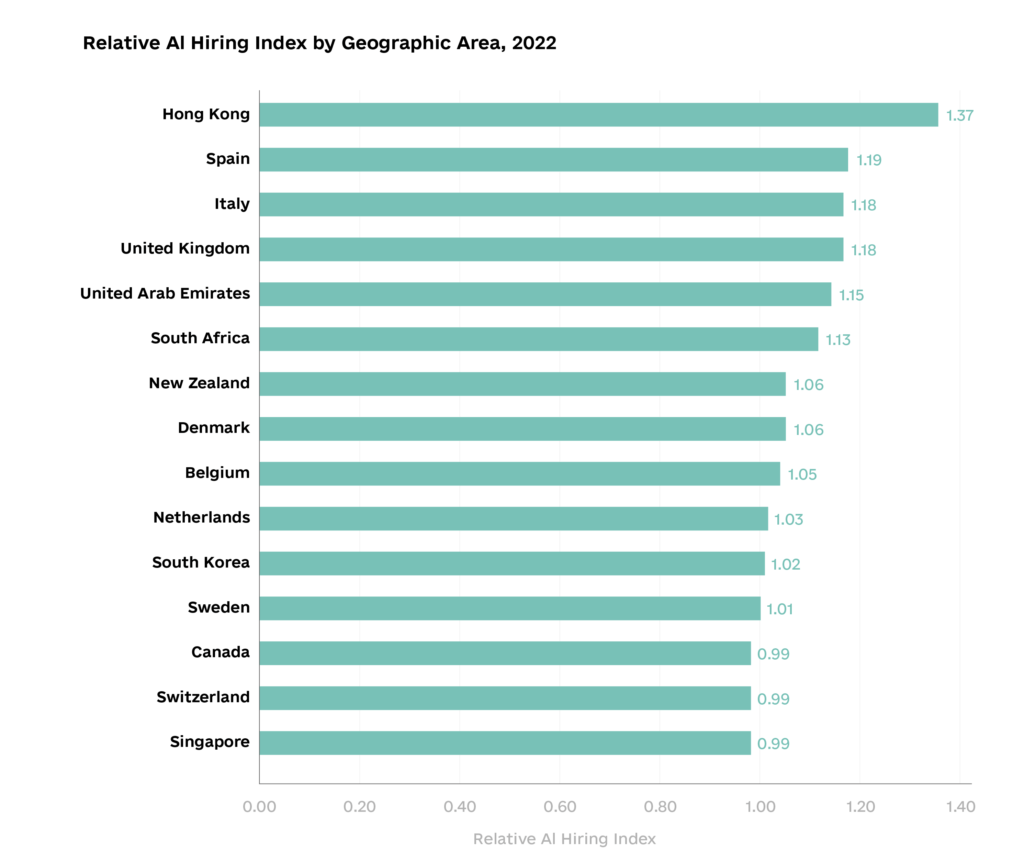
Source: Artificial Intelligence Index Report 2023
Globally, only one in eight IT leaders have a fully staffed team to deliver on what the C-suite is asking. Among financial companies, 36% singled out “recruiting/retaining AI experts, data scientists” as the biggest constraint to achieving their growth goals.
According to McKinsey, organizations find it difficult to hire for the following AI-related roles last year:
- AI data scientists: 78%
- Data architects: 72%
- Machine learning engineers: 70%
- Data engineers: 69%
- Software engineers: 65%
- AI product owners: 62%
In the US, in turn, the most in-demand skill clusters were machine learning, artificial intelligence, natural language processing, neural networks, autonomous driving, and visual image recognition. Each of these is substantially more in demand than a decade ago.
Constrained AI talent acquisition leads to salary growth acceleration. The median base salary for data scientists in the US ranges from $90,000 to $145,000, according to a Burtch Works salary survey. AI engineers expect a median base compensation of $105,000 to $175,000, whereas AI managers expect a median base salary of $167,000 to $275,000. The top 75th percentile ase salary for an AI manager is $300,225.
High salary expectations price out smaller companies and scale-ups from the talent market. Especially, when the payroll figures are combined with wider operational costs of AI teams and supporting infrastructure. For example, Latitude — a text-based role-playing game — was among the first adopters of Open AI’s generative AI model. However, the team soon realized that at peak usage, the team had to foot a $200,000/month Amazon Web Services (AWS) bill to ensure sufficient computing resources for user query processing.
With the scale and complexity of AI models growing, business leaders need to strike a careful balance between revenue prospects and operating costs. High AI talent acquisition and infrastructure costs aren’t sustainable in the long run, especially with extended time-to-market (and ROI by proxy) for new projects.
Overcoming the AI Talent Shortage: Global Cooperation as the Path Forward
Scientific advances in AI happen in every corner of the world. New educational and talent hubs emerge around the organizations, propelling the research. At the same time, open-source AI models accelerate the speed of global knowledge dissemination and cross-border innovation.
Some of the most successful AI teams are globally dispensed and consist of individuals with diverse backgrounds. Diversity in AI development companies plays a huge role. As Kate Crawford of the AI Now Research Institute pointed out: “Artificial intelligence will reflect the value of its creators. So inclusivity matters—from who designs it to who sits on the company boards and which ethical perspectives are included. Otherwise, we risk constructing machine intelligence that mirrors a narrow and privileged vision of society, with its old, familiar biases and stereotypes.”
Diversity-related flops in AI models have already been apparent. Amazon once deployed a resume-rating algorithm, trained exclusively on men’s resumes, which ended up penalizing submissions that included the word “women”. Whereas a healthcare algorithm, designed for recommending better patient care to insurance customers, favored patients with better insurance coverage and higher income. The favored group also turned out to be predominantly white and it received better care recommendations than less privileged and predominantly Black patients.
To avoid conscious and unconscious biases from crippling the effectiveness of produced AI innovation, progressive leaders search to assemble diverse teams. By doing so, companies can not only produce better models but also close the persisting AI talent gaps.
Recruitment efforts should be widened to include candidates from different countries, people with disabilities, women, and senior people. Team members with different backgrounds can bring diverse ideas and perspectives to AI projects and improve their outcomes. At Microsoft, for instance, women now make up over 30% of the core workforce worldwide, while employees from racial and ethnic minority communities make up 53.2% of Microsoft’s core U.S. workforce.
Instead of battling for talent locally, smart leaders are broadening their perspectives and hiring AI talent globally, via establishing new local offices, merger and acquisition (M&A), spin-off enterprises, and strategic partnerships with AI development companies.
Circumvent talent constraints with confidence. Get the strategies from our whitepaper:
“Navigating Software Development Skills Shortages: Scale Fast with Global Talent”
Strategies for Overcoming the AI Talent Shortage: Global Solutions
Effective AI teams require multiple roles (data scientist, data engineer, machine learning engineer, QA staff, product manager, and designers among others) to support building a top-notch AI software development team. With constrained acquisition for almost every role and a limited budget, IT leaders cannot hire at the speed they need. Prolonged hiring, in turn, leads to delays in project delivery and ultimately ROI. This often results in questions from the C-suite and other business stakeholders.
Apart from expanding hiring efforts to new markets to overcome talent shortages, companies also employ a range of other strategies, with a different degree of success.
In-House Talent Upskilling
Talent up- and reskilling is the most common strategy for acquiring AI competencies. By investing in internal learning programs organizations can improve digital literacy among their staff and nurture a future-proof workforce with interdisciplinary AI capabilities. Upskilling programs can also bridge the gap between the employed talent and the required talent for successful AI adoption, effectively serving as an alternative to layoffs.
The main downsides of AI upskilling programs are high time commitment and limited scalability. McKinsey found that companies need to assign up to 200 hours of learning annually per employee and establish extra apprenticeships to nurture the AI workforce in-house. Since many AI teams are already understaffed, re-assigning people from core work to mentoring can further reduce operating speeds.
Another common concern is high AI talent attrition. Newly trained AI engineers may be poached by competitors, offering better compensation or perks as the race for talent becomes more cut-throat.
Joint Ventures and Spin-Off Projects
As the adage goes: when you cannot build, you buy or lease. To win the AI race, companies now join forces on AI development initiatives, where each side brings its know-how to co-produce cutting-edge research. By choosing the path of collaboration, over competition, larger firms can gain access to the innovation they need, while smaller players receive the funding and operational support they need to bring their vision to a reality.
For instance, Porsche AG and UP.Labs, set up a spin-off startup, which will focus on developing a machine-learning-as-a-service solution for vehicle data analysis. The new team consists of experienced automotive and ML experts from the US and Germany. UP.Labs and Porsche plan to establish six more joint companies by 2025 to help Porsche deploy innovative business models in strategic mobility areas.
The upside of such partnerships is accelerated talent acquisition, knowledge exchanges, and faster time-to-market. However, much of the venture’s success rates depend on the alignment in vision and internal processes. Spin-off ventures may be ready to move at faster cruising speeds but are constrained by bureaucratic processes within the parent organizations.
Software Development Partnerships
Great AI talent can be found everywhere. Harvard Business Review estimated that the top 50 AI talent hubs span over Europe, the Americas, and Asia. Although the Bay Area still maintains the biggest concentration of tech talent, a much bigger talent pool is available globally. A Clutch data analysis found that Ukraine and Poland have the highest number of AI providers compared to Western European countries.
Remote work further spreads the availability of competent AI talent, who can be employed via AI development companies. Unlike joint ventures, software development partnerships require less operational and monetary resources to set up an execute.
Joint ventures are just one form of collaborative effort, which often require substantial monetary resources and time commitment. To get fast-tracked results, leaders also choose to team up with software development partners using proven AI outsourcing strategies.
New service offerings like a dedicated AI development team model enable companies to remotely absent software development capabilities and scale up their AI programs at faster speeds. In fact, 76% of global executives now have IT services (including ML/DL development) delivered via third-party collaboration.
Such synergistic partnerships enable leaders to acquire missing AI skills or staff entire projects with a partner-supplied and co-managed AI team. At 8allocate, we can staff your dedicated team in one week’s time, plus facilitate effective onboarding and full integration into your SDLC.
Our company has a strong talent network in Eastern Europe, counting over 1.5 million software development professionals across Ukraine, Poland, Romania, and the Czech Republic.
A strong focus on STEM skills and high experience in remote collaboration makes CEE a preferred region for tech talent sourcing. In Poland alone, over 22K students graduated with engineering degrees in the span of three years. Strong education, paired with early entry to the job workforce, results in high competency rates among local professionals. Ukraine, Moldova, and Romania ranked globally as the top three countries for hiring the best JavaScript and C/C++ developers.
Today, over 500 companies across 30 tech hubs form Eastern Europe’s sprawling AI ecosystem, which includes a new generation of unicorn startups and promising scale-ups as, as well as prolific software development partners, supporting global businesses.
Discover how 8allocate can help you assemble a high-performing AI team.
Conclusion
AI is at the tipping point of scaled deployments across functions. Companies that will be among the first to launch and scale advanced algorithms will cement their position in the emerging multi-billion dollar AI economy.
But winning the race is impossible without the right AI talent in place. The industry facing historic talent shortages, which are unlikely to resolve soon. While some companies may afford to engage in the costly tug-of-war for experienced tech employees, others choose to avoid the unnecessary local confrontation. Smart leaders expand their talent search to new markets and build strategic collaborators with AI development companies to create future-proof talent pipelines and long-term competitive advantage.
Contact 8allocate for a consultation on AI talent acquisition approaches and a personalized introduction to our approach to global partnerships.