
Artificial intelligence (AI) now permeates almost every industry, from automotive to wellness.
The latest McKinsey data says that globally, 55% of companies have adopted AI for at least one function, and about a third – for two or more. Sounds a bit underwhelming, given all the news hype, right?
Truth be, AI application development is a complex process. It requires a strong business case and mature data management practices as a starting point, plus expertise in various supervised and unsupervised machine learning techniques.
In other words: You need qualified human talent. This post provides step-by-step guidance on how to find the best software engineers for your A-grade AI development team and how to best manage them.
How To Build An AI Development Team To Deliver a Successful Project
Because AI software development is relatively new and in demand, finding AI engineers isn’t the easiest task. And even when you get the people with the right skill sets, there’s also the question of effective AI project management.
Not all AI models will end up commercially viable. On average, companies “shelf over 40% of their machine learning experiments due to feasibility constraints, limited budgets, misrepresentative data, and manual mismanagement.
Therefore, to successfully bring AI solutions to the market, you need to think on both “people” and “processes” levels. In this section, we explain how to get operationally prepared for leading an AI developer team.
1. Formalize Your Business Case for AI Software Development
AI isn’t an end-all-be-all solution to any business problem. In many use cases, statistical or rule-based data analytics can be as effective (and much more affordable) to deploy.
Successful AI use cases begin with a systematic investigation of the business problem and the different AI solutions available. Formally, it’s called the discovery process — a stage where formalize the technical and user requirements, evaluate different types of algorithms, and estimate the project timeline, budget, and possible bottlenecks.
Ideally, the product discovery stage should involve both business analysts and senior AI developers, who could design the reference AI solution architecture and comment on the possible shortcomings (e.g., insufficient training data, limited computing resources for model deployment, etc).
If you lack data engineering and machine learning expertise in-house, consider doing a product discovery session with an engineering partner, offering strategic AI consulting and custom development.
2. Determine the Required AI Development Team Roles
Successful AI developer teams have versatile skills in data modeling, programming, statistics, and various machine learning methods.
The core roles you’ll need on your perfect AI team are:
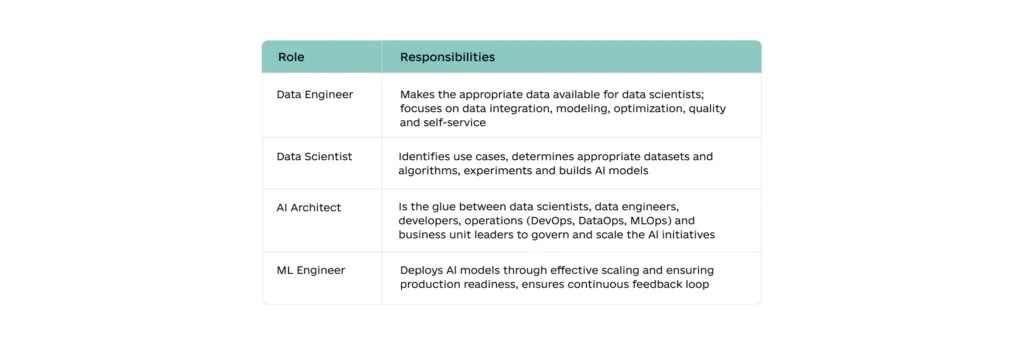
Source: Gartner
Because data is central to AI development, you’ll need to have sufficient talent for data management tasks, namely data analysts and data engineers. These people will be responsible for:
- Building data pipelines, architectures, and infrastructure for your AI projects
- Datasets generation, validation, and management, using real-world or synthetic data
- Optimization of the data engineering workflows and data annotation strategies.
You’ll also need a “task force” of data scientists and machine learning engineers, who’ll be responsible for the development of custom algorithms and data science models. ML engineers also handle a lot of operational tasks including AI model deployment, performance monitoring, and fine-tuning; model testing, debugging, and version control management.
Most AI teams also require auxiliary roles, namely in the project management office (PMO) — product owner or project manager. In addition, you will likely need to involve several software engineers (front-end and back-end) plus a UX designer to “package” the developed model into a ready-to-use software product.
Likewise, your AI engineers will likely need access to business domain experts and IT infrastructure experts to successfully deliver the planned AI initiatives.

3. Decide on the Talent Sourcing Strategy
With 80% of business leaders thinking that automation technologies can be applied to any business function, the race for AI talent is hot.
According to McKinsey, the talent crunch is particularly pronounced for tech trends such as cloud computing and industrializing machine learning, with the current talent availability ration being 20 skilled people for 10 job postings for “machine learning” and just 10 skilled candidates for 10 job posts for “PyTorch”.
On the brighter side, business leaders now have more strategies to find the AI talent they need, namely:
- In-house talent upskilling
- Joint ventures with technology firms
- Software development partnerships
The latter option appears to be the most preferred one with 76% of global executives now having IT services (including AI development services), delivered via third-party collaboration.
Software development partners can help assemble a dedicated team for your AI project by proposing candidates from their internal talent pool, including proven vendors like 8allocate recognized among top AI development companies. In the case of 8allocate, we also support our partners on the project management side — help with product backlog prioritization, Sprint planning, team management, and ongoing mentorship.
Learn how to find AI talent to cast a wider net to capture the best engineering talent.
4. Evaluate Current Data Infrastructure
AI models require a high volume and velocity of data for training and validation. One of the first problems many companies run into with AI software development is data issues — poor data quality, siloed storage, expensive data transformation, costly labeling, etc.
As a general rule, the amount of training data required for an AI model should be 10 times the number of used parameters. More advanced algorithms like supervised deep learning for image classification may require up to 5,000 labeled examples per training category. The costs of producing datasets for a selected use case can become exorbitant.
Insufficient data can’t be compensated by tweaking the math behind the algorithm, noted Aaron Edell, director of applied AI at Veritone. It’s good, clean training data sets that make a difference. Having an effective data acquisition and management strategy is therefore critical for successful AI deployments.
The data infrastructure your AI engineering team will need includes:
- Data lakes and data warehouses
- Database management systems
- Scalable data pipelines
- Metadata storage and management platforms
- Data annotation tools and frameworks
- Model testing platforms
- Model monitoring solutions
You will need to if your available company infrastructure can handle it without disrupting the core processes. If not, you may have to acquire additional storage, computing, and network capacities to give your project a solid foundation to run on. Consider shifting to the cloud if your budget doesn’t allow you to buy additional hardware. Or go for a hybrid cloud model and move at least part of your operations to the cloud.
5. Set Up Your MLOps Cycle
Software engineering best practices like CI/CD help teams deliver new code with high confidence levels and at cruising speeds.
MLOps, short for machine learning operations, aims to bring the same degree of performance and predictability into machine learning model development through process standardization and automation.
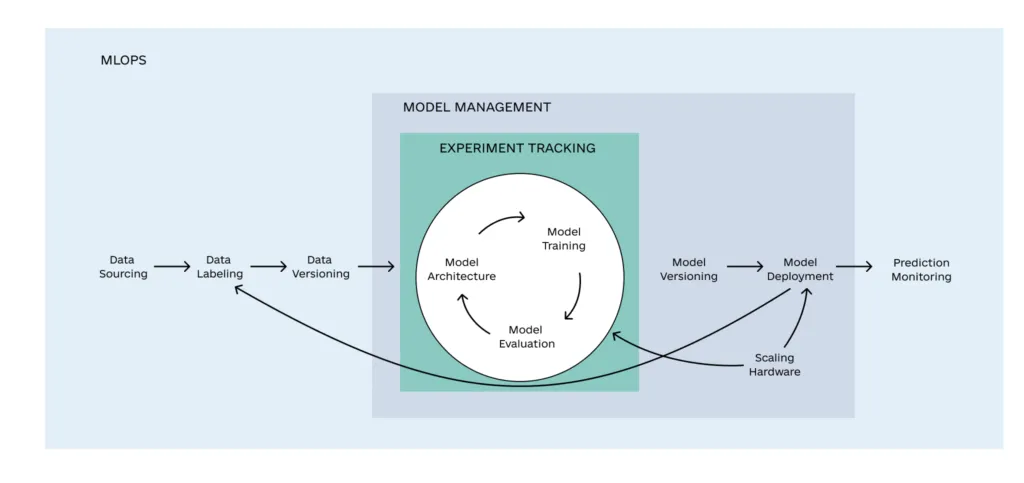
Source: Neptune
Similar to DevOps for software products, MLOps methodology promotes the creation of a unified release process for new models: from data gathering to successful model deployment and ongoing performance monitoring.
The objective of an MLOps team is to progressively automate different workflow steps in the model development process — model training and re-training, ML model testing, model component builds, and deployments. Other focus areas include improving data versioning, results reproducibility, workflow orchestration, continuous model training, and collaboration between the teams.
A mature MLOps process helps AI development teams develop and deploy new models into production faster and with fewer errors, plus implement faster patching and feature updates.
6. Determine How You Will Measure Impact
Most leaders expect AI to start adding immediate value to their organization. But more times than not, the exact ROI is hard to quantify, especially for one-off, proof of concept (PoC) deployments.
The lack of justifiable ROI often results from a poorly scoped initial business case. When planning an AI software development project, you should think about the downstream business metrics that ML models and that impact can be quantified. For example, you may want to track business metrics such as:
- Number of business processes (or business process steps) automated and the impact of automation on staff performance and/or productivity
- Increases in customer satisfaction levels, attributable to using AI-powered self-service tools.
- Direct revenue affected and/or generated by the new ML solution.
Gartner also encourages leaders to start with AI use cases that have already proven to drive value such as:
- Price optimization
- Lead scoring
- Demand generation
From our side, we can also add a couple of proven AI use cases from FinTech such as fraud detection, personal finance management, and next-best-action recommendations in wealth management.
In addition to business metrics, you should also set and track the following technical model metrics:
For classification models:
- Accuracy
- Precision
- Recall
- AUC
For regression models:
- Root mean squared error
- Adjusted R2
- Mean absolute error
For deep learning models:
- Perplexity, cosine similarity, Jaccard similarity, BLEU (Natural Language Processing)
- Word Error Rate (speech recognition)
- Intersection Over Union, Average Precision, Mean average precision (computer vision)
These metrics help you ensure model validity and value, plus any deviations in these also help identify model drift at the onset.
Final Thoughts
Going forward, the value generated by AI will increase exponentially. By 2032, the global AI market will increase to $2,5 trillion — and your company can be part of this growth. You now know what’s required for successful AI software development and 8allocate would be delighted to help you with that.
Our AI, ML, and data science teams help global businesses identify the best technology use cases, shape the product development roadmap, and successfully deploy new models. From high-concurrency and low-latency data management infrastructure to sophisticated algorithms for computer vision and natural language processing (NLP), we’re helping usher the new era of AI-powered operations. Contact us for a personalized intro to our service models.
Frequently Asked Questions
Quick Guide to Common Questions
What are the key steps to building a high-performing AI development team?
To build an effective AI development team, businesses must:
- Formalize a strong business case to ensure AI is the right solution for their problem.
- Define the right team structure, including ML engineers, data scientists, and MLOps specialists.
- Choose a talent sourcing strategy, balancing in-house hiring, upskilling, and external partnerships.
- Evaluate data infrastructure to support AI model training and deployment.
- Establish an MLOps framework for scalable, repeatable AI development.
- Define key success metrics to measure AI project impact and performance.
What are the essential roles of an AI development team?
An AI software development team typically includes:
- Data Scientists – Develop and fine-tune AI models.
- Machine Learning Engineers – Implement, optimize, and deploy AI models.
- MLOps Engineers – Manage automation, monitoring, and infrastructure for AI pipelines.
- Data Engineers – Build and maintain data pipelines and storage solutions.
- Software Developers – Integrate AI models into applications.
- Project Managers & Product Owners – Align AI development with business goals.
- Having domain experts, UX designers, and IT infrastructure specialists can also be valuable.
Why is MLOps critical for AI project success?
MLOps (Machine Learning Operations) standardizes AI development, ensuring:
- Faster AI model deployment and iteration.
- Better model monitoring and automated retraining.
- Reduced errors and improved reproducibility of AI experiments.
- Efficient collaboration between AI engineers, DevOps, and data teams.
A mature MLOps framework helps companies integrate AI into production smoothly and scale it across operations.