
There’s a new buzzy job in tech right now: the forward-deployed engineer, or FDE. Everyone’s talking about it but few can say what the role actually is, or how it’s different from an AI engineer.
As a company that helps businesses hire forward-deployed AI engineers, we couldn’t stay out of the conversation. Based on what we see in the market and across client projects, companies increasingly need engineers who can connect AI systems directly to measurable business outcomes.
In this article, we’ll explain what a forward-deployed AI engineer does, how this role differs from a regular AI engineer, and when it makes sense to hire a forward-deployed engineer.
TL;DR: What Is a Forward-Deployed AI Engineer
- An FDE is an engineer who works right inside the business, not tucked away in the IT department. A forward-deployed AI engineer understands the technical side of AI and the strategic business goals equally well. Their role is to ensure AI doesn’t just “sit in the company,” but drives real returns.
- The boom for forward-deployed engineers is happening now because of three shifts at once: AI tools got easy to access but business value stayed hard, AI coding agents made one strong engineer far more productive, and companies need someone who builds and launches AI, not just advises.
- Both AI engineers and forward-deployed AI engineers build AI-powered systems. The difference is that an FDE goes further: they make sure the system fits the business context, integrates into real workflows, and works reliably in live operations, not just in a prototype.
- You may need a forward-deployed AI engineer when: you use AI tools, but nothing really changes, your AI needs to work with legacy systems, uncontrolled AI usage, you need to safely scale AI across the operations and departments.
- Strong forward-deployed AI engineers combine software engineering depth, practical AI literacy, business translation, critical thinking, and the courage to push back when a requested AI solution doesn’t make sense.
What Is a Forward-Deployed AI Engineer?
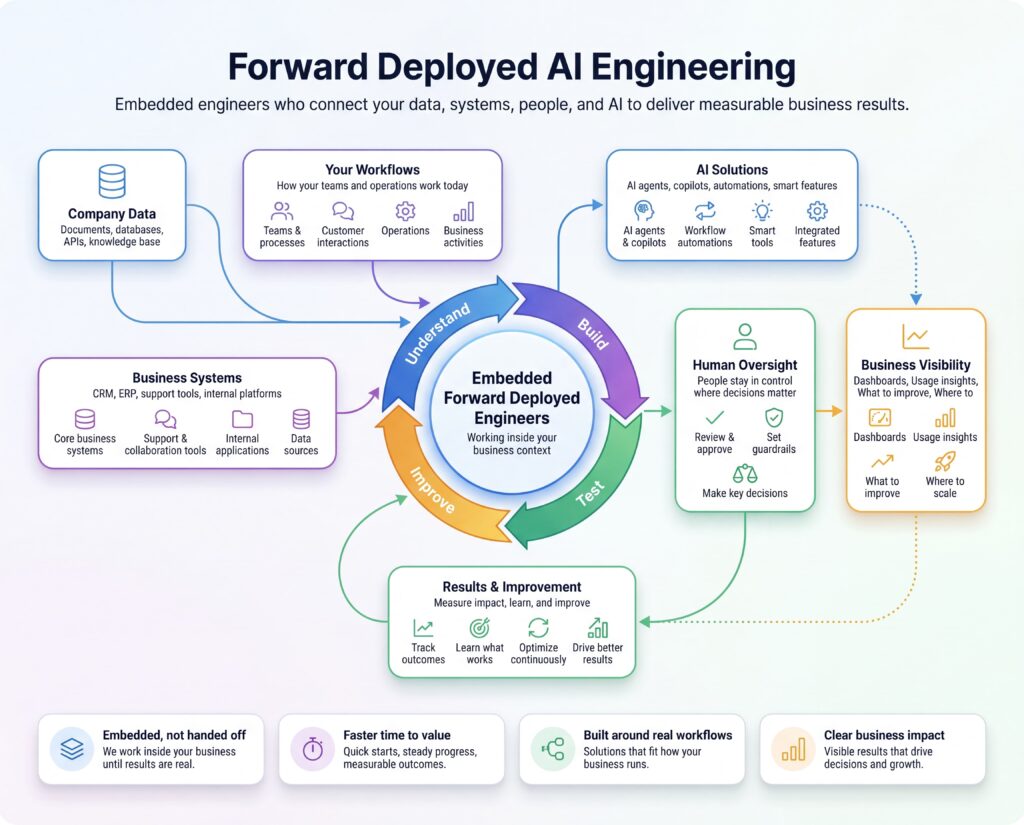
A forward-deployed AI engineer is a hands-on engineer who works right inside your business ( in marketing, in product), not tucked away in the IT department. They don’t only build AI components. Forward-deployed AI engineers understand how your business runs, help shape the right AI solution, and make sure AI works with real users, workflows, data, tools, business rules, and compliance requirements.
FDEs usually show up in one of two scenarios:
- Building a custom AI solution. When you want an AI solution built from scratch, you need someone who can connect that new solution to your business context, data, legacy systems, and compliance requirements.
- Adapting existing AI to real workflows. You already use an off-the-shelf AI tool, model, or platform, and you need help fitting it to your real workflows, users, data, and compliance rules.
In both cases, a forward-deployed AI engineer helps AI survive contact with the real business. They handle the messy last mile: integrations, workflow gaps, legacy systems, user adoption, data quality, and the production issues that decide whether AI becomes useful or stays a demo.
Here’s how that looks in practice. For a mid-sized energy company, 8allocate embedded a forward-deployed AI engineer alongside the client’s business teams. The company already had AI activity — around 70 employees were using mostly public LLMs, while many others weren’t using AI at all. The problem was control, ownership, and practical adoption.
Our FDE mapped how each department was actually using AI, where shadow AI created risk, which workflows were ready for AI support, and what governance had to come first. From there, our team built the operating layer around it: AI Use, MCP, and Agent/Skill policies, GitOps screening, department-level AI workbenches, prompts, templates, and handover docs.
That’s the role in practice: FDE worked inside the client’s reality and made AI safe, useful, and owned by the business. So when you choose an AI development partner, check whether they offer a forward-deployed AI engineering model. It’s a strong signal that the AI partner can build a custom AI solution and prepare it to function in production.
Why the Sudden Popularity of “Forward-Deployed AI Engineer” Again?
Forward-deployed AI engineers are becoming critical right now for three reasons:
- AI transformation is urgent. Businesses need real answers, fast: how do we analyze finance, risk, marketing, and sales more effectively with AI?
- The “wrapper” era is ending. Instead of bolting on another chatbot, companies need AI built into their operational processes, and even into how they hire.
- Change is moving faster than ever. The traditional, linear career path is fading, and companies need generalists who can adapt tools to new needs on the fly.
But what do we see on the ground? Plenty of companies already “have AI”: ChatGPT, Copilot, a few pilots, an automation experiment or two. But ask your colleagues, business partners, or peers what changed, and you’ll often hear something like this:
- We have AI, but nothing really changed
- We can’t control how our people use these copilots, or what data goes into them.
- We’ve got pilots running but we’re not sure they’d survive a compliance review.
Meanwhile, the core workflows stay fragmented. Data is scattered across tools nobody fully maps. Security risk quietly grows. The AI is technically there but it’s just not doing its job.
Now let’s look at the market, because the numbers tell the same story from a different angle.
- Gartner expects worldwide AI spending to reach $2.59 trillion in 2026, up 47% from 2025
- McKinsey found that 88% of organizations now use AI, yet only 39% can tie any impact to enterprise-level EBIT, and for most of them it’s under 5%.
- S&P Global reports that the share of companies abandoning most of their AI initiatives jumped from 17% to 42% in a single year, with projects dying between proof-of-concept and production.
So, what do we see? Money is available, technology is available, and AI is more accessible than ever. But businesses keep hitting a wall when it comes to the AI-powered transformation many of you dream about. Why? Because AI has to work in the operational world with real users, data, and processes. That’s why a forward-deployed AI engineer role gains popularity again. A forward-deployed AI engineer is the person standing right at that collision point, where AI meets the real production environment.
Have AI but the work still feels the same? Read our guide on “AI Adoption Strategy: How to Prepare Your Company for a New Way of Working”
Forward-Deployed AI Engineer vs AI Engineer
AI engineers can build an AI chatbot, RAG system, AI agent, model integration, or automation workflow. While, a forward-deployed AI engineer goes one step closer to the business. They need to understand how the support team works, which cases are exceptions, what data the AI can use, which answers may create risk, when the agent should escalate to a human, and how the workflow should fit into existing tools.
Put simply: AI engineers build AI systems. Forward-deployed AI engineers make sure those systems work inside real business operations.
For example, you want to build a custom AI support agent. One or two AI/software engineers can build the technical system: RAG, backend logic, integrations, testing, and deployment. But you may also need one forward-deployed AI engineer to work with your support team, map real ticket flows, define escalation rules, check risky answer types, understand CRM limitations, and make sure the agent fits how the support department actually works.
Without that role, you may end up with a technically good AI agent that fails in daily operations. With a forward-deployed AI engineer, you reduce that risk because someone owns the messy business layer between the AI system and the real workflow.
Here’s the practical difference between forward-deployed AI engineer vs AI engineer.
| Criteria | AI Engineer | Forward-Deployed AI Engineer |
| Main focus | Builds AI components, agents, RAG systems, APIs, and automation logic. | Makes AI work inside a real business workflow, with real users, data, tools, and constraints. |
| Starting point | Usually starts from a defined technical task. | Often starts from an unclear business problem, messy workflow, or stalled AI pilot. |
| Business context | Uses context provided by product managers, analysts, or stakeholders. | Works directly with business teams to understand how the process actually works. |
| Typical work | Builds prompts, retrieval logic, model integrations, agent flows, evals, and backend AI logic. | Maps workflows, shapes the AI use case, handles painful integrations, tests with users, and helps productionize the solution. |
| User interaction | May not work directly with end users. | Often works with founders, operators, support teams, sales teams, analysts, or department leads. |
| Integrations | Builds integrations when the requirements are already clear. | Works through the messy last mile: CRM gaps, legacy tools, permissions, data quality, approvals, and human-in-the-loop flows. |
| Requirements | Works best when the task is clear and scoped. | Adds the most value when the business need is real, but the right AI solution is not fully clear yet. |
| Production role | Makes the AI component technically work. | Makes sure the AI system can be used safely and reliably in daily operations. |
| Team setup | Can work as part of a small AI/product engineering team. | Can build the first workflow alone for small use cases, or work with 1-2 AI/software engineers on a larger custom solution. |
| Success metric | The AI feature works as designed. | The AI system creates business value and fits the workflow people use. |

When Do I Need a Forward-Deployed AI Engineer?
You need a forward-deployed AI engineer when AI is already present in your business, but it still doesn’t change how work gets done.
You have AI tools, but nothing really changed
Your team may already use ChatGPT, Copilot, AI note-takers, CRM AI features, or automation tools. But people still search documents manually, move data between spreadsheets, write reports by hand, or repeat the same operational decisions every week.
A forward-deployed AI engineer helps move AI from “nice to have” experiments into workflows that support real business outcomes.
At 8allocate, we saw this in one of our analytics projects. The client’s analysts already had dashboards and used different AI tools, but their work was still slow and scattered. Our forward-deployed AI engineer started with a Team AI Maturity Assessment: how analysts worked, where data came from, which steps were manual, and what had to change before adding more AI. The result was a clearer AI-supported workflow for data analysis.
AI has to work with messy workflows and legacy systems
If you work in logistics, finance, supply chain, operations, insurance, or another process-heavy industry, AI can’t just be dropped into the business. It needs to understand data flows, exceptions, approvals, risk signals, compliance rules, and operational dependencies.
A forward-deployed AI engineer helps translate those messy real-world workflows into an AI system that can actually support decisions or automate work safely.
Read also: AI Agents for Data Analysis in 2026: What They Are and How They Change BI
Shadow AI is becoming a risk
Your team may already use ChatGPT, Copilot, AI note-takers, browser extensions, CRM AI features, or automation tools. But leadership may not know what’s being used, what data is shared, which outputs are trusted, or where the risks are.
A forward-deployed AI engineer helps map current AI usage, identify risky workflows, define safer patterns, and move AI from scattered experiments to controlled, business-aligned adoption.
Your AI pilot needs to become a working system
The demo may look good, but production is where problems appear: messy data, user resistance, unclear ownership, broken integrations, edge cases, and compliance questions.
A forward-deployed AI engineer helps close that gap. They work through the practical delivery layer so the AI system can move from pilot to daily use.
Read also: Your AI-Built MVP Just Got Funded. Now, How to Scale a Vibe-Coded MVP?
Forward-Deployed AI Engineer Skills to Look For
A strong forward-deployed AI engineer isn’t just a good coder. The role takes a mix of engineering depth, AI literacy, business sense, and people skills. Here’s what to look for:
- Solid software engineering background. They can build, debug, and ship in real environments. Backend, data, infrastructure, or full-stack experience helps most because FDEs deal with unfamiliar systems, messy integrations, and shifting requirements.
- Practical AI literacy. They understand how LLMs, RAG, AI agents, evals, APIs, and data flows actually work. No need to train models from scratch but they know how to turn AI capabilities into real workflows and features.
- Business translation. This is the core skill. They turn fuzzy business needs into clear technical decisions, and keep founders, operators, product teams, and engineers all solving the same problem.
- Critical thinking. AI suggests options; it can’t always pick the right one for your context. A good FDE knows when to trust it, when to question it, and when a human call is still needed.
- Product and user thinking. They ask the right questions: who’ll use this, what workflow it supports, what happens if AI gets it wrong, and how success gets measured.
- Communication, curiosity, and courage. The best FDEs ask sharp questions, explain trade-offs clearly, and push back when a requested AI solution doesn’t make sense.
- Domain or startup experience. For scale-ups and SMBs, this is a real plus. They move fast, work lean, and bridge business and delivery solo. Domain knowledge in fintech AI, logistics, healthcare, or operations helps too.
Looking to set up an AI team? We’ve put together a guide on how to build and structure an AI development team.
The Bottom Line
Real value from AI doesn’t come from buying more tools, it comes from execution. The companies that win reshape how work gets done, get their data in order, and build the governance to support it.
That’s why forward-deployed AI engineers matter. Think of them as the conductors of practical AI delivery. They understand the business process, use AI systems and coding agents well, pull in engineers when needed, and make sure the final solution holds up in production. So if your AI is stuck somewhere between “we have it” and “it actually works,” that’s the gap an FDE closes.
At 8allocate, you can Hire Forward-Deployed AI Engineers as a part of our services to move your AI idea, pilot, or custom solution into real workflows and production-ready delivery. Get in touch, we’ll send you engineer CVs and rates matched to your project.
Still Got Questions on What Forward-Deployed AI Engineer Is?
Quick guide to common questions
Why hire forward-deployed AI engineers instead of regular AI engineers?
Hire regular AI engineers when you already know what needs to be built and only need technical AI execution. Hire forward-deployed AI engineers when the challenge is bigger: you need AI to fit your business process, work with your existing systems, support real users, and create measurable value.
What is the hourly rate of forward-deployed AI engineers?
The hourly rate depends on seniority, domain expertise, location, engagement model, and whether you need one engineer or a managed AI pod. In general, forward-deployed AI engineers cost more than standard software engineers because they combine AI engineering with product thinking, business analysis, and production delivery experience.
What does a forward-deployed engineer actually do?
A forward-deployed engineer (FDE) works directly with the customer’s team and operating environment to make AI work in the real world. For example, if you want to use AI for document processing, FDE checks how documents move through your business today: where the data lives, what needs to be extracted, which systems need that data, where human review is required, and what can go wrong if AI makes a mistake. Then they help design the right workflow for AI.
Can one forward-deployed AI engineer build the whole AI solution?
Sometimes, yes, one forward-deployed AI engineer can build the whole AI solution – but if the use case is focused and not too complex. For example, one FDE may build or adapt the first AI workflow for support, analytics, internal search, or document processing. But for larger custom AI systems like AI for logistics, fintech, manufacturing, or regulated environments, the FDE usually works with AI engineers, data engineers, backend developers, or solution architects.