Over the years, we’ve seen a significant reduction in software interaction complexity. What once required navigating complex command lines can now be achieved through simple clicks, taps, or even voice commands. This evolution has set the stage for conversational AI, supported by conversational AI and agent development services, a technology that goes beyond early chatbots to enable more natural, human-like interactions.
Learn how conversational AI differs from early chatbots and how leading companies now embed AI assistants into their workflows.
What is Conversational AI?
Conversational artificial intelligence (AI) is a collection of technologies that enable software to interpret and respond to text-based or voice-based inputs in a human-like manner.
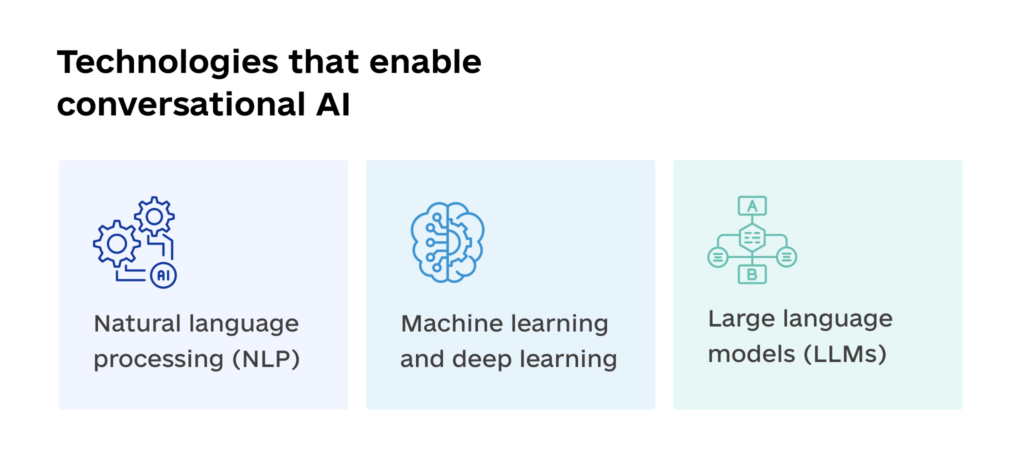
Thanks to advances in natural language processing (NLP), a subset of machine learning, focused on linguistics interpretation, modern algorithms can better understand the syntactic and semantics of the languages. Later came large language models (LLMs) — algorithms pre-trained on a larger corpus of data using new deep learning techniques.
How Conversational AI Differs from Machine Learning Chatbots
First, there was Siri and Alexa. Now it’s ChatGPT and Gemini. So what has changed?
The first voice assistants were mostly speech-to-text engines — machine learning systems trained to detect language patterns, cross-correlate words, and retrieve a response from a knowledge database. Such engines could perform tasks like translation, call summarization, or voice command recognition with moderate accuracy.
Text-based assistants (aka chatbots) were programmed to parse sentence structure, understand word relationships, and generate language outputs. Machine learning techniques like probabilistic context-free grammars (PCFGs) and sequence-to-sequence (Seq2Seq) models made coherent conversations possible.
By the end of 2014, over 34,000 chatbots actively assisted businesses with customer support, marketing, and sales. However, the first chatbots were only mildly helpful and somewhat frustrating. In 2018, the majority of chatbot users found customer service chatbots to be “not effective” or only “somewhat effective.”
By 2021, Gartner moved chatbots to the ‘trough of the disillusionment stage’ on its Hype Cycle for Artificial Intelligence. Only to place generative AI and foundation models atop of the ‘peak of inflated expectations’ two years later in 2023.

Source: Gartner
A few important things happened during this period. In 2017, a research team at Google Brain (now Google Deepmind) introduced the first transformer model — an NLP model, based on a novel deep learning technique, with self-attention mechanisms enabling better language interpretation.
A year later, Google also introduced BERT — a bidirectional encoder representation from the transformers model, trained on about 3.3 billion words. It was the first LLM. Apart from superior performance on general language tasks, BERT could be fine-tuned for specific tasks like sentiment analysis. OpenAI published its paper, introducing a new architecture for better language processing — the Generative Pre-trained Transformer (GPT).
Advances in deep learning, coupled with innovative NLP techniques in word representations like Stanford’s GloVe (Global Vectors for Word Representation) and Google’s Word2vec paved the way for much more robust conversational systems.
Unlike early machine learning algorithms, LLMs interpret the semantic distance between words to understand their relationships. Word embeddings provide the language knowledge LLMs use.
The next major breakthrough was the retrieval augmented generation (RAG) technique, developed by the Meta AI team. RAG enables an LLM to retrieve data from a connected external source for more contextually relevant responses. With RAG, a general-purpose large language model like BERT or GPT, with strong language processing capabilities, can be fine-tuned to generate responses based on a specific knowledge base (e.g., customer support documents).
Fine-tuning involves training an exciting model on a curated dataset to better handle a specific query while preserving the knowledge it gained during initial training. It’s much faster and less resource-intensive than training a language model from the ground up.
6 Viable Use Cases of Conversational AI
What first chatbots started, conversational AI systems now continue with more gusto. Conversational AI technologies power agents that can accurately interpret text and voice commands, synthesize information, and exhibit logical reasoning.
The algorithm’s ability to perform cognitive work can bring major operational efficiency. The optimistic forecasts state that global labor productivity can grow by 0.1 to 0.6 percent annually through 2040. And in some cases, Gen AI can boost workers’ performance on skilled tasks by as much as 40%. Although the data needs to be taken with a pinch of salt.
As we discussed in our post about generative AI trends, these systems can streamline semi-structured tasks that traditionally require human cognitive skills: data look-up, synthesis, and analysis. However, there are also tangible limits to their capabilities. Even the best LLMs fail in common sense reasoning tasks, lose context in lengthy conversations, and lack creativity.
Still, we believe there are at least six domains where conversational AI can give businesses a major edge.
Customer Service Agents
Customer service traditionally has high operating budgets and low attributable ROI. This is mostly because the teams focus on reactive issue resolution rather than proactive customer care and engagement.
That’s changing thanks to technology. Top organizations now rely on a combination of self-service solutions with conversational UX and back-office AI systems for automatic issue resolution. High self-service maturity means handling 70%-80% of customer interactions without human involvement, with agents remaining on standby to take over more complex cases.
Gecko Hospitality is one of the companies that reached 90% customer service automation. The hospitality recruitment agency created an automatic system for sorting incoming resumes and transferring the best candidates to the recruiter in charge. By eliminating manual reviews, Gecko dramatically reduces application response time. A conversational AI system, in turn, answers all applicants’ questions, including tips on how to use the job board, where to send resumes, and how soon to expect a reply.
At the same time, conversational systems can provide real-time support to human agents. Thanks to RAG, models can be tuned to provide answers, based on company documents, supplying relevant replies to your staff. According to Cresta, 65% of service agents want real-time AI assistance during their customer interactions
Implementing conversational AI systems has become easier too as pre-trained foundational models can be now accessed via an API. Amazon recently launched Transcribe Call Analytics — a generative AI-powered API for call summarization, transcription, and sentiment analysis. Azure OpenAI Service, in turn, provides managed access to a choice of high-performing foundation models. Our team can help with solution implementation.
Workplace Assistants
Arguably, the best use case of conversational AI is knowledge management. Thanks to advanced NLP capabilities, conversational AI agents can perform quick text analysis, summarization, and sentiment analysis. Thanks to RAG, agents can generate highly relevant responses using data from a connected corporate database.
With conversational AI, you can automate a range of administrative tasks ranging from document reviews and form validations to report generation and data analytics. For example:
- Sales analytics. Empower your teams to analyze data from a CRM or ERP via a conversational interface rather than complex data querying commands.
- Market intelligence. By combining textual and numerical data, agents can help your teams identify nascent trends and potential growth opportunities.
- Due diligence. Agents can help better identify risks, inconsistencies, and critical insights that leaders need to know to make better deals.
EY deployed a conversational AI system to support its global workforce of 400,000. Nicknamed EYQ, the system uses a combination of multimodal systems and fine-tuned small language models (SLMs). EY used RAG to train the system on a specific corpus of corporate documents and data sets to support designated use cases. The gains so far include a 15% to 20% uplift in productivity across the board.
Canadian RBC Wealth Management, in turn, focused on bringing extra efficiencies to its customer relationship management (CRM) processes. By adding AI to its Salesforce deployment, the team enabled greater visibility into employee and branch performance, as well as automated some mundane tasks. Previously, the managers needed to reference up to 26 different systems, extending meeting prep time to 3-4 hours, the team shared. Now all key insights are easily accessible through one interface.
Thanks to an integration with Slack AI, RBC Wealth Management’s advisors can also get automatic document summarizations, based on the client channel insights. The agent also provides quick answers about client management using data from existing messages.
Learning Assistance
Conversational AI is one of the hottest technology trends in EdTech, and for a good reason, as shown in comparisons like AI tutor vs simple chatbot, where algorithms are driving better student outcomes. Voice-based systems can provide accurate feedback on spoken texts, detailed explanations on text assignments, and personalized assistance with breaking down complex concepts.
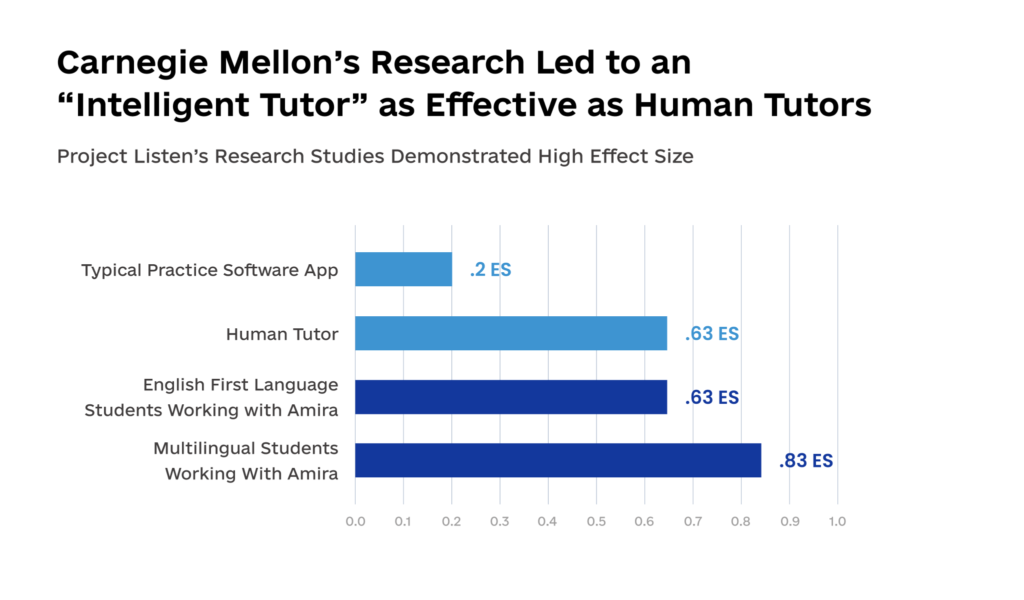
Amira Learning, developed an intelligent reading tutoring assistant that combines speech recognition and artificial intelligence with the science of reading. The app delivers personalized in-the-moment feedback as students read out texts, correcting annunciations and mistakes. Several independent studies confirmed that students who use Amira for at least 10 minutes a day learn to read at a 2X faster rate than the US national average.
Source: Amira Learnings
Language tutoring app Loora, in turn, leverages conversational AI to teach English to students. The app provides real-time voice feedback on grammar, pronunciation, and accent, and — if users get stuck — a direct translation in their native language.
Conversational AI is also making inroads into corporate learning and development (L&D), assisting in employee onboarding and professional development through personalized learning paths. 5Mins.ai developed a corporate micro-learning platform that matches learners with available content, based on the skills pre-assessment and gamifies the learning experience through chatting.
Generally, Morgan Stanley expects generative AI to bring $200 billion in value to the global education sector by 2025 through improvements in learning outcomes, reduction of administrative work, and increased human interaction. For EdTech companies, this can translate to higher revenue and lower operating costs.
Sales Support
Sales teams need to stay abreast of multiple conversations, have easy access to all prospects’ data, and be closely in sync with other departments to deliver the best outcomes. Conversational AI can help improve these data flows and democratize access to analytics. Pre-trained models have already shown great results with tasks like customer journey mapping, sales forecasting, and commercial proposal reviews among others.
Iron Mountain recently integrated Conversica conversational AI tools into its marketing automation platform to streamline customer engagement. The sales teams use digital assistants at the early stages of the conversation to pre-qualify prospects and connect them with the right person. The tool can distill the website visitor intent, based on the conversation and route a prospective lead to relevant conversation tracts, based on the generated intent scoring, persona identification, and product interest.
Here’s another example: One Asian bank implemented an AI-powered conversational assistant to enhance its product discovery process, similar to real-world use cases of AI chatbots in fintech. The assistant was pre-trained on over 2,500 product collateral documents and integrated into the bank’s website. As a result, it achieved a 99% precision rate and a 95% recall rate, delivering personalized product recommendations to the bank’s 12 million customers around the clock.
Product Marketing
With better language chops, conversational AI agents can also take over a wide range of inbound marketing tasks: Product recommendations, upsells, sizing assistance, and lead nurturing. They can perform the role of sales associates in digital storefronts.
IKEA recently launched a Gen AI assistant in the OpenAI GPT Store, which can help shoppers brainstorm remodeling projects and find the best company products. For example, the tool can generate “cozy living room layouts for a small kitchen” or “suggest the best products for a kid’s bedroom remodel” from the IKEA catalog, with data on availability across different locations.
Conversational product marketing experience can be particularly helpful in B2B ecommerce — a growing market of $2.641 trillion with more complex purchase journeys. Pre-trained agents can help shoppers compare product specs and configurations, provide price quotes for wholesale orders, give information on warranties, and complete a wide range of other tasks, which previously required a phone conversation with a human associate.
For instance, Adobe Journey Optimizer (AJO) B2B Edition recently added conversational AI to its suite of advanced marketing technologies to help businesses:
- Create buying groups and align them with the company’s product portfolio, based on data from the entire customer lifecycle. Gen Al features provide recommendations on buying group roles and member assignments.
- Orchestrate personalized journeys across channels (email, web, chat, etc) to create a higher-performing sales funnel. The on-platform AI assistant provides relevant tips and data as they build these customer journeys.
Conversational AI solves two major problems for B2B markers: it enriches digital interactions and streamlines internal workflows, removing frictions in revenue enablement.
IT Assistants
Gen AI developer tools are a hot software engineering trend, with adoption rates continuing to soar. A May 2024 survey on Stack Overflow found that three-quarters of software developers are either already using or planning to use AI code assistants. Gartner expects that 75% of software engineers will use AI coding assistants by 2028 — a big boost from less than 10% of enterprises in 2023.
From our experience, coding copilots can produce decent boilerplate code, when pre-trained on the corporate codebase. But there are some inherent limitations too. The code quality can vary a lot between programming languages, and assistants often fail at refactoring tasks. Where algorithms help a lot is code reviews. Duolingo saw a 67% decrease in median code review turnaround time after adopting Gitlab Copilot.
Beyond software engineering, conversational AI assistants can add value to other IT processes. For example, security alerts and case investigations in cybersecurity. The majority of security specialists need to investigate over ten daily alerts, of which 50% end up being false positives. Low-fidelity data, paired with an alert overload, eventually leads to mistakes. Conversational AI systems can help with alert prioritization and investigation.
IBM recently added a gen AI assistant to its Threat Detection and Response (TDR) platform. The assistant analyzes historical patterns in threat activity and provides the security analysts with prompts for case investigation and issue remediation. The tool has already helped one of the IBM clients reduce alert investigation times by 48%.
Conversational AI can also copilot infrastructure management teams in their day-to-day work. Instead of switching screens and analytics tabs to cross-check configurations, engineers can get the latest data and recommendations from a chat interface. BMW Group recently deployed a Gen AI assistant to support its DevOps team. The tool provides real-time insights about the company’s AWS infrastructure, recommendations for resource optimization, and tips for cost-saving measures.
Conclusion
Greater cloud computing capacities and advances in deep learning turned marginally useful chatbots into versatile conversational assistants. And we’re just at the cusp of exploring the full potential of conversational AI systems, with many market use cases remaining untapped.
8allocate AI team would be delighted to introduce you to the new model training and fine-tuning techniques and explain their capabilities for your business. Contact us to learn how you can gain extra operating efficiencies, enable new revenue channels, and gain a competitive edge through custom conversational AI solution development.

Frequently Asked Questions
Quick Guide to Common Questions
What is Conversational AI?
Conversational AI is a technology that enables machines to interact with users in a natural, human-like manner using text or voice inputs. It combines natural language processing (NLP), machine learning, and deep learning models to understand and generate responses in real time.
How does Conversational AI differ from traditional chatbots?
Early chatbots relied on predefined rule-based responses and pattern recognition, while Conversational AI leverages large language models (LLMs) and deep learning to interpret language, maintain context, and generate more dynamic, context-aware responses. Unlike traditional chatbots, Conversational AI can retrieve and synthesize information from external sources using retrieval-augmented generation (RAG).
What are the main components of Conversational AI?
Conversational AI systems typically consist of:
- Natural Language Understanding (NLU) – Interprets user intent and extracts meaning.
- Natural Language Generation (NLG) – Produces human-like responses.
- Machine Learning Models – Continuously improve responses based on new data.
- Dialogue Management – Maintains context and flow in conversations.
What industries benefit most from Conversational AI?
Conversational AI is widely adopted in industries like customer service, healthcare, education, finance, IT support, and sales. It enhances efficiency by automating responses, personalizing interactions, and assisting employees in various tasks.
How is Conversational AI improving customer service?
Conversational AI enables businesses to automate up to 70%-80% of customer interactions through AI-driven chatbots, reducing costs while improving response times and customer satisfaction. It also supports human agents by providing real-time assistance and relevant knowledge retrieval.
What role does Conversational AI play in education and training?
AI-driven assistants enhance learning by providing real-time tutoring, personalized feedback, and automated assessments. Applications like Amira Learning and Loora offer speech recognition and conversational tutoring to improve reading and language skills.
What are the challenges of implementing Conversational AI?
Challenges include:
- Maintaining accuracy and reducing inaccuracies in responses
- Ensuring security and data privacy in AI interactions
- Managing high computational costs for real-time processing
- Integrating AI systems with existing enterprise workflows
What advancements are driving Conversational AI’s growth?
Key advancements include:
- Transformer models like GPT and BERT improve language understanding.
- RAG (Retrieval-Augmented Generation) for retrieving real-time information.
- Multimodal AI combines text, voice, and images for richer interactions.
How can businesses implement Conversational AI effectively?
Businesses should start by identifying key automation opportunities, selecting the right AI model, fine-tuning it with industry-specific data, and ensuring smooth integration with existing systems. Expert AI partners like 8allocate can help tailor solutions for optimal impact.