Modern SIS LMS integration has become a strategic imperative for universities. Campus operations falter when student information systems (SIS), learning management systems (LMS), and HR systems (HRIS) run in silos. To stay efficient and AI-ready, institutions need SIS and LMS integration for EdTech that unifies data without ripping out core systems. Below, we explore why unification matters, how an integration-first architecture works, ways to establish trusted metrics, and steps for a secure, quick integration pilot.
Why Operations Fail Without Unification
Higher education runs on a patchwork of applications. Many universities use hundreds of software systems across departments. Admissions, academics, HR, and finance often each have their own databases. The result? Data silos that hinder informed decisions and efficiency. When SIS, LMS, and HR data don’t talk, administrators can’t get a complete picture of operations. Decision-makers lack a holistic view of enrollment, performance, and resource needs, making planning difficult. Staff end up manually exporting and reconciling data from multiple systems, wasting time and introducing errors. For example, admissions teams often report spending full workdays manually re-entering data before integration.
Fragmented data also hurts the student experience. Students must often re-submit information to different offices, or get inconsistent answers when data isn’t in sync. A registrar’s records might not reflect a course drop reported in the LMS, leading to billing mistakes or advising errors. These silos frustrate students and staff alike. They also impede institutional outcomes: identifying at-risk students or improving retention is hard when academic performance data (in the LMS) is isolated from advising notes or attendance (in the SIS).
Finally, siloed systems make analytics and AI nearly impossible. Modern universities want to apply predictive models for student success and automate processes. But without unified data, they lack the insight needed to deploy such initiatives. In short, operations suffer delays, extra labor, and blind spots when campus data is not unified.
SIS LMS Integration Architecture: Don’t Rip-and-Replace
Replacing a legacy SIS or LMS with a single new platform sounds tempting but is rarely feasible. Rip-and-replace projects are expensive and high-risk, often exceeding budgets and disrupting operations. Instead, successful institutions adopt an integration-first architecture: keep existing systems of record and connect them via interfaces, APIs, and middleware. This approach layers new capabilities on top of stable core systems, avoiding the cost and risk of a wholesale replacement.
Most modern campus systems offer integration hooks. For example, many LMS and SIS support open standards for data exchange. IMS Global’s OneRoster is a widely-used standard for securely sharing roster, course, and grade data between an SIS and other systems (like an LMS). With OneRoster, a university can auto-sync class lists and grades from the LMS back to the SIS without custom code. Similarly, the Learning Tools Interoperability (LTI) standard allows an LMS to seamlessly integrate third-party learning apps and share student context with them. Leveraging such standards means universities can extend functionality without replacing their LMS or SIS.
Most SIS/HR systems also provide REST APIs or integration modules to pull and push data. An integration-first strategy might use an iPaaS (integration platform as a service) or middleware layer to orchestrate data flows between the SIS, LMS, HRIS, and other apps (CRM, finance, etc.). This middleware handles transformations and ensures each system gets the data it needs in the right format. Crucially, it’s an open architecture approach: you preserve your core systems and simply bridge them. Gartner and EDUCAUSE often advocate this “best-of-breed, connected” strategy over monolithic ERPs.
Integration Standards and APIs
Using standard connectors greatly reduces integration time. As noted, OneRoster can automate exchange of enrollment and grade data between SIS and LMS, eliminating manual CSV imports. LTI integration allows, for example, an LMS like Canvas or Moodle to embed an external tool (e.g. a plagiarism checker or AI tutor) with single sign-on and data pass-back. Many major LMS and SIS come certified for these standards, so hooking them together is more plug-and-play than custom development.
Beyond standards, institutions should leverage vendor-provided APIs. Leading SIS platforms (e.g. Ellucian Banner, PeopleSoft Campus) and LMS platforms have robust APIs to retrieve or update records. By using these instead of direct database access, you preserve vendor support and reduce breakage on upgrades. Custom connectors or scripts can call these APIs on a schedule (or real-time via webhooks) to synchronize data—such as updating the LMS when a student’s enrollment status changes in the SIS.
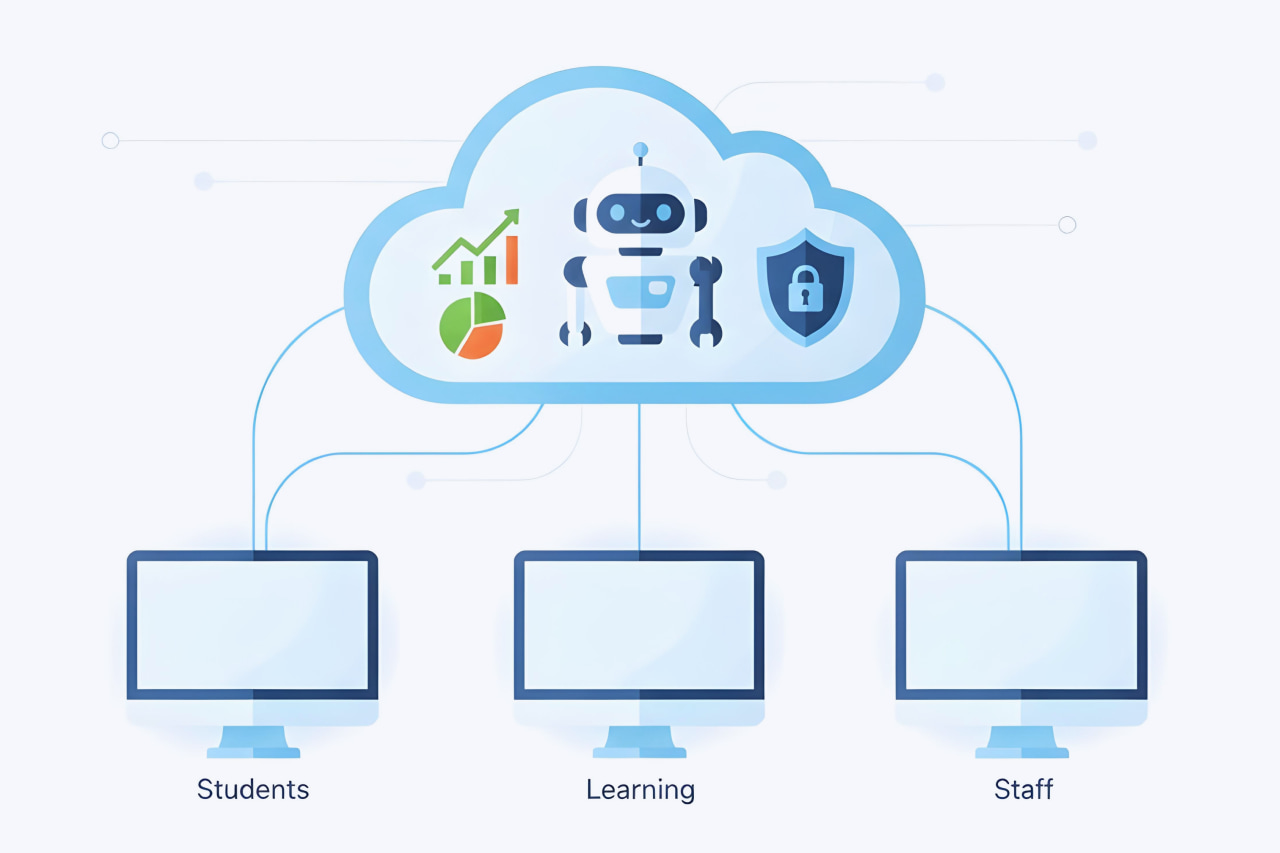
The key is to architect a data integration layer that sits between systems — the core focus of AI and ML implementation and integration services when connecting SIS, LMS, and adjacent platforms. This layer might be a cloud integration service, or even a data warehouse where all systems feed their data. The integration layer ensures that each source remains the authoritative system of record for its domain (e.g. SIS for student info, HRIS for personnel), but data is shared and unified for reporting and AI. By focusing on integration instead of replacement, universities modernize incrementally: you can add new analytics or workflow tools on top of existing systems, confident that they’ll have access to complete, up-to-date data.
Connectors & Trusted Metrics: Achieving SIS-LMS Integration
Creating integration connectors between campus systems establishes a single source of truth rather than just handling data plumbing. When SIS, LMS, and HR data streams converge, the institution gains trusted metrics that everyone can rely on.
For instance, instead of separate reports from each department with conflicting enrollment figures, integration yields one consolidated dashboard — the foundation for AI learning analytics dashboards that surface unified data to instructors and academic leaders. Decision-makers can trust that “total active students” or “average class size” means the same thing everywhere, because the metric is derived from unified data rather than isolated silos.
Without this, leaders often see conflicting numbers and lose confidence in reports. By contrast, an integrated data hub deduplicates and reconciles records, so a student or course has one consistent ID across systems. Data cleaning and master data management (MDM) processes in the integration layer eliminate discrepancies (e.g. a student name spelled differently in HRIS vs. SIS). The result is clean, accurate, and trustworthy data for analytics. Tamr’s higher-ed data study noted that breaking down silos produces “clean, accurate, and trustworthy student data” that unlocks better insights.
With connectors in place, universities can build a “trusted metrics” layer—often a data warehouse or business intelligence (BI) platform—that draws from all systems. This layer enforces common definitions: for example, what counts as an “active student” or how retention rate is calculated. Everyone from the COO to department chairs can then operate from the same numbers. One analytics provider describes how aligning records and automating data cleaning lets faculty and staff “work from the same trusted dataset” in real time. When data is integrated daily (or faster), reports and dashboards reflect the latest state, boosting agility.
Unified data also enables advanced analytics and AI that simply aren’t possible with siloed information. Once SIS, LMS, and other sources feed a central analytics layer, the institution can deploy machine learning models to predict and improve outcomes:
- Predictive analytics for student success: With academic records (SIS), learning engagement (LMS), and even advising or attendance data unified, AI models can flag at-risk students early. For example, if a student’s LMS activity drops and their grades slip, an integrated system will catch it. Studies show that only by aggregating data from various systems (LMS, co-curricular, SIS) can predictive models accurately identify at-risk students and effective interventions.
- Workload and enrollment forecasting: Combine historical enrollment data from SIS with course engagement from LMS and faculty HR data to forecast demand and optimize scheduling. Integrated datasets let operations teams predict how many sections or instructors will be needed next term, based on trends.
- AI-driven personalized learning: A unified view of each student (a “student 360” profile) means AI tutors or adaptive learning platforms can tailor content. For instance, an AI learning assistant can access SIS data about a student’s major and academic history along with LMS data on current course progress, to personalize tutoring. This is only feasible when data flows freely via integration connectors, rather than being locked in one system.
- Operations co-pilot (AI assistant for staff): A university AI automation co-pilot can answer questions and perform tasks across systems only if it’s integrated. A registrar’s co-pilot bot might pull a student’s info from SIS, check graduation requirements from the degree audit system, and update a record—all in one workflow. Indeed, campuses deploying AI chatbots find they must connect to SIS, LMS, CRM and more to provide accurate, context-aware answers.
In short, integration is the prerequisite for trustworthy reporting and for unleashing AI innovation. By investing in connectors and common data definitions now, universities set the stage for future-ready capabilities like predictive analytics and AI-driven services. Trusted metrics are an integration dividend: they build executive confidence in data-driven strategies, which is crucial when pursuing AI projects that will rely on that data.
Security & Compliance: Audit-Ready Data Pipelines
Integrating SIS, LMS, and HR data brings great power—and a heightened responsibility to secure that data. Educational institutions are stewards of sensitive student and employee information, from grades and personal IDs to health and financial records. Any unified data pipeline must be designed with strict security controls and compliance in mind from day one.
Firstly, AI data governance and role-based access controls are essential. Unifying data doesn’t mean everyone sees everything. Each user should only access data appropriate to their role (principle of least privilege). For example, an AI analytics dashboard might aggregate student performance trends for deans, but not expose individual counseling records. The integration layer should enforce these rules, masking or filtering sensitive fields except for authorized personnel. All data transfers between systems should be encrypted in transit (e.g. via HTTPS or VPN tunnels) and encrypted at rest in any central repository.
Auditability is another key feature. A unified data pipeline must keep detailed logs of who or what system accessed or modified data, and when. This is crucial for both security forensics and regulatory audits. Under laws like FERPA (Family Educational Rights and Privacy Act in the U.S.), students have rights to privacy and institutions must account for disclosures of education records. If AI tools tap into student data, administrators need an audit trail of those data flows. As one compliance checklist asks: can you demonstrate the auditability and traceability of data usage in your AI model’s pipeline? Building integration with logging and monitoring from the start will make it easier to answer such questions.
FERPA and GDPR compliance must be baked into the design. FERPA prohibits releasing personally identifiable student info without consent, except under specific exceptions. Feeding all student data into a black-box AI could violate FERPA if not managed carefully. One legal analysis warns that AI systems trained on student records could increase the risk of non-compliance, especially if de-identification is insufficient. To mitigate this, any data unified for AI use should exclude or anonymize non-essential personal data, and agreements with AI vendors should ensure they only use the data for authorized purposes. Due diligence is required on how AI tools collect, protect, anonymize, and use student data.
In the EU (and for global programs), GDPR adds additional mandates like data minimization and the right to be forgotten. An integrated data architecture should include data governance policies to meet these obligations—for instance, ability to delete a student’s data from all systems upon request, which is easier if systems are interconnected. Compliance and security teams should be involved early in integration projects to set requirements.
Fortunately, by using modern integration platforms and cloud services, much of this can be handled with built-in features. Many iPaaS solutions offer differential privacy tools, OAuth2 authentication, and out-of-the-box compliance certifications (ISO 27001, SOC 2, etc.). Universities can configure these platforms to automatically enforce encryption and retain logs. Additionally, vendors experienced in education often support FERPA-compliant modes for their integrations, ensuring no student PII is exposed improperly. For example, higher-ed chatbot platforms note the importance of encrypted transfers, rigorous authentication, and controlled access when connecting to student systems.
Audit-ready integration pipelines provide peace of mind while directly enabling AI adoption. Leadership and regulators will ask: if we deploy an AI model using student data, can we prove it’s secure and compliant? With the right integration backbone, the answer can be yes. All data flows will be cataloged, permissioned, and monitored. And if an incident occurs, incident response teams can trace it quickly (another reason integration logs are vital). By unifying data securely, institutions actually improve their security posture: it’s easier to protect one well-guarded data hub than dozens of shadow IT spreadsheets floating around.
In summary, treating integration and security as two sides of the same coin is non-negotiable. Integration-first must also mean security-first. The goal is a governed, compliant data environment that unlocks innovation (like AI) without compromising privacy or breaching regulations. This foundation will be crucial as campuses explore AI tools under frameworks like the forthcoming EU AI Act or updated domestic guidelines. Responsible data unification today sets the stage for deploying AI responsibly tomorrow.
30-Day Pilot Plan: From Integration to AI in Weeks
A massive multi-year IT project isn’t the only way to start unifying campus data. In fact, an agile 30–45 day pilot can demonstrate the value of integration and AI quickly, building momentum for broader initiatives. Here’s how a one-month pilot might unfold:
1. Pick a high-impact, low-risk use case
Identify one area where data integration would solve an immediate pain point without disrupting core operations. For example, connecting the SIS and LMS for early alerts on at-risk students, or automating data sync for a new AI advising chatbot. Choose a scope that’s manageable (one or two systems and a single outcome) so the pilot stays focused.
2. Assess readiness with an integration checklist
Before diving in, run a quick evaluation of your data stack. Focus on essentials such as:
- Inventorying data sources and silos: List all relevant systems (SIS, LMS, HRIS, etc.) and what data each holds.
- API & access review: Ensure you have API endpoints or export methods available for each system, and proper credentials.
- Data quality scan: Check for obvious issues like inconsistent IDs or missing records that need cleaning.
- Compliance safeguards: Confirm approval from your data privacy officer if needed, and plan to mask any sensitive fields for the pilot.
- Success metrics: Define what the pilot will measure (e.g. reduction in manual data entry time, or accuracy of an AI prediction) to prove ROI.
Spending a few days on readiness prevents headaches mid-pilot. The checklist ensures you don’t overlook essentials like stakeholder buy-in or fallback plans if something goes wrong.
3. Implement lightweight connectors
With prep done, set up the integrations. This could be as simple as writing a script that pulls data from the SIS API and pushes to the LMS daily, or configuring a cloud integration service. Use sandbox environments if available to test data flows before touching production systems. Aim to automate the data exchange for the chosen use case – for instance, automatically feed LMS gradebook data into a central dashboard. Keep it lean: we’re not re-engineering everything, just linking what’s needed for our pilot scenario.
4. Layer an AI or analytics component on the unified data
Since our goal is demonstrating integration + AI, introduce a small AI or analytics tool once the data pipeline is live. If the pilot is about student risk alerts, perhaps use a simple machine learning model (or even rule-based algorithm) to flag students with low LMS activity and poor grades, and send an alert to advisors. If it’s about process automation, maybe deploy a chatbot that can answer “What’s my class schedule?” by pulling from the SIS. Keep the AI component modest – it’s there to show what becomes possible thanks to the integrated data.
5. Run in parallel and measure
Execute the pilot for a few weeks alongside existing processes. Monitor the results closely. Are advisors acting on the new alerts? Did the chatbot answer X queries without staff intervention? Collect both qualitative feedback from users (e.g. “this saved me two hours a week”) and quantitative metrics. For example, a successful pilot might show a 30% reduction in manual data entry for the admissions team, or that the AI model correctly identified 8 out of 10 at-risk students who were previously overlooked.
6. Iterate or scale
After ~30 days, evaluate the pilot outcome with stakeholders. If it achieved a clear win (e.g. faster reporting, improved accuracy, positive user feedback), you’ll have evidence to propose scaling up. If results were mixed, take the lessons and iterate on the approach. The beauty of a short pilot is that it limits risk – any issues are contained to a small scope and can be addressed before wider rollout. In either case, document what was learned about your data, systems, and team capabilities.
By the end of this sprint, you should have a tangible demonstration of how integration-first leads to value. Perhaps the advising office is thrilled that they can now see LMS and SIS data in one place to guide students, or the registrar’s staff enjoy not double-entering grades. These real examples turn abstract ROI calculations into concrete stories that win support across the institution.
Equally important, a pilot often reveals gaps to fix (maybe an API was slower than expected, or data definitions didn’t match perfectly). That’s valuable insight before investing in a large-scale project. As one SMB tech guide notes, pilots “reveal gaps in data quality, integration, or team skills” early so you can address them before major investments.
With a quick pilot under your belt, you can confidently craft a roadmap for full data integration and AI adoption. This might involve phasing in additional systems (e.g. include the HRIS in the next phase) or scaling the AI solution (deploying the at-risk student model across all departments). The pilot’s success provides the proof-of-concept and stakeholder buy-in needed to proceed.
Remember: you’re not alone in this journey. Engaging an experienced integration and AI development partner can accelerate the process. 8allocate, for example, specializes in building these connective solutions and custom AI applications for educational operations. We bring in best practices for both cloud integration and responsible AI development, ensuring your pilot (and eventual full project) adheres to compliance and delivers measurable ROI fast.
An integration-first approach is the smartest path to AI-powered innovation. It lets you modernize without starting from scratch, leveraging what you have and layering on what you need. With unified and governed data, your institution will be ready to deploy intelligent solutions—from predictive analytics to AI tutors to operational co-pilots—that truly transform the campus experience.
Partnering with an experienced team accelerates results. 8allocate delivers secure Data Integration & Unification, Compliance & Security, and AI Consulting & Custom AI Development services, with proven expertise in EdTech solutions. We ensure your integration projects create AI-ready pipelines that are compliant, governed, and designed for measurable ROI.
Contact us to assess your data stack and outline a 30–45 day integration + AI pilot. We’ll help you connect your SIS, LMS, HR systems into a trusted, compliant whole and rapidly prototype an AI solution on top. The future of higher-ed is connected and intelligent—let’s build that future together, one integration at a time.

FAQ
Quick Guide to Common Questions
Why not just replace our legacy SIS or LMS with one system?
Rip-and-replace projects are costly, disruptive, and often unnecessary. Your existing SIS, LMS, and HRIS are deeply embedded in operations. An integration-first approach extends their life by connecting them, so you get new capabilities (like unified data and AI tools) without the risks of a migration. It’s usually faster and far cheaper to integrate than to replace.
How does unifying SIS, LMS, and HR data make us “AI-ready”?
AI systems require comprehensive, high-quality data. By unifying data, you create a 360° view of students and operations that AI models can learn from. For example, a retention AI needs both LMS engagement stats and SIS academic records. If those are siloed, predictions will be weak. Unified data also means consistent, trusted metrics for training AI, so you’re not feeding models conflicting or incomplete information.
What about data privacy? Can integration be done securely?
Absolutely. Integration doesn’t mean putting all data in one pot for everyone to see. A well-designed integration uses role-based permissions, encryption, and audit logs at every step. For instance, when LMS data flows to a data warehouse, sensitive fields can be masked for general analysts but visible to authorized staff. By logging all data access, you maintain an audit trail. In many ways, integration can improve security because it centralizes oversight—making it easier to enforce FERPA, GDPR and other policies uniformly.
Can we use AI tools like chatbots without integrating our systems?
You can deploy an AI chatbot without integration, but it will be a glorified FAQ bot with generic answers. The real value comes when AI hooks into your SIS, LMS, etc. Then a student can ask, “What’s my next class?” and the bot fetches their schedule from the SIS, or “How do I apply for graduation?” and it knows their academic progress. Integration is what makes AI assistants useful by giving them context and real-time data.
How long does it take to connect our campus systems?
It varies, but many integrations can be done in weeks. Modern SIS and LMS platforms have APIs and pre-built connectors, so it’s often a configuration task more than coding from scratch. We recommend starting with a 30-day pilot focusing on one or two critical integrations. This quick win proves the concept. From there, expanding to more data sources or more use cases (analytics, AI) can be phased over a few months, with each phase delivering value.
How does unified data improve decision-making at the executive level?
When your data is unified and cleaned, you get consistent metrics and real-time dashboards rather than static, siloed reports. Executives can drill down from an institutional KPI (say, current enrollment) into department or course-level data in seconds, because it’s all connected. This means faster decisions based on evidence. Also, unified data often reveals patterns you’d miss otherwise—like how academic performance (LMS) correlates with advising interventions (another system)—leading to insights that drive strategic initiatives (e.g. investing more in tutoring or scheduling changes). In short, it provides a single source of truth from which leaders can confidently plan and act.