
Technical debt continues to be one of the biggest constraints to innovation. As infrastructure ages and new capabilities get built atop legacy architectures, companies are forced to divert budgets and human resources from innovation to servicing technical debt.
Protiviti found that tech debt management takes up 30% of IT budgets and requires 21% of IT resources to manage. And three-quarters of business leaders blame technical debt for delaying digital transformation projects.
It’s time to confront the problem. Here’s the framework we recommend.

7-Step Framework for Managing Technical Debt
Being intentional about repaying technical debt literary pays off. Companies that reduce tech debt achieve at least 50% faster service delivery times. Moreover, tech debt reduction can free up to 50% of engineers’ time, allowing them to focus on value-driving projects.
To address technical debt, assess and document its proliferation, prioritize areas for investment, implement a repayment plan, and introduce measures to avoid future growth.
Scope Your Technical Debt
Technical debt can be intentionally acquired during high growth periods or be a result of poor code and architecture choices early in your product development journey. In both cases, your decisions cause a chain of consequences.
As Robert Nord, Ipek Ozkaya, and Philippe Kruchten framed it in the book: “Managing Technical Debt: Reducing Friction in Software Development”, the equation looks like this:
“Causes → Technical debt → Consequences → Symptoms”
The best way to scope and prioritize the most problematic tech debt is to investigate the chain of cause and effect in reverse i.e.,
“Symptoms → Consequences → Technical debt → Causes”
Effectively, your goal at this stage is to look for problematic “artifacts” across your IT portfolio — application design decisions, code, and infrastructure configurations that are causing negative impacts (e.g., high downtime, increased cloud computing costs) on your operations.
Usually, such tech debt assessment is done at three levels:
- Code
- Production
- Architecture
Code-level symptoms of technical debt are referred to as code smells. Smells can include bloated code classes, long methods, feature envy, and many others. Their impacts are, however, the same: they make code slow to perform and hard to work with. Code smells can be detected with various code quality inspection and static analysis tools (e.g., SonarQube).
To scope and evaluate code-related issues, use metrics like:
- Code duplicability
- Cyclomatic complexity
- Maintainability
- Code churn
When it comes to production, tech debt can manifest in areas like build scripts, test suites, or deployment infrastructure. Problems may include low coverage of automated test cases, lack of security testing, subpar CI/CD processes, resulting in prolonged deployment or a high percentage of failed builds. Again, these issues must be properly diagnosed and eventually addressed.
Lastly, architecture-related technical debt is the most complex one and requires more in-depth conversation.
Analyze Your System Architecture
System architecture decisions like the choice of platform, middleware, technologies for communication, user interface, or data persistence usually have the strongest consequences on your system performance, stability, and scalability. However, repaying architecture debt is also the most challenging.
Architecture-level debt hinders system evolvability. You have difficulty extending it with new features, scaling it to service more users, or processing new data formats. Most of the architecture-related debt is intentional. It was acquired at the early phase of the project, often because the software engineering team didn’t know how the system would evolve in the future.
Yet, architecture debt can be also unintentional due to the technological gap. The original architecture was fine at the time of making, but since then technologies evolved significantly, turning the original choice obsolete. This is the dilemma incumbent banking services providers are facing, with many core banking systems built in a legacy fashion and now incompatible with more modern FinTech technology trends.
To scope architecture-level tech debt and determine its impacts, you’ll need to evaluate the following:
- Complexity of individual software elements: Lines of code, module size uniformity, and cyclomatic complexity of the key system components.
- Interfaces of software elements: Dependency profiles identify hidden, inbound, outbound, and transit modules, state access violations, and API function usage, among other parameters.
- Interrelationships among the software elements: Coupling patterns, inheritance, associations, dependency, and cohesion help better understand the system design.
- System-wide properties: Change impact, cumulative dependencies, propagation, and stability provide extra context into system behavior.
Establishing a data-backed system decoupling level (DL)—an indicator of how isolated different system components are from one another—is a good idea. Loosely coupled modules are easier to modernize without causing upstream or downstream issues, while tightly coupled systems will require a more intricate approach.
We also recommend estimating the system propagation cost (PC) — the percentage of the system’s components that are directly or indirectly affected by a change in a single component. Again, this would make it easier to map dependencies and prioritize the subsequent scope of work.
Decide on The Optimal Approach to Repayment
The next step is to determine how to best address all the causes and consequences of technical debt. Prioritizing repayment can be difficult since you’ll have to address other stakeholder concerns around system stability and persuade them of the value of addressing the “old”, instead of building the “new”
Ben Hartshorne, Principal Engineer at Honeycomb, shared some great tips on how his team built a case for putting tech debt on the roadmap. “We get a dollar number of our ARR target, but that doesn’t translate to upgrading a database,” Hartshorne shared in his presentation. So, he asked the business teams to write down their current scaling limits with the system and expected sales targets.
The engineering team helped come up with this data. For example, in the case of Honeycomb, their primary API service, which does data authentication, authorization, validation, and transformation and sends it to a Kafka cluster, had several critical dependencies on downstream systems. So if the sales targets increased, the system could hit a scaling limit after some time. Effectively, Honeycomb’s engineering team linked business data to arguments to address specific technical issues.
You can use a similar approach to better articulate the need for technical debt repayment. All the documented cases can then be prioritized using the Quadrant Method, classified based on the cost-to-fix and impact.
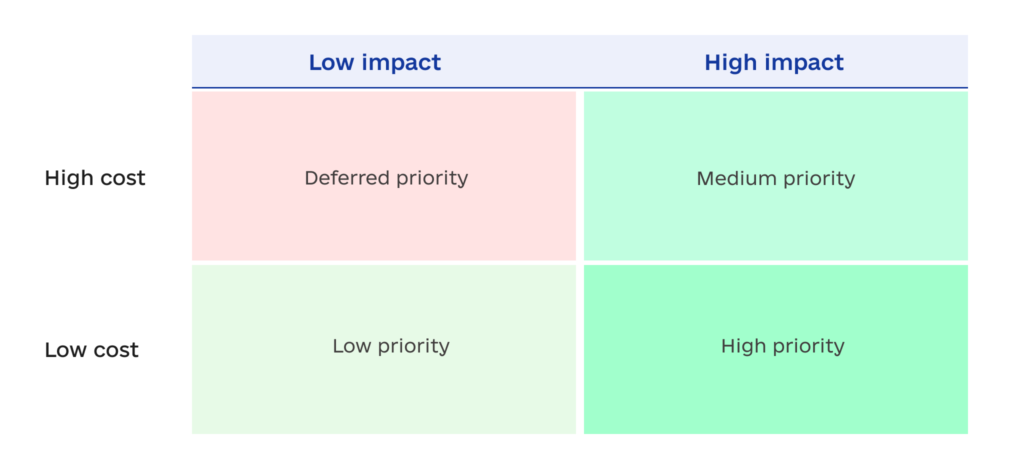
Most production-level and some code-level issues will likely fall into the low-cost, high-impact categories, making them the most prudent category to tackle first. Architecture-level problems, however, are more likely to sit in the high-impact/high-cost category but will require a more deliberate strategy. You may face the decision between incremental system modernization and full replacement.
Incremental modernization strategies like re-architecture or re-building steps require more effort than individual component refactoring but bring more future-proof results in the long run. However, such projects also require more resources, monetary and engineering, which you may not have immediately available. An experienced technology consultant can help prioritize the right areas of intervention and advise you on the best approach for different types of systems in your portfolio.
Implement a Tech Debt Repayment Plan
With a high-level overview of prioritized tech debt issues, you can put in place strategies for repayment. Your goal is to introduce tech debt on your product development roadmap, alongside new feature development to curb high interest rates.
Some teams allocate time in each sprint to repay tech debt. For example, 20% of user stories go towards code refactoring and addressing other issues, while 80% are allocated towards new feature development. This is a good approach for addressing certain groups of code smells and some production-level issues.
For more complex items (e.g., replatforming), you may need to dedicate whole sprints just to fixing this problem. Simon Guest suggested an ‘annual swarms’ strategy, where you allocate 20% of the contiguous sprints at one point in the year towards technical debt. For example, all engineers “swarm” to work on the problem during 5 contiguous sprints over the summer.
Alternatively, you can assign a dedicated team to all tech debt repayment throughout the year. If you don’t have sufficient in-house resources for that, consider partnering with a vendor who can bring both the expertise in legacy system modernization and the right talent for different stages of the project.
Look Into Build and Integration Debt
Beyond IT systems, tech debt can accumulate in production and development-related processes. For example, usage of outdated libraries and frameworks in the development environment eventually leads to system compatibility issues and security vulnerabilities. Likewise, manual build and deployment processes lead to longer release cycles and a higher volume of bugs. Misalignment between the build dependencies and the actual code can result in backward compatibility issues over time.
In other words, these types of problems affect your software development productivity, and thus add up to the cost of doing business.
To address the problem, look into progressively implementing build automation and introducing continuous integration (CI) — the practice of automatically building, testing, and integrating code changes in a shared repository. Review the build scripts in place — instructions that compile, link, and package code into executable files or deployable artifacts. Some of these may contain outdated or buggy code, leading to application-level issues in production.
Apply DevOps principles and best practices to avoid that. Use Infrastructure as a Code (IaaS) tools to manage and provision infrastructure, ensuring consistency in configuration and version control with a rollback feature. Introduce version control and easy roll-back for all code, configurations, and scripts to monitor changes and reduce the risk of
Inconsistencies. Embed static code analysis and code style checks into the CI pipeline to maintain high code quality and consistency.
Additionally, work towards introducing strong platform engineering practices — a well-maintained integrated developer environment (IDE) with a standardized toolkit, libraries, and reusable code templates for creating different application components.
Address Testing Debt
If your goal is to achieve a high degree of DevOps maturity (which it should be), you should also address tech debt in quality assurance (QA) processes. Testing debt leads to frequent bugs and vulnerabilities in production, which in turn, increases cybersecurity risks.
The reasons for testing debt include:
- Imperfection or suboptimal design and coding of tests, which include low automated test coverage, outdated or flaky test tools, and heavy reliance on manual testing.
- Misalignment between the tests and the actual code: As your software evolves, some tests may be missing or may only cover an older interpretation of the requirements.
The signals of pressing testing debt include a growing rate of defects/bugs in production, growing defect distribution, and high automated test failure rates. If that’s what you’re seeing, look into improving your QA processes.
Continuous integration (CI) helps shift the testing left i.e., into the development stage. Automated unit and integration tests help avoid getting more complex issues into production, reducing the cost to fix. Invest in more tools and frameworks for increasing automated test coverage in your CI/CD pipeline.
Likewise, implement better documentation: Maintain a well-organized test plans, scenarios, and test cases database. Work on creating an overarching test strategy document that defines all key testing approaches, methodologies, and objectives during the product life cycle.
Finally, consider switching to test-driven development (TDD) for new product features. TDD encourages developers to create automated tests before producing new code, which ensures that new code is always tested from the outset and thus less likely to contain bugs. Because tests are written first, developers need to think harder about the application design and produce more modular, management system components. This helps maintain a mode manageable codebase.
Put Guardrails to Avoid Unintentional Tech Debt
Tech debt accumulation is inevitable, but your goal is to keep it to a manageable minimum, especially if you’re on a repayment journey. This requires prudence and deliberation.
Establish sound, modern coding standards, which cover different programming styles, practices, and methods for the used programming language. Coding standards must indicate acceptable and objectionable code idioms like naming conventions, formatting of code, and permissible language constructs. When integrated into development environments and auto-enforced, coding standards help improve code quality and maintainability.
Next, introduce regular code and architecture reviews. The goal of a code review is to evaluate the adherence to coding standards and style guides, plus assess how recent code changes fit in the context of the larger system. For example, whether they create new dependencies, or, on the contrary, resolve an earlier scalability issue. Google’s guide to code reviews is a good place to start.
It also pays to improve the focus on system security. As new threats emerge on the radar, regular security scans and proactive vulnerability management help keep the malicious actors outside of the corporate perimeter.
To avoid architecture-related problems, you may also want to address your requirements-gathering process. Eliciting quality attribute requirements from stakeholders during the software specification stage and analyzing their impacts on the system can help better understand the possible risks and tradeoffs.
Your goal is to provide continuous education on the cost and consequences of technical debt to all technical teams (and business users) to reduce the odds of acquiring intentional technical debt.
Conclusion
Technical debt repayment can be a one-off project, but technical debt management requires ongoing efforts. To avoid its accumulation over time, you need to become deliberate about identifying new technical debt and have guardrails in place for addressing it. Or else, you will never escape its vicious cycle.
Proactive technical debt management means ongoing investment into better software engineering practices and new technologies — from better test automation tools to leaner build scripts and a greater degree of automation in continuous deployment. Likewise, it also means having sufficient resources allocated towards regular technical debt repayment sprints.
8allocate team would be delighted to help you implement an effective technical debt management strategy. We can help scope the current size of the problem, suggest the optimal repayment approach, and progressively work towards improving your engineering processes. Contact us for a consultation.
Frequently Asked Questions
Quick Guide to Common Questions
What is technical debt, and why is it a challenge for businesses?
Technical debt refers to short-term trade-offs in software development that lead to long-term maintenance challenges, reduced scalability, and increased operational costs. It slows down innovation, increases system fragility, and diverts engineering resources from high-value projects.
What are the key steps to managing technical debt effectively?
Managing technical debt requires a structured approach:
- Scope your technical debt – Identify system bottlenecks and inefficiencies.
- Analyze system architecture – Assess code complexity, dependencies, and scalability constraints.
- Prioritize repayment – Address the highest-impact, lowest-cost issues first.
- Implement a structured repayment plan – Balance debt reduction with feature development.
- Resolve build and integration debt – Optimize CI/CD pipelines and reduce deployment friction.
- Fix testing debt – Improve automated test coverage to prevent future defects.
- Put guardrails in place – Establish coding standards, security best practices, and continuous monitoring.
How can companies assess the impact of technical debt on their systems?
A thorough technical debt audit should include:
- Code-level analysis – Detect inefficiencies using metrics like cyclomatic complexity and code duplication.
- Architecture evaluation – Identify tightly coupled components and propagation costs.
- Production performance metrics – Measure downtime, deployment failures, and security vulnerabilities.
How should businesses prioritize technical debt repayment?
Use a cost-impact matrix to classify tech debt into:
- High-impact, low-cost fixes (quick wins – code refactoring, CI/CD improvements).
- High-impact, high-cost challenges (architecture modernization, re-platforming).
- Low-impact, high-cost items (legacy components with minimal disruption risk).
How can DevOps practices help reduce technical debt?
Adopting CI/CD automation, test-driven development (TDD), and infrastructure-as-code (IaC) minimizes recurring tech debt by ensuring code quality, security compliance, and streamlined deployments.
How can businesses prevent unintentional technical debt?
- Implement coding standards and architecture reviews to maintain system quality.
- Adopt proactive security measures to prevent vulnerabilities from compounding.
- Educate engineering teams on best practices to avoid accumulating unnecessary debt.