
Business owners usually do not evaluate an AI development partner only on “can they build it”. They look at whether the team can help define the right problem, reduce delivery risk, and create a practical path to AI adoption in the business.
In this article, we identified 7 recurring concerns companies face when choosing a tech partner. We turned them into criteria you can use to evaluate an AI development partner for integration projects – the one who takes responsibility for your product.
Why Choosing the Right AI Development Partner Matters
Right now, business owners spend heavily on AI but see minimal returns.
- Around 56% of CEOs report zero financial impact from AI, while only 12% achieved both cost reduction and revenue growth.
- Nearly two-thirds of organizations have not yet begun scaling AI across the enterprise.
- Only 25% of organizations have converted 40%+ of AI pilots into production.
- Only 21% of organizations have mature governance models for autonomous AI agents, even though nearly 75% plan to deploy them within two years.
- More than 70% of EU enterprises that considered AI but did not implement it cited lack of relevant skills or expertise as the top barrier.
The gap is no longer in AI awareness or strategic intent. It is in execution, especially across talent, data foundations, and use-case discipline. That gap between ambition and execution is why partner choice matters. You are not just choosing a vendor. You are choosing the team that will help define the use case, reduce hidden risks in AI projects, and move one AI initiative from idea to production.
Looking to build an AI development team? We’ve got you covered. Read everything you need to know in our article “How to Build and Structure an AI Development Team in 2026.“
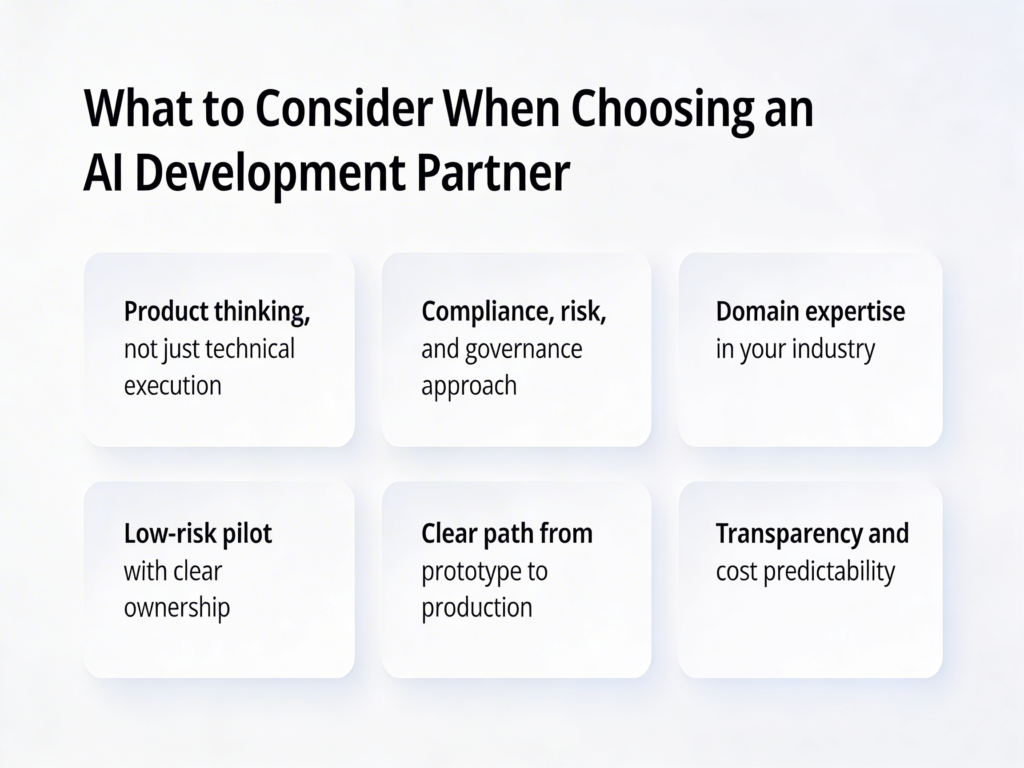
7 Things to Consider When Choosing a True AI Development Partner
Based on recurring client questions, we’ve highlighted the most common concerns companies face when working with AI development partners:
- Missing the product context
- Weak compliance and governance approach
- Unclear ownership
- Domain knowledge gaps
- No clear path from pilot to production
- Low transparency and predictability
- Inability to integrate AI into complex business workflows
Based on these concerns, here are the key things to look for when choosing an AI development and integration partner.
Look for product thinking, not just technical execution
Leaders are not looking for technical execution alone. Companies want an AI development partner that can understand the product, challenge weak assumptions, recommend the right approach, and then deliver it professionally. In other words, they want a company that can evaluate AI ideas, shape them into practical solutions, and integrate AI into existing software products, or build an end-to-end AI module when the opportunity is strong enough.
We’re searching for an AI team who not only delivers code, but can logically justify solutions and cooperate effectively with both clients and teams.
8allocate’s client
Example from 8allocate: At 8allocate, we believe AI without product thinking is expensive decoration. That’s why we start with the business goal and the product metric the feature should influence, then design the right solution inside the product to improve adoption, retention, support efficiency, or monetization.
What to look for in an AI partner:
- A team that talks about users, workflows, and business outcomes, not only models and tools
- A partner that can help shape and prioritize the use case, not just implement a fixed brief
- Clear ownership from strategy through production, not task-by-task execution
What to ask on a first call:
- How would you decide whether this AI idea is worth building now?
- What user or business metric should this improve?
- How would you adapt the solution to our product, data, and workflows?
- How do you make sure the AI feature fits the product?
Evaluate the AI partner’s approach to compliance, risk, and governance
The gap between “we’ve built for fintech” and “we understand regional compliance nuance” is significant. In Europe, trust is still a real barrier to AI adoption: nearly 60% of government organizations remain skeptical of AI, and only 6% combine high trust in AI with strong capability to deliver trustworthy AI (The Data and AI Impact Report 2026: The Trust Imperative). This matters even more for European product teams. The EU AI Act will be fully applicable on 2 August 2026, with some obligations already applying earlier. So leaders are looking for AI development partners who can work with regulated workflows and understand how compliance shapes system design.
One of 8allocate’s EU-based clients in fintech learned this the hard way. They hired an AI team that looked strong on paper, but as the product approached EU rollout, compliance review exposed major gaps. Key areas like data residency, audit trails, access controls, logging, and KYC/AML workflows had been handled too loosely or left for later. The team had built it like a standard SaaS product, assuming compliance could be added at the end. That is usually where costly rework begins.
Example from 8allocate: 8allocate approaches EU fintech and other regulated AI products with controls and evidence built into discovery from day one, not added as a checklist before launch. During discovery, we walk clients through the basics: how EU data flows are handled, what is captured in audit logs, how GDPR deletion and retention are supported, and which rollout mistakes we have seen in similar environments. When needed, we also involve internal or external legal, security, or compliance experts.
What to look for in an AI partner:
- Proof of work in regulated or compliance-sensitive environments, not just claims
- A clear approach to data flows, access control, logging, and auditability
- Evidence that compliance is considered during discovery and system design, not added before launch
- The ability to explain risks in clear business language, not only technical terms
What to ask on a first call:
- Can you walk us through a real compliance-sensitive scenario you’ve designed before? For example: how would you architect KYC data flow for a German user onboarding through a UK entity?
- How do you decide what data can and cannot be sent to an AI model or third-party provider?
- What would need to be logged, reviewed, or kept auditable in this workflow?
- How do you handle data residency, retention, deletion, and access control in practice?
Building AI in a regulated industry? Read our guide “How to Stay Compliant with the EU AI Act While Building AI Products.”
Check AI expertise in your domain
An AI partner may be good at AI integration in general, but that does not automatically mean they understand how AI should work in your industry. An internal assistant for summarizing meetings is one thing. Building AI for EdTech and Education is another. In that case, the model should support the learning process.
Gartner predicts that by 2027, more than 50% of the GenAI models enterprises use will be domain-specific. It also expects organizations to use small, task-specific models three times more often than general-purpose LLMs by then. So companies look for an AI partner who can demonstrate AI engineering expertise in their domain.
Example from 8allocate: In EdTech, 8allocate built an AI Tutor Assistant for GoIT, a global digital education provider, that was trained on the client’s curriculum and integrated into the LMS. In Construction Tech, 8allocate built an AI document processing solution that helps teams retrieve and interpret technical documentation faster. In FinTech, 8allocate developed an AI risk assessment platform for enterprise security teams. Same AI space, but three very different domains, workflows, and requirements.
What to look for in an AI partner:
- Proof they have built AI for workflows like yours, not just generic chatbots or internal copilots
- An understanding of what can go wrong in your industry and how to put the right guardrails in place
- A partner that adapts the model to your data, users, workflows, and quality standards, instead of simply plugging in an LLM
What to ask on a first call:
- Can you share an example where you built AI for a domain-specific workflow?
- How would you adapt the AI to our process, rules, and data?
- What are the biggest risks or failure points for AI in our industry?
- How do you test whether the system is useful and accurate for end users?
Choose a partner who can define a low-risk pilot with clear ownership
Many companies hesitate when choosing an AI development partner because they do not know when they will actually see something working. That is still a common issue in software projects. A team may work in sprints, but each sprint often delivers only part of the logic, backend preparation, or technical setup. From the client side, that can still feel like waiting.
With AI, that uncertainty often becomes even greater. That is why companies look for an AI partner who can define a narrow pilot with clear ownership, real workflows, real data, and clear success criteria. That is also the thinking behind the AI MVP development services 8allocate offers.
Example from 8allocate: 8allocate offers a One AI Feature Pilot, an 8-12 week engagement where we build one narrowly scoped AI feature inside your product. By the end of the pilot, you get a working AI feature embedded in your product environment, a view of its value in practice, success metrics, and a practical next step toward broader production rollout.
What to look for in an AI partner:
- A partner that can reduce scope to one clear, useful AI feature instead of starting with a broad and risky transformation
- Clear ownership on both sides: who defines success, who makes decisions, and who is responsible for delivery
- A pilot plan with real timelines, real data, and clear success criteria, not just a discovery phase with no visible outcome
What to ask on a first call:
- If we start small, what is the first AI feature you would pilot and why?
- What would we be able to see working by the end of the pilot?
- How would you define success for that pilot in business and product terms?
- Who would own decisions, delivery, and evaluation during the pilot?
- How do you make sure the pilot can turn into production?
Ask about their approach to take AI from prototype to production
A model may look impressive in a demo, but that does not mean the feature is ready for production. AI has to work with your data, users, permissions, workflows, latency requirements, edge cases, and quality standards. So companies choose an AI partner who can create an AI adoption roadmap for moving AI from prototype to a reliable feature inside your product.
Example from 8allocate: 8allocate uses an internal framework called the 5-Layer Production Gap to understand whether an AI feature can handle real use in a product. After the pilot, we evaluate an AI solution across five check zones: evaluation, guardrails, monitoring, edge cases, and integration into real workflows, systems, and permissions.
What to look for in an AI partner:
- A clear plan for how an AI feature moves from prototype to a production-ready part of the product
- Experience with real AI integration, not just model demos or isolated PoCs
- A practical approach to testing, monitoring, and improving the feature after launch
- A clear understanding of what happens when the model is wrong, incomplete, or unreliable in a live workflow
What to ask on a first call:
- How do you move an AI feature from pilot to production?
- What tends to change between a working demo and a production-ready solution?
- How do you test quality, reliability, and usefulness before and after launch?
- How do you handle cases where the AI output is wrong or low-confidence?
- What needs to be in place for this feature to work reliably inside our product and workflows?
Choose a partner who works transparently and predictably
Many teams still cannot forecast, explain, and control AI spend well enough. According to the 2025 State of AI Cost Governance report, 85% of organizations said they miss AI cost forecasts by more than 10%, and nearly one in four miss by 50% or more. That’s why companies do not just choose an AI development partner who can build the feature. They look for a partner who can explain what the feature will cost to build, what it may cost to run in production, where spend may grow, and what trade-offs exist between quality, latency, and cost.
We’ve covered this in more detail in our article on ‘How to Measure AI ROI and Avoid Costly Mistakes.’
Example from 8allocate: 8allocate takes AI feature economics into account early. 8allocate team looks at likely running costs, margin impact, and the technical choices that may affect AI feature economics as usage grows, such as model choice, routing, caching, and batching.
What to look for in an AI partner:
- A team that can explain both cost-to-build and cost-to-run in production
- Clear thinking around success metrics, not only delivery milestones
- Transparency about what is fixed, what is variable, and where spend may grow
- The ability to explain cost, quality, and latency trade-offs in plain business language
What to ask on a first call:
- How would you estimate the cost of this feature to build and to run in production?
- What do you see as the biggest cost drivers in this use case?
- What product, usage, or operational metrics would you use to understand whether this AI feature is delivering value?
- What trade-offs might we face between quality, latency, and cost as usage grows?
- What signals would show that this feature needs cost optimization before broader rollout?
Choose a partner experienced in both software engineering and AI development
Many companies find it tough to find an AI development partner that combines strong software engineering with AI delivery capability. Some vendors are good at traditional software development but treat AI engineering as an add-on. Others are AI-focused, but lack experience with enterprise systems, legacy architecture, scalability, and production software delivery. That is why companies look for an AI development partner that can do both: engineer solid software systems and integrate AI into them in a way that works reliably at scale.
Example from 8allocate: 8allocate is not coming into AI from only one side. Since 2015, the company has been building digital products and modernizing software systems for mid-sized and enterprise clients, while also expanding its AI/ML expertise and AI agent development services.
What to look for in an AI partner:
- A team with proof of both software product delivery and AI implementation, not just one of the two
- Experience working with existing systems, complex workflows, and legacy or enterprise environments
- The ability to explain how AI will fit into architecture, permissions, data flows, and product logic
- Evidence that they can take ownership beyond prototyping and build for production reliability and scale
What to ask on a first call:
- Can you share an example where you integrated AI into an existing product or enterprise system?
- How do you adapt an AI feature to business logic, permissions, and system constraints?
- What usually breaks when AI is added to an existing product, and how do you avoid that?
- Who on your team covers software architecture, product integration, and AI engineering together?
- How do you make sure the feature is production-ready?
A Checklist: How to Spot AI Development Partner for AI Integration Projects
To recap, when evaluating AI development partners, use these questions as a quick filter. If a vendor can answer most of them with clear examples, you are likely speaking with a true AI development team.
Product thinking
- How would you decide if this AI idea is worth building now?
- What should this feature actually improve for the business or the user?
- How would you fit it into our product, data, and workflows?
Compliance and governance
- Have you worked on AI in compliance-sensitive environments before?
- How do you handle data access, storage, and deletion in practice?
- What would need to be logged or reviewed in our case?
Domain expertise
- Have you built AI for workflows like ours before?
- What are the biggest risks for AI in our industry?
- How do you check if the system is actually useful for end users?
Pilot scope and ownership
- What would be the first AI feature you’d pilot, and why?
- How would you define success for that pilot?
- Who would own decisions, delivery, and evaluation?
Prototype to production
- How do you take an AI feature from pilot to production?
- What do you do when the AI gets things wrong or is not confident?
- What needs to be in place for this to work reliably in our product?
Transparency and cost predictability
- How would you estimate the cost to build this and run it in production?
- Where do costs usually start growing?
- How do you balance quality, speed, and cost?
Software engineering + AI capability
- Have you integrated AI into an existing product, not just built demos?
- What usually breaks when AI is added to a real system?
- How do you know when a feature is ready for production, not just for a demo?
Why Choose 8allocate as Your AI Development Partner
8allocate offers AI integration services for SaaS and tech businesses that want to embed AI into existing software products. Since 2015, we’ve helped mid-sized companies build digital products and integrate AI capabilities into existing platforms. We deliver copilots, AI agents, domain-specific assistants, intelligent search, document intelligence, and workflow automation across FinTech, EdTech, Logistics, and ConstructionTech.
Working with 8allocate, you get:
- One AI feature in production in 8-12 weeks using proven architecture patterns, evaluation frameworks, and reusable components.
- AI built around your product with full integration into your architecture, data layers, permissions, and user workflows.
- Product, AI, and strategic thinking in one team so the feature is tied to business goals like adoption, retention, support efficiency, or monetization.
- Compliance and governance built in with EU AI Act, GDPR, and DORA considered from day one.
- Flexible delivery models including managed AI delivery or AI engineers embedded into your team, with full code ownership and knowledge transfer.
- AI engineers who understand your domain in FinTech, EdTech, Logistics, and ConstructionTech.
- Pre-vetted AI/ML expertise ready in 1 week through access to 100+ senior engineers.
If 8allocate sounds like the kind of AI development partner you’re open to work with, drop us a line and we’ll map out an AI integration roadmap for you.
Still Got Questions on Choosing AI Development Partner?
Quick Guide to Common Questions
How is an AI development partner different from an AI development company?
An AI development company can simply build what you ask for. An AI development partner like 8allocate, helps you choose the right use case, ties AI to a product metric, works inside your architecture and workflows, and takes it from idea to production.
Should we build AI in-house or work with an AI development partner?
When deciding whether to build AI in-house or work with an AI development partner, you should consider factors, such as internal AI expertise, time-to-market, hiring capacity, integration complexity, compliance and security requirements, budget, long-term ownership, and the need for domain-specific experience. In some cases, AI outsourcing can be the faster and lower-risk option, especially when you need to close internal capability gaps fast.
How do I evaluate compliance and security readiness in an AI partner?
To evaluate compliance and security readiness in an AI partner, check whether they treat compliance as part of system design, not as a last-step checklist. 8allocate, AI product development company, build AI solutions with guardrails, monitoring, privacy, auditability, and documentation in place from day one, with the EU AI Act, GDPR, and DORA in mind.
What are the red flags when choosing an AI development partner?
The biggest red flags when choosing an AI development partner are generic “we do AI” claims, no clear method for getting from prototype to production, weak product thinking, vague answers on compliance and risk, and no plan for ownership transfer or code transparency. Here’s 7 things to consider when choosing a true AI development partner.