AI in 2026 is entering a phase of rapid expansion. Almost every second company is rethinking its strategy around AI. According to the World Economic Forum 2025 report, 62% of firms are actively hiring AI experts to strengthen operations.
Hiring AI talent is just the starting point. If you build AI-powered products, you’re probably wrestling with questions like “Do I need a separate AI product team or should I integrate AI specialists into my existing dev team?” Maybe you’re wondering how many AI engineers to hire, or whether to go in-house versus outsourced. The thing is, AI team structure is more nuanced than just posting a few job listings.
As an AI-focused team, we at 8allocate have 11+ years of experience helping businesses across industries adopt and scale different types of AI. Being familiar with the technical complexities, AI development platforms and practical applications of GenAI and AI agents development, we would like to talk more about how to build an AI team and which roles matter.
TL;DR: How to Build AI Team
- Core AI team roles include AI Product Manager, AI/ML Engineers, Data Engineers, Data Scientists, and MLOps. Roles such as AI Architect and Project Managers are also critical for complex projects. You don’t need all roles in-house, start small and tap into external AI expertise as you grow.
- Start with 2 hires (AI Product Manager and AI Engineer). Add an AI Solution Architect for designing and overseeing the AI system architecture in complex cases. Expand only after your data infrastructure is ready.
- There are three AI team structure models: flat (3-10 people, startups), functional (10-50 people, growing companies), matrix (50+ people, enterprises).
- By 2030, 80% of engineering teams will be smaller, AI-augmented units (Gartner). Design workflows where humans and AI work together.
- Best practices for AI-enabled teams include fostering cross-functional collaboration, delivering AI MVPs quickly, tying AI initiatives to business KPIs, building leadership AI literacy, and designing for human-AI partnership.
- Effective AI product development teams require a mix of technical and business-focused roles working in sync.
Top 9 Roles in an AI Development Team
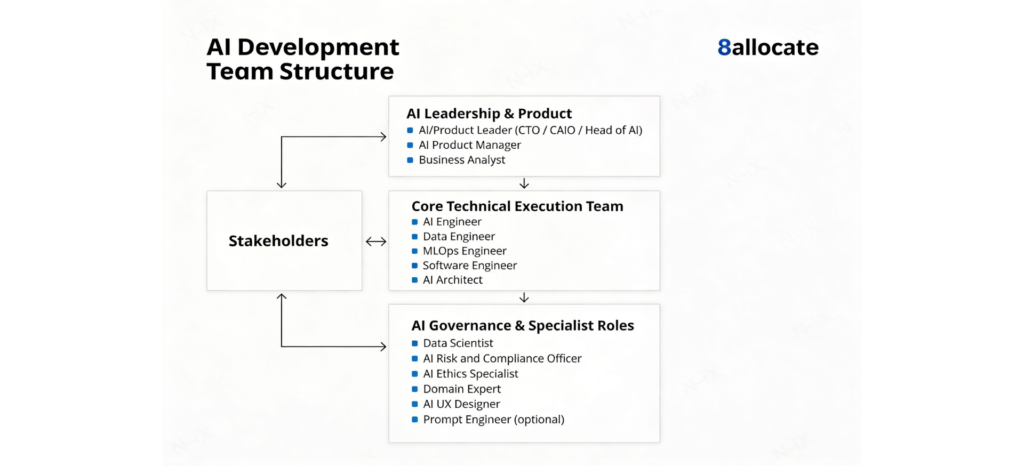
An effective AI team structure combines specialized technical roles with product management oversight and cross-functional cooperation. Core roles include Data Scientists, ML Engineers, Data Engineers, Software Engineers, and AI Strategist, AI Architect, and Project Managers. For an AI product development team, you’ll also need AI Product Managers and UI/UX Designers. The AI team structures usually follow one of three models, from flat structure (typical for startups) to functional or matrix models in more mature companies.
AI/product leader (AI strategy and oversight)
At the leadership level, someone needs to define the AI vision and ensure it aligns with business goals. Larger enterprises may appoint a Chief AI Officer (CAIO) responsible for the AI strategy and roadmap. In other cases, this could be a CTO or Head of AI who champions AI adoption across products. This leader sets direction, prioritizes AI opportunities, and oversees ethical and regulatory compliance.
AI product manager (or product owner)
Building AI into products requires strong product management. The AI Product Manager defines requirements, prioritizes the backlog (often informed by data), and measures the success of AI features. In AI projects, they also manage uncertainties (e.g. feasibility of a model) and adjust scope accordingly.
Data scientists and AI researchers
AI Data Scientists design and experiment with algorithms to extract insights and predictions from data. They might develop machine learning models, run experiments, and fine-tune algorithms. Data scientists work closely with the product manager to understand what predictions or intelligence the product needs, and with engineers to deploy their models.
Machine learning (ML) engineers
If Data Scientists are prototyping models, ML Engineers turn those into robust, scalable solutions. They specialize in the technical implementation of AI models, including writing production code, optimizing model performance, and integrating models into the broader software system. In many teams, ML engineers serve as the bridge between data science and software engineering. In smaller AI teams, one person might wear both data scientist and ML engineer hats, but the skill sets differ: data scientists focus on analysis and experimentation, ML engineers on engineering and operations.
Data engineers
Data Engineers build and maintain the data pipelines, databases, and infrastructure that feed AI models. This includes extracting data from various sources, transforming and cleaning it, and setting up data storage with proper governance. Data engineers also implement data security and compliance measures, which are especially important in regulated industries like finance or healthcare.
Software engineers and DevOps
Even when building a top-notch AI software team, you still need traditional specialists like software and DevOps engineers. Yep, these roles aren’t disappearing. Software engineers are needed to build the non-AI parts of the product (frontend, backend integrations, APIs) and to integrate AI components into a cohesive application. They work closely with ML engineers to embed models into products in a user-friendly way. Meanwhile, DevOps/MLOps Engineers set up the infrastructure and automation for deploying and monitoring AI systems. MLOps specialists in particular focus on automating the machine learning lifecycle, from model training to deployment and updates.
Domain experts and business analysts
AI solutions must make sense in context. Domain experts (or subject matter experts) bring in industry-specific knowledge, whether it’s finance, healthcare, education, etc. These specialists help the team define problems correctly and interpret model outputs with business context. Often, a Business Analyst or Requirements Analyst may also be part of the team to translate business needs into data/AI requirements. These roles ensure the AI product is solving the right problem and that insights from AI are actionable in the business domain.
AI governance roles (ethics and compliance)
By 2028, Gartner predicts that over 50% of enterprises will leverage AI security platforms to protect their AI investments. That’s why many companies are now introducing dedicated roles like an AI Ethicist or an AI Risk and Compliance Officer. An AI Ethicist focuses on the ethical implications of AI. These experts help define policies around AI system security risks and solutions and review models for potential bias or regulatory issues. Likewise, compliance specialists ensure AI systems meet data privacy laws and industry regulations (for example, GDPR or upcoming AI-specific regulations).
(New) AI specialist roles
AI is evolving fast, and new specialist roles have emerged. For instance, a Prompt Engineer (for generative AI) fine-tunes the prompts and queries to get the best results from large language models. While not every team will need a dedicated prompt engineer, teams working heavily with GPT-type AI might. Other emerging roles include AI UX Designers (ensuring AI features deliver good user experiences), Knowledge Engineers (curating knowledge bases for AI to use), and AI Model Ops/Model Manager (who oversee the lifecycle of many deployed models).
You’ve got the AI development team roles! But you don’t need all of them at once. Hire people as complexity grows. Below, we’ll discuss the order to bring AI specialists on board. Keep reading.

So, How Do You Build an AI Development Team in 2026?
Here are four steps to build an AI team that makes AI solutions work for your business.
Step 1. Define your AI use case before you hire anyone
This is where many companies go wrong. They try to roll out different forms of AI everywhere at once. As a result, resources get spread too thin across initiatives that don’t move the business forward. Start with the business problem you want to solve, and hire AI specialists for that.
Step 2. Start with first 2 hires
Start with an AI Product Manager and one or two AI Engineers.
Many companies begin with a Data Scientist or AI Researcher. But in most AI product initiatives, you don’t need research first, you need delivery. Thanks to mature AI platforms and open-source frameworks, you can deliver AI features fast. In more complex cases, you may also need an AI Solution Architect to design the overall architecture.
This is where the AI development outsourcing works well. You can hire the AI product manager in-house and bring in an AI engineer externally to quickly validate your AI use case. Or you can outsource both roles. At 8allocate, we support companies with experienced AI engineers on demand.
Step 3. Build data infrastructure before hiring more AI experts
Gartner highlights poor data quality as one of the critical issues undermining GenAI success. At the beginning, you can move fast using existing models and tools like Anthropic’s Claude or frameworks such as LangChain. But once you want to scale with AI, you need AI-ready data. That’s why your next hire should be a Data Engineer to build clean, reliable data pipelines.
Step 4. Scale your AI team
As your AI dev team grows, your AI team structure must evolve with product complexity. Use this framework to scale your AI team by complexity.
Level 1. AI Feature (One Use Case, One Model)
Team:
- 1 AI Product Manager
- 1-2 AI Engineers
- 1 Data Engineer (part-time or shared)
Total: 3-4 people
Level 2. AI Workflow Automation (One Department)
Team:
- 1 AI Product Manager
- 2-3 AI Engineers
- 1 Data Scientist (experimentation and model tuning)
- 1-2 Data Engineers
- 1 DevOps / MLOps (shared or part-time)
Total: 6-8 people
Level 3. AI Copilot Across Departments
Team:
- 1 AI/Product Leader (Head of AI or CTO oversight)
- 1 AI Product Manager
- 2-4 AI Engineers
- 1-2 Data Engineers
- 1 Data Scientist
- 1 MLOps Engineer
- Domain expert(s)
If you operate in a regulated industry, like Finance, add an AI Compliance Specialist.
Total: 8-12 people
Level 4. AI-Native Product
This is where AI is your core value proposition. Now you need full lifecycle ownership.
Team:
- AI/Product Leader
- 1–2 AI Product Managers
- 3–5 AI Engineers
- 1–2 Data Scientists
- 2 Data Engineers
- 1 MLOps Engineer
- 1 DevOps Engineer
- Domain experts
- AI Compliance / Ethics (for regulated industries)
Total: 10-15+ people
Keep in mind that AI team roles appears in this order (not the other way around):
- AI Product Manager
- AI Engineer
- Data Engineer
- MLOps
- Data Scientist
- Governance and Compliance
Based on our experience, here’s the timeline for building an AI team that works.
| Timeline | Actions |
Month 1-3 | Define use case Hire Product Manager and AI Engineer Build AI MVP, validate feasibility Consider outstaffing cooperation with AI experts |
| Month 4-6 | Add Data Engineer Build production infrastructure Deliver product-ready AI |
| Month 7-12 | Add 1-2 Data Scientists Add MLOps if scaling models Choose AI team structure |
| Month 12+ | Scale based on complexity Consider a hybrid approach: internal team + AI outsourcing |
Note: The companies that succeed start small, with 2-3 AI talent and scale intentionally. The market won’t wait. Sometimes an external AI partner can deliver an AI MVP development service in just 4–6 weeks, helping you validate the idea before committing to a full AI product development team.
AI Team Structure Models: Which One Is Right for You?
In practice, AI teams usually follow one of three models, from flat structures (common in startups) to functional or matrix setups in more mature companies.
Flat AI team structure
This structure works best for startups or your first AI project with 3-10 people. All AI specialists report to one Product Manager or AI Lead and operate as a single unit, not separate departments. The pros of this model are fast communication and full alignment around one product goal.
Functional AI team structure
This structure works best for growing companies with 10-50 AI specialists, especially SaaS products with multiple AI features. Specialists are grouped by discipline and report to functional managers, which often aligns well with a dedicated AI development team model. The benefit here is deeper expertise and knowledge sharing within each specialty.
Matrix AI team structure
This structure works best for larger organizations (50+ AI experts) running multiple AI products or initiatives. Team members have dual reporting. For example, an ML engineer reports to the Head of AI and to a product manager for a specific project.
Note: Revisit your team structure as you scale. What works with 5 people often breaks at 50. The most successful AI organizations stay flexible and adapt as projects move from research to production.
In-House vs Outsourced vs Hybrid AI Teams?
Should you go fully in-house? Rely on external AI partners? Or combine both? The answer usually depends on resource availability, speed requirements, and how critical AI is to your business.
In-house AI team
Building a fully in-house AI team gives you maximum control and ensures knowledge stays within the company. However, it requires significant time and investment. It also comes with the challenge of recruiting in a highly competitive market, where 45% of businesses report limited availability of high-skilled AI talent. For smaller organizations, a fully in-house setup may be impractical at the start, which is why how to find AI talent matters for planning.
Outsourced (external) AI specialists
Working with an external AI development partner can accelerate your product development and reduce costs by up to 60% while bringing in specialized skills quickly. A seasoned partner will have an established process for delivering AI projects from data pipeline to deployment, which is a huge advantage if your company lacks existing AI expertise.
Learn more about effective AI outsourcing strategies to maximize impact in our guide!
Hybrid approach
Many companies find a middle ground most effective: a core in-house team augmented by external AI experts, often by maximizing efficiency with AI outsourcing. For example, you might have an internal Product Manager who deeply understands your business, then outsource AI solutions development or data engineering to a partner like 8allocate. This model offers the best of both worlds, combining internal ownership with the flexibility to scale quickly using external AI talent when needed.
Best Practices for AI-Enabled Team Success
Once you have the right people and structure, it’s critical to establish practices that enable the team to thrive. Based on 50+ AI teams we at 8allocate built, here are the key practices that drive success.
Cross-functional collaboration
Encourage a culture where data scientists, AI engineers, and domain experts work hand-in-hand, not sequentially handing off work. Avoid “throwing models over the wall”, involve AI engineers early when data scientists are prototyping and have business stakeholders review model outputs to ensure they make sense.
Iterative AI development and MVPs
Given the experimental nature of AI, embrace an MVP mindset. Begin with a smaller AI model first, release it to get user feedback, then iterate quickly. This reduces risk and investment if the idea doesn’t pan out, and it’s common for initial AI models to be scrapped or overhauled after real-world testing.
Set clear metrics and outcomes
Define what success looks like by tying AI projects to business KPIs from the start. The AI Product Manager should establish both model performance metrics with AI engineers and business impact metrics with stakeholders. Monitor these throughout AI solutions development to identify if you need more data engineering support or adjustments to team composition.
Build AI literacy across leadership first
Employees feel excited about AI but lack support from leaders (McKinsey 2025 report). CTOs and VPs who understand AI’s capabilities and limitations make better decisions about team structure, budgets, and timelines.
Your team won’t become AI-ready on its own. It starts with you. As leaders, we set the direction, create the environment, and make sure people get the training and support they need to grow with AI.
Volodymyr Potapenko, CEO and Co-Founder at 8allocate
Build for human-AI collaboration
Gartner predicts that by 2030, 80% of large engineering teams will be reorganized into smaller, AI-augmented units. Success will depend on redesigning workflows so AI engineers, product managers, and domain experts work with AI systems under clear ownership, defined guardrails, and measurable outcomes.
Why Select 8allocate for Building Your AI Development Team
We offer three core cooperation models designed to match your stage and needs:
- Staff Augmentation extends your internal team with skilled AI engineers who integrate directly into your workflow.
- Managed Team provides a self-sufficient AI engineering team that takes ownership of specific components or workstreams. The team integrates with your delivery organization but handles execution independently.
- Custom AI Solution Development delivers complete AI products, from discovery and architecture to deployment. We build cross-functional teams covering all necessary roles and take full responsibility for delivering business results.
What sets 8allocate apart is that we combine strategic clarity backed by 11 years of tech entrepreneurship and 5 years of AI expertise with hands-on engineering execution. Brands choose 8allocate because we:
- Deliver AI features faster through a development model that combines experienced engineers, AI agents, and internal accelerators..
- Launch a working AI MVP in 4–6 weeks and scale only the solutions with measurable business impact.
- Bring cross-domain AI expertise, with deep focus on FinTech, EdTech, Logistics, and ConstructionTech.
- Provide pre-vetted AI/ML talent within one week, giving you access to 100+ senior AI engineers across our R&D hubs in Central & Eastern Europe and LATAM.
- Demonstrate proven internal AI maturity with AI is embedded in our daily delivery. About 98% of our engineers use AI in their work, saving over 1,000 hours monthly. The patterns we bring are already validated in real production environments.
Get in touch with us to accelerate your AI initiatives with a team built for success. Let’s turn your AI vision into reality, with the right people powering the journey.
Still Got Questions on Structuring AI Product Teams?
Quick Guide to Common Questions
Do we really need a dedicated AI team, or can our existing software team handle AI projects?
If your AI initiative is minor, such as integrating a simple AI API, your existing software team can likely manage it. However, substantial AI product development requires specialized skills in data preparation, model tuning, and performance evaluation. A dedicated AI team (whether in-house or through an experienced AI partner like 8allocate) ensures focus and technical depth.
What roles are absolutely essential when starting an AI-enabled project?
At minimum, you need three roles:
- Product Manager to define the problem and align it with business value.
- AI Engineer to build the model.
- Software Engineer to integrate and productionize it.
For complex AI projects, it is important to include key roles such as an AI Architect, who oversees the overall AI system architecture, and Project Managers, who coordinate collaboration and ensure alignment across the team.
If data is complex or unstructured, a Data Engineer becomes critical early on.
How does an AI Product Manager differ from a regular Product Manager?
An AI Product Manager(PM) has all the responsibilities of a standard Product Manager but adds AI-specific skills. But AI PM needs a solid understanding of AI/ML concepts, manage higher uncertainty, define model success metrics, and work closely with data scientists and AI engineers.
Should AI specialists (data scientists, ML engineers) be centralized in one team or distributed across product teams?
The right model depends on your AI maturity. Centralized AI teams help establish standards, governance, and shared expertise in early stages. Embedded AI specialists within product teams drive stronger collaboration and more tailored solutions. Many organizations begin with a centralized structure and evolve toward a hybrid or embedded model as AI adoption scales. The priority is balancing governance with product-level impact.
What if our AI project fails or doesn’t show ROI? How do we keep the team motivated and justify the investment?
Not every AI experiment succeeds. Use phased milestones, fail fast, and learn from outcomes. Treat setbacks as learning opportunities, celebrate incidental wins, and focus on business-aligned goals. Quick wins (like small NLP classifiers) help maintain team confidence, while failed projects inform future iterations, turning “failure” into strategic insight.
Which partners structure internal teams for sustained ai transformation?
Several AI development firms provide dedicated teams to support internal AI transformation. AI development partners like 8allocate stand out for domain expertise, production experience, rapid AI MVP delivery (4–6 weeks), and strong focus on security, ethics, and compliance.