Enterprise organizations are under pressure to leverage artificial intelligence to drive innovation and efficiency. However, enterprise AI development is a complex journey that requires careful planning and execution. How do you go from an initial idea or proof-of-concept to a fully deployed AI solution that scales across the business? This playbook provides a step-by-step guide for technology leaders – from upfront AI consulting services and strategy, through AI MVP development, to scaling a full-cycle AI development project into production. We’ll cover best practices for defining your enterprise AI strategy, building an AI proof of concept (PoC) and MVP, and expanding that MVP into a robust, enterprise-grade AI product. By following this playbook, you can minimize risks, accelerate time-to-market, and maximize the impact of AI in your organization.
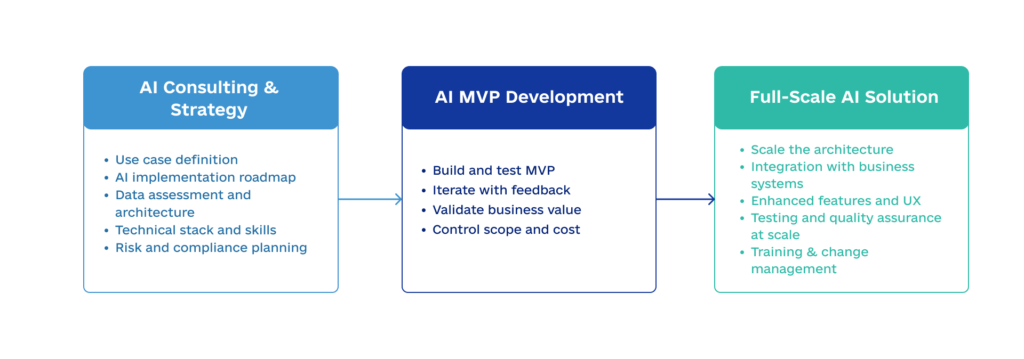
Phase 1: AI Consulting & Strategy – Laying the Foundation
Every successful AI initiative starts with a strong foundation. In this phase, you define why and how you will use AI to meet your business objectives. Engaging in strategic AI consulting helps clarify the roadmap before any code is written.
Every successful enterprise AI solution begins with a clear strategy aligned to business goals. By working with experienced consultants, you ensure that your AI project is feasible, valuable, and aligned with corporate strategy.
During the consulting and planning stage, you will develop an enterprise AI strategy and detailed AI project planning artifacts. Key outcomes typically include:
- Use case definition and success criteria: Identify high-impact AI use cases (e.g. predictive analytics, automation, customer insights) that align with your business priorities. Define what success looks like in measurable terms (KPIs, ROI).
- AI implementation roadmap: Lay out a phased plan for implementation, from initial AI proof of concept to MVP and full deployment. This roadmap includes timelines, milestones, and required resources.
- Data assessment and architecture: Evaluate the data you have (or need) for the AI solution. Ensure data quality, availability, and security. Plan the data pipeline and infrastructure (cloud platforms, data lakes, etc.) required to support development and deployment.
- Technical stack and skills: Choose appropriate AI technologies (machine learning frameworks, AI platforms, cloud services) and assess skills required. Determine if you need to augment your team with a partner or training. (This is where 8allocate’s AI consulting services can guide you through technology selection and AI readiness assessment.)
- Risk and compliance planning: Identify regulatory requirements or ethical considerations (e.g. GDPR, industry standards) early. Plan for AI governance to ensure compliance and responsible AI use.
By the end of Phase 1, you should have a solid AI strategy & roadmap, executive buy-in, and the groundwork to proceed with development. This upfront investment in consulting prevents costly missteps later. It’s much easier to refine your strategy before development than to fix a misaligned AI product after it’s built.
Phase 2: AI MVP Development – Proving Value with a Pilot
With a clear strategy in place, the next step is to build a Minimum Viable Product (MVP) for your AI solution with AI MVP development services. An AI MVP is a functional prototype or initial version of the AI-driven system that includes just the core features needed to test the concept in a real-world environment. The goal is to prove the value of the solution quickly and gather feedback, with minimal cost and development time by testing market fit with AI MVPs. Bold insight: An AI MVP allows enterprises to test real-world performance and business value with minimal risk before fully investing in a large-scale project.
Often, this phase begins with an AI proof of concept (PoC) to validate technical feasibility. A PoC might be a small experiment or model that demonstrates that the AI approach (e.g. a machine learning model) can work on your data. Once the PoC shows promise, you evolve it into an MVP by adding the basic user-facing features and integrating it into a test environment. The MVP should solve the primary problem identified, but it won’t have all the bells and whistles of the final product.
Key considerations for AI MVP development:
- Focus on core functionality: Identify 1–3 must-have features that address the main problem. For example, if you’re building an AI customer service assistant, the MVP might handle a few common support requests with AI, rather than covering all possible topics.
- Use real data and scenarios: Ensure the MVP is trained and tested on representative data from your business (with appropriate data governance). This makes the results credible. If needed, start with a limited dataset or synthetic data to get going, and plan to expand data coverage later.
- Iterate quickly: Adopt an agile approach. Develop the MVP in short sprints (many teams can build an initial AI MVP in ~8 weeks). Continually test the AI with real users or stakeholders and refine based on feedback. Rapid iteration helps catch issues early and adapt to user needs.
- Validate business value: Throughout the MVP phase, measure outcomes against the success criteria defined in your strategy. Are the AI model’s predictions accurate enough? Do users find the solution helpful? Use these insights to decide if and how to proceed to full-scale development.
- Control scope and cost: An MVP by definition should be minimal. Avoid the temptation to include every nice-to-have feature. This keeps the project manageable and budget-friendly. Remember, the MVP’s purpose is to validate assumptions; full features can come later.
By the end of Phase 2, you will have a working AI MVP – e.g. a pilot solution in a sandbox or limited production environment – and real user or customer feedback on its performance. This phase significantly de-risks your AI project: you either demonstrate that the solution can deliver value (making a case for further investment), or you learn that adjustments are needed (saving your company from a potential larger failure). As 8allocate’s experience shows, developing an AI MVP first minimizes risk by ensuring the product solves real problems before full-scale investment is made.
Phase 3: From MVP to Full-Scale AI Solution – Scaling Up and Integration
Once your MVP has proven its value, it’s time to expand it into a full-scale, production-ready AI solution. This phase transforms your pilot into a robust application that can be rolled out organization-wide, handling more data, users, and use cases reliably. Bold insight: Don’t treat the MVP as the final destination – it’s a stepping stone to a scalable AI ecosystem. Scaling up an AI product involves careful planning across technology, people, and processes.
Key activities in scaling from MVP to full product include:
- Architecture hardening: Revise and extend the system architecture for robustness, scalability, and security. What works for a prototype may not be sufficient for enterprise scale. You might need to refactor the codebase, move to a more scalable cloud infrastructure, or optimize the model for performance. Ensure you design for handling high volumes of data and requests.
- Integration with business systems: Integrate the AI solution into existing enterprise systems (CRM, ERP, data warehouses, etc.). This often means developing APIs, data pipelines, and middleware so the AI can fetch data and deliver outputs seamlessly as part of business workflows. User authentication, access control, and compatibility with IT policies are crucial at this stage.
- Enhanced features and UX: Based on MVP feedback, add the additional features and user interface improvements needed for a full product. For example, build out an admin dashboard, add support for more data sources, or include fail-safes for when the AI is unsure. The user experience should be polished for broader adoption.
- Testing and quality assurance at scale: Perform rigorous testing – not just of the AI model’s accuracy, but of the entire system’s performance under load, security penetration testing, and edge-case handling. In enterprise AI, issues like model bias or drift need to be monitored. Develop a plan for ongoing monitoring and maintenance of the AI (MLOps – automated re-training, model versioning, etc., might come into play).
- Training & change management: An often overlooked aspect of scaling AI is preparing your organization. Ensure end-users and IT staff are trained on the new AI tool. Update processes to incorporate AI outputs. Gather continuous feedback as more users interact with the solution.
A successful transition from MVP to full-scale deployment results in an AI solution that is fully integrated into your business and delivers consistent value. At this stage, you should have an enterprise-grade system with appropriate reliability, security, and governance.
Scaling from an AI MVP to a production solution requires enterprise architecture thinking – focusing on scalability, integration, security, and maintainability. It’s truly a full-cycle AI development effort, potentially involving refactoring the MVP’s quick hacks into solid engineering solutions.
Many companies partner with specialists for this phase to ensure nothing is missed. Engaging a development team experienced in full-cycle AI product development can accelerate this journey. These experts can augment your team to handle cloud engineering, data engineering, and DevOps, while your internal team provides domain knowledge and oversees alignment with business needs.
Choosing the Right AI Development Partner
Embarking on an enterprise AI initiative can be daunting. Having the right partner by your side – from consulting through MVP and full implementation with strategic AI consulting and custom development – can dramatically increase your chances of success. Bold insight: Choosing the right AI development partner can make or break your AI initiative. Here are a few qualities to look for in a partner:
- AI domain expertise and a proven track record: Look for a partner with experience delivering AI product development projects similar to yours. They should have success stories or case studies in enterprise AI, demonstrating they can build and deploy AI solutions at scale.
- End-to-end capabilities: The ideal partner can support you across the entire AI journey – from initial consulting and strategy to data engineering, model development, UI/UX, integration, and ongoing support. This ensures continuity and that no phase of the project is overlooked.
- Understanding of enterprise requirements: Enterprise AI projects have unique needs: strict quality standards, compliance and security mandates, integration with legacy systems, etc. A good partner understands enterprise AI strategy and can navigate challenges like data privacy, model bias, and regulatory compliance.
- Collaborative and consultative approach: The partner should work closely with your stakeholders, adapt to your domain knowledge, and transfer know-how to your team. Avoid one-size-fits-all vendors – you need a collaborator invested in your success.
- Flexible engagement and support: Enterprise projects evolve. Choose a partner who can scale the team up or down as needed, adjust scope when requirements change, and provide long-term support (maintenance, model updates, new features) after the initial deployment.
A strong AI development partner not only brings technical skills, but also accelerates your project timeline and provides confidence that industry best practices are being followed. As one of 8allocate’s clients remarked:
8allocate is always willing to go the extra mile, no matter what the project is. Timely and reliable, 8allocate has successfully completed various projects. Their responsive team goes above and beyond to deliver solutions tailored to fit the engagement. Their dedication and expertise have led to a successful ongoing partnership.
This kind of feedback highlights the importance of working with a partner who is responsive, knowledgeable, and truly committed to your project’s success.
Conclusion: From Idea to AI Success – Execute the Playbook
Transforming a promising AI idea into a full-scale enterprise solution is a journey that requires vision, diligence, and the right expertise. By following this Enterprise AI Playbook, you de-risk the process and set your team up for success. Start with strategic planning and AI consulting to ensure you’re building the right solution. Develop an AI MVP to validate and refine the concept in practice. Then invest in scaling that MVP into a robust, integrated AI product that delivers real business value. Along the way, don’t hesitate to leverage AI consulting services, tools, and development partners that specialize in enterprise AI – they can bring hard-earned lessons from similar projects and accelerate your timeline.
Ready to accelerate your enterprise AI journey from MVP to full-scale success? 8allocate is here to help. As a global AI solutions company, we offer AI consulting, MVP development, and full-cycle AI development services to guide you through every phase of the AI project lifecycle. Whether you’re exploring use cases or ready to scale an existing AI pilot, our experts can step in as your dedicated AI development partner. Contact us today to discuss your AI ambitions and let’s turn your vision into a reality.

Frequently Asked Questions (FAQ) on AI ROI
Quick Guide to Common Questions
Why start with an AI MVP instead of building a full-scale solution immediately?
Jumping directly into a full-scale AI project is risky. An AI MVP (Minimum Viable Product) lets you validate the concept and business value early without heavy upfront investment. By developing a small-scale version of the solution first, you can test core functionalities and gather user feedback in real conditions. This approach ensures that you’re solving the right problem and that the AI works as expected. If the MVP shows promising results, you’ll have justification (and insights) to scale up. If not, you can pivot or improve quickly, saving your enterprise from potentially wasting significant resources on the wrong solution.
How long does it take to build an AI MVP and then scale it to production?
The timeline can vary widely based on complexity, but typically an initial AI MVP can be developed in a few months. This involves data preparation, model development, and basic feature implementation in an iterative cycle. Once the MVP is validated and you move to full-scale implementation, expect additional months for scaling up: integrating with enterprise systems, adding features, and rigorous testing. Many enterprise AI projects take around 6–12 months from kickoff to a production-ready solution, though simpler projects might be faster. Key factors influencing timeline are data availability, the difficulty of the AI task, team expertise, and how many integration points with other systems are needed.
How can we ensure our AI MVP will scale and integrate with existing systems?
To ensure scalability and integration, it’s important to architect your MVP with the future in mind. Use cloud-native services and modular design so the solution can handle more data and users as you grow. For example, you might build the MVP on a microservices architecture and containerize your AI models, making it easier to deploy updates and scale horizontally later. Integration should also be planned early: design APIs or data interfaces in the MVP stage so that connecting to your CRM, ERP, or other software will be straightforward.
What should we look for when choosing an AI development partner?
You should look for expertise and experience above all. The partner should have a track record of delivering enterprise AI solutions or similar advanced software projects – ask for case studies or client references. Evaluate their technical skills in the AI domain relevant to you (for example, natural language processing, computer vision, big data engineering, etc.). Additionally, look for a partner who understands business strategy, not just coding. They should be willing to consult on use-case selection, ROI analysis, and post-deployment support. Scalability and full-cycle capability are also key: the best partners can support you from initial strategy through development and scaling (end-to-end), as this ensures consistency. Finally, consider communication and culture fit – a partner who collaborates well with your in-house team, is transparent, and can adapt to your way of working.