
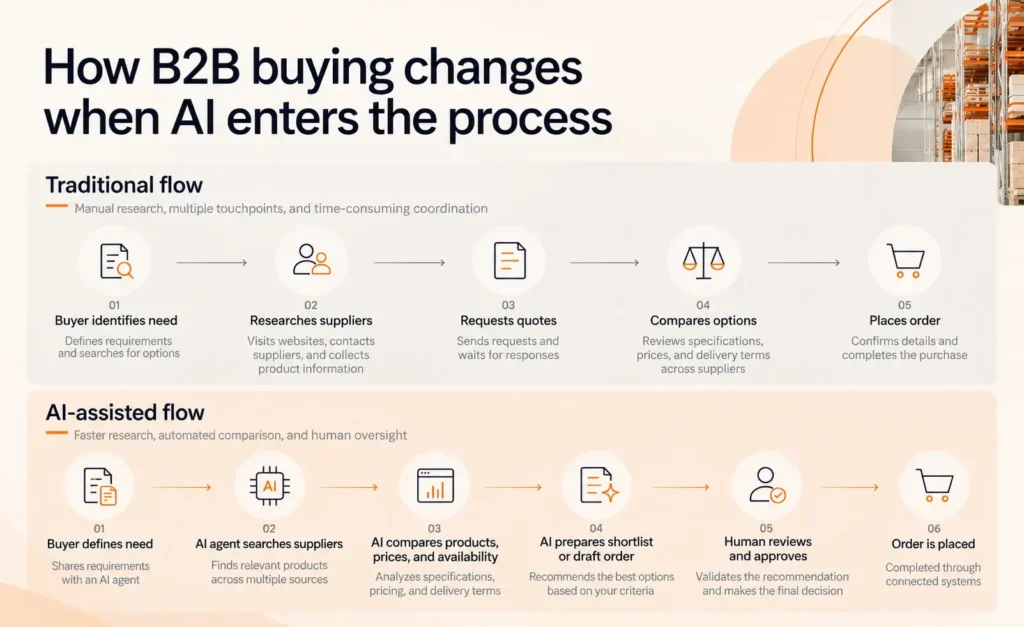
Imagine a customer needs 200 replacement parts. Instead of contacting suppliers and comparing quotes manually, an AI agent checks specifications, prices, and availability, then prepares a shortlist for approval.
The buyer still makes the final decision. But AI has already influenced which suppliers they consider.
This is the shift behind B2B agentic commerce. For manufacturers and distributors, it raises a new question: Will your products make it onto an AI-generated shortlist?
At 8allocate, we build digital products and AI solutions for businesses across industries. Our recent work includes AI-powered anomaly detection solution and AI container number recognition system for logistics. This hands-on experience gives us a practical understanding of how AI is becoming part of everyday business operations.
We also keep a close eye on how AI is changing industries, including B2B commerce. In this article, we explore how AI agents changes the way businesses buy and sell, what you can already automate today, and how manufacturers and distributors can prepare for what’s coming next.
TL;DR: AI Agents in B2B Commerce
- AI agents move beyond product search to compare suppliers, request quotes, and prepare orders on behalf of business buyers.
- Manufacturers and distributors may lose potential customers before the first sales conversation if AI agents cannot find or compare their products.
- Businesses already explore how AI agents can support purchasing, sales, and supplier interactions.
- AI-assisted buying could reduce manual work for buyers while increasing expectations for faster quotes, accurate pricing, and reliable delivery information.
- AI agents need access to accurate product specifications, customer-specific prices, inventory, and order information across connected business systems.
- Human oversight remains essential for pricing exceptions, purchase approvals, and other decisions that carry financial or operational risks.
- Businesses can already automate RFQ processing, quote preparation, product matching, and repeat orders without waiting for fully autonomous AI commerce.
What Is B2B Agentic Commerce, and How Does It Change Buying?
B2B agentic commerce means using AI agents to carry out parts of the business buying and selling process. Unlike a traditional chatbot that answers questions, an AI agent can work through a series of tasks toward a specific goal.
For example, a procurement manager could ask an AI agent to find five suppliers that offer a particular component, meet the company’s technical requirements, and can deliver within two weeks.
The agent could search product catalogs, compare specifications, check available prices, and prepare a recommendation. With the right access and approval rules, it could also request quotes or prepare an order.
The difference is that AI moves from providing information to helping complete the work.
This doesn’t mean every purchasing decision will become fully automated. Complex contracts, unusual orders, and significant financial commitments will still require human judgment. However, routine tasks such as checking product availability, comparing standard offers, or preparing repeat orders are increasingly suitable for AI assistance.
According to Deloitte’s 2026 analysis of B2B agentic commerce, businesses are already exploring how AI agents can support purchasing, sales, and supplier interactions.
The direction is becoming clearer, even if the speed of adoption varies across industries.
What Changes When AI Starts Comparing Suppliers and Making Buying Decisions?
For B2B companies, the impact goes beyond faster purchasing. AI could change how customers discover products, evaluate suppliers, and decide who gets their business.
Customers may shortlist suppliers before visiting their websites
Today, a customer might visit several supplier websites and speak with sales representatives before choosing a product.
With AI-assisted purchasing, that initial comparison could happen elsewhere. An AI agent might examine product specifications, technical compatibility, pricing, availability, and delivery conditions. It then recommends the suppliers that best meet the buyer’s requirements. The customer may only contact the companies on that shortlist.
This changes what suppliers need to pay attention to.
A good-looking website is still important for human buyers. But AI also needs product information that is accurate, complete, and easy to access. If one supplier clearly explains product compatibility and delivery options while another provides incomplete information, the first may be easier for an AI agent to evaluate.
Being easy to find may no longer be enough. Your products also need to be easy for AI to understand and compare.
Buying and selling could involve fewer manual steps
Consider how a B2B quote works today.
A buyer sends an email with product requirements. A salesperson checks the catalog, contacts the warehouse, confirms prices, and prepares a proposal.
If the requested item is unavailable, the process starts again with alternative products.
AI can already help reduce this repetitive work. As these capabilities develop, more of the exchange between buyers and suppliers could happen automatically, within agreed rules.
For businesses, this creates an opportunity to respond faster, reduce administrative work, and handle more requests with the same team. It also raises expectations. Customers who receive accurate quotes in minutes may become less willing to wait several days.
Businesses may see the order but not the full buying journey
There is another, less obvious change.
Imagine an AI assistant recommends your product. The customer then places an order through a distributor. Your company sees the transaction, but it may not know that the recommendation came from AI.
As AI becomes involved in product discovery, businesses may have less visibility into the early stages of the buying process. This makes it harder to understand which channels and recommendations influence sales.
Companies will need to connect the information they can observe across product discovery, customer accounts, quotes, sales channels, and completed orders.
Not every AI-influenced decision will be measurable. But better connections between existing data sources can provide a clearer picture of what leads to a sale.
What Can AI Already Do for B2B Commerce Today?
You don’t need a fully autonomous purchasing system. A better starting point is to look at the work their teams repeat every day.
Where do employees spend hours copying information, checking details, comparing options, or waiting for approvals?
These are often the processes where AI can create practical value.
| Business process | What AI can help with | What to measure |
| Incoming RFQs | Read customer requests, match products, and prepare draft quotes | Time to prepare a quote |
| Order processing | Extract order details, check item codes, and prepare entries in business systems | Processing time and errors |
Product information | Find suitable products, check specifications, and suggest alternatives | Product search time |
Inventory and repeat orders | Review stock levels and purchasing history, then suggest replenishment | Stock availability and manual effort |
| Customer service | Answer questions using verified product, pricing, and order information | Response time and accuracy |
Take RFQ processing as an example.
A distributor receives dozens of requests from customers every day. Each request may contain different product descriptions, part numbers, quantities, and delivery requirements.
An AI-enabled workflow can read incoming requests, identify the products, retrieve available information, and prepare a quote for a salesperson to review.
The salesperson focuses on exceptions, customer relationships, and commercial decisions instead of manually processing every line.
This doesn’t mean the AI should independently approve discounts or promise delivery dates. Those actions need reliable information and clearly defined rules.
The business value comes from completing more work accurately, with fewer repetitive steps. And these improvements prepare the company for a future in which some RFQs may come directly from customers’ AI agents.
Read also: How AI Automates RFQ Processing for Freight and Logistics
What Needs to Be in Place Before AI Can Handle More of the Buying Process?
Before investing in advanced AI agents, you should examine how your product information, business processes, and existing systems work today.
This is often where the real preparation begins.
Make product information accurate and easy to compare
Suppose a manufacturer sells industrial components.
Its product catalog contains technical specifications, but some descriptions are incomplete. Similar products use inconsistent names. Compatibility information is stored in separate documents.
An experienced salesperson may understand these details. An AI agent may not. Before AI can reliably recommend products, the company needs to make sure important information is correct and consistent.
That means checking product codes, specifications, available options, compatible parts, certifications, and replacement products. It also means deciding where this information should be maintained so that teams and AI tools work from the same reliable source.
Read also: Top 32 Agentic AI Implementations and Production Use Cases in 2026.
Connect prices, stock levels, and order information
You already have the information AI needs. The problem is that it lives in different places.
Product specifications may be stored in a catalog. Stock levels sit in an ERP system. Customer-specific prices are maintained in a CRM or spreadsheet. Orders are processed in another application.
If an AI agent cannot access the right information, it cannot reliably confirm whether a product is available or what a particular customer should pay. This is where systems integration becomes important. In practical terms, it means connecting existing systems so approved tools can retrieve the information they need when they need it.
A 2026 BCG study of technology procurement identified inconsistent data, integration with existing systems, and governance as major barriers to scaling AI. Buying better AI software alone won’t solve those problems.
Decide what AI can do and what requires approval
AI should not have unlimited authority over commercial decisions.
For example, a distributor could allow an AI agent to prepare standard quotes using approved prices. But what happens when a customer requests a large discount, an unusual delivery commitment, or an order above a certain value?
The company needs clear rules.
Which actions can AI complete automatically? When should a salesperson review the result? Who can approve a purchase or change a price?
These rules protect margins, reduce mistakes, and make AI decisions easier to review. They also make it possible to increase automation gradually, rather than giving an AI system more responsibility than the business is ready to manage.
Measure whether automation improves business results
Completing tasks faster is useful. But speed alone doesn’t prove that AI has improved financial performance.
Suppose AI reduces the time needed to prepare a quote from 30 minutes to 10 minutes. That’s a meaningful operational improvement.
But what happens next?
Can the same team process more requests? Do customers receive offers sooner? Are there fewer pricing errors? Does faster quoting help the company win more business?
These are the questions worth measuring. A good AI project starts with a clear picture of how the process performs today, then checks what actually changes after automation.
Where Should Your Business Start? Choose One Workflow
Preparing for B2B agentic commerce doesn’t require a company-wide transformation from day one.
For most businesses, a focused project with measurable results is a more useful starting point.
Here is a practical approach.
1. Find a process that slows your team down
Look at how requests, quotes, and orders move through your business.
Where do employees repeatedly copy information, search for missing details, or wait for someone to check a document? Choose a process where improvement would matter to customers or operations.
2. Check the information behind that process
Identify which systems contain the required data.
Can employees find the correct prices, product details, and stock information quickly? Are different systems showing conflicting information? These gaps need to be understood before automation begins.
3. Test AI on a limited workflow
Start with a defined use case, such as preparing draft quotes for standard products.
Keep human approval where needed and test the system against real business scenarios, including incomplete requests and unusual customer requirements. The aim is to find out what works reliably, not simply demonstrate that AI can produce an answer.
4. Measure the results before expanding
Compare performance with the original process.
Track how long tasks take, how many requests the team handles, how often errors occur, and what the improvement means for operating costs or service quality. If the results justify further investment, expand into related workflows.
You don’t have to automate the entire buying journey to make meaningful progress.
A faster, more reliable quoting process can deliver value today while creating a foundation for more advanced AI-assisted buying and selling tomorrow.
How 8allocate Can Help You Prepare for AI-Driven Buying Decisions
8allocate is an AI solutions development and product engineering company, founded in 2015 and headquartered in Tallinn, Estonia.
We design, build, and integrate digital products and AI-powered systems into existing business operations. Our experience includes AI agent development services, automating workflows, and connecting AI to business-critical data and software across industries, including manufacturing and logistics.
For manufacturers and distributors preparing for B2B agentic commerce, here’s what we can build:
- AI-powered RFQ and quoting solutions. We build software that reads customer requests, matches products and prices, and prepares draft quotes for sales teams.
- AI-ready product and commercial data systems. We connect product catalogs, pricing, inventory, and order data across existing systems so AI agents can access accurate information.
- AI agents for buying and selling workflows. We develop agents that compare products, prepare supplier shortlists and draft orders, with human approval for important decisions.
- AI pilots for commercial operations. We build and test AI solutions for specific workflows, such as quote preparation or repeat ordering, and measure their business impact.
Preparing for AI-driven commerce doesn’t mean replacing your entire infrastructure. It means improving commercial operations today while building the capabilities your business will need tomorrow.
Want to see where AI could improve your commercial operations?
Contact us to discuss which parts of your quoting, ordering, or procurement processes could benefit from AI and how to measure the results.