Artificial intelligence has become a critical driver of enterprise growth, but not every organization has the in-house resources to fully capitalize on it. This is where AI outsourcing comes in. By partnering with external AI experts, companies can tap into specialized skills and proven solutions to deploy AI faster and more effectively. Importantly, outsourcing AI is no longer just about cost savings – it’s a strategic approach to accelerating innovation, reducing project risks, ensuring compliance, and scaling AI/ML capabilities, as discussed when maximizing efficiency with AI outsourcing. In this guide, we explore how enterprise CTOs, product leaders, and innovation executives can leverage AI outsourcing for competitive advantage, backed by industry research and practical insights.
AI Outsourcing: Cost Efficiency and Access to Talent
Building an in-house AI team is expensive and time-consuming. The average salary for a single AI specialist can exceed $120,000–$150,000 per year, and there’s a well-documented shortage of qualified AI talent. In fact, demand for skilled AI professionals far outstrips supply, making finding AI talent a persistent challenge for enterprises.This talent gap makes it challenging for enterprises to recruit and retain the expertise needed for advanced AI projects.
Outsourcing AI development offers an immediate solution to this talent crunch. By working with a dedicated AI outsourcing partner, you gain access to a global pool of specialists in machine learning, NLP, computer vision, data engineering, and more. These external teams bring broad experience from multiple projects and domains, often possessing expertise that would be difficult to assemble internally. Outsourcing helps overcome this barrier by providing ready access to top AI experts without the lengthy hiring and training process.
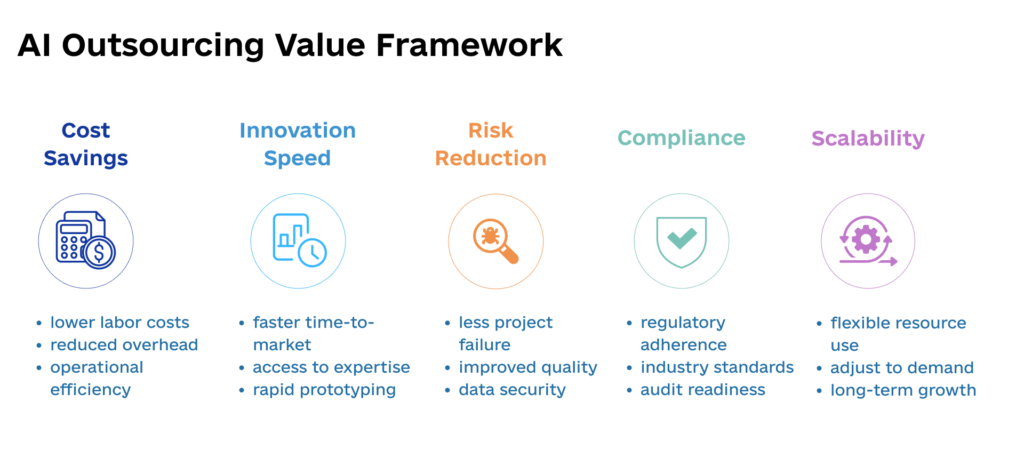
Cost efficiency is another attractive factor. Outsourcing can significantly reduce the operational costs of AI initiatives. Savings come from lower labor costs in offshore/nearshore locations, no need for investing in expensive AI infrastructure (since vendors often provide their own computing resources), and eliminating recruitment and training expenses. Instead of bearing fixed salaries and overhead for an in-house team, outsourcing allows a variable cost model where you pay for results delivered. This financial flexibility means you can scale spending up or down as project needs evolve.
Equally important, outsourcing frees up your internal teams to focus on core competencies. Routine AI development tasks can be handled by the external partner, while your in-house talent concentrates on strategic projects, product vision, and domain-specific innovation.. In short, AI outsourcing offers a cost-effective path to obtain world-class talent and resources, allowing you to do more with less and fast-track your AI agenda.
AI Outsourcing for Accelerated Innovation and Faster Delivery
Enterprises that can innovate quickly with AI gain a significant competitive edge. However, developing AI solutions in-house often takes many months or even years due to steep learning curves and experimental dead-ends. By contrast, working with experienced AI providers can dramatically accelerate time-to-market for new AI-driven products and features.
Outsourcing partners come ready with proven frameworks, pre-built components, and deep institutional knowledge of what works. Faster delivery is not just about writing code quicker – it also comes from the agile processes and reusable assets that specialized AI firms have developed. Reputable AI outsourcing companies typically maintain libraries of pre-trained models, templates for data pipelines, and automation tools that streamline the AI lifecycle (from data preprocessing to model deployment). They have honed best practices through many projects, avoiding common pitfalls that might trip up less experienced teams. All of this translates into accelerated innovation: you can rapidly prototype, test, and iterate on AI ideas. For example, rather than spending months building an AI proof-of-concept that might fail, an outsourced AI MVP development can deliver a functional prototype in a short sprint, allowing you to validate the concept and iterate quickly.
Moreover, being first to market with new AI capabilities can be crucial in establishing market leadership. Whether it’s implementing an AI-enhanced feature in your product or rolling out an internal AI automation tool, reducing the development cycle by even a few months can result in earlier ROI and a stronger competitive position. AI outsourcing gives enterprises the agility to experiment and innovate at startup speed, without being bottlenecked by internal resource constraints.
Reducing Delivery Risk with Proven AI Frameworks
Developing AI solutions comes with inherent uncertainties – from algorithm performance to data quality issues. Many AI projects stall or fail to meet objectives due to these complexities. Outsourcing can significantly reduce delivery risk by entrusting your project to teams who have successfully delivered similar solutions before. An experienced AI outsourcing provider brings battle-tested frameworks for project execution, governance, and quality assurance that de-risk the development process.
One major risk in AI initiatives is investing heavily only to discover the model doesn’t perform as expected or the project cannot be operationalized. Outsourcing mitigates this through an iterative, MVP-focused approach. For instance, 8allocate’s AI MVP development service emphasizes rapid prototyping and market validation to prove value early and minimize risks before scaling up full development. By starting small and refining the solution with real user feedback, you avoid the “all-or-nothing” risk of a big bang project. This incremental delivery ensures that technical or data challenges are identified early rather than after sinking huge costs.
Another way outsourcing reduces risk is by providing access to robust infrastructure and tools. Top AI firms have reliable devops pipelines, automated testing frameworks, and monitoring systems to ensure models are built and deployed with high quality. They also often have access to high-performance computing resources (GPUs, cloud clusters) optimized for AI workloads. This means your project runs in a stable environment with lower chances of unexpected failures due to infrastructure limitations. If an issue does arise, an experienced team likely has seen it before and can resolve it quickly, preventing long delays.
Crucially, outsourcing partners typically employ seasoned project managers and AI architects who enforce best practices in project management. They will set clear milestones, deliverables, and KPIs for the AI initiative. Regular progress reviews and transparent communication keep the project on track and aligned with your business goals. If scope changes or risks emerge, a mature vendor will flag them and adjust proactively, rather than letting problems fester. This level of governance and accountability can be hard to replicate if your internal team is new to AI projects.
There is also a risk-sharing element when outsourcing. Vendors are often bound by contracts with performance guarantees or outcome-based payment structures. This incentivizes them to deliver results and share some of the downside risk. Deloitte’s 2024 outsourcing report notes a shift toward value-based and outcome-driven relationships, where providers are as invested in results as the client. In practice, that could mean tying payments to achieving certain accuracy levels or business metrics, which reduces the risk of paying for a failed experiment.
Finally, outsourced AI experts stay up to date with the latest research and pitfalls in the field. They are aware of common failure modes (like model overfitting, drift, bias issues) and how to mitigate them, having learned from many prior engagements. This expertise greatly improves the success rate of AI projects. Instead of reinventing the wheel, your organization benefits from methodologies that have been refined over dozens of deployments. The result is a more predictable outcome with fewer surprises. As a bonus, your internal stakeholders gain confidence in AI when they see projects hitting milestones and delivering value, which builds support for further AI investment.
Ensuring Compliance and Security in AI Outsourcing
For enterprise leaders, one of the biggest concerns in any outsourcing is maintaining security, privacy, and regulatory compliance. This is especially true in AI projects, which often involve sensitive data and new algorithms that must adhere to emerging regulations. The good news is that a reputable AI outsourcing partner can help you navigate these requirements and even improve your compliance stance.
Data privacy and security should be front and center in any AI outsourcing arrangement. Leading AI service providers implement strict security protocols – from secure data transfer and encryption to access controls and compliance certifications (e.g. ISO 27001, SOC 2). When evaluating partners, it’s critical to choose one that has a strong track record in data protection and can integrate with your cybersecurity policies. Many enterprises require vendors to sign robust NDAs and data processing agreements to protect intellectual property and customer data. By outsourcing to a provider with mature security practices, you reduce the risk of data breaches or leaks compared to hastily ramping up an internal team that might not yet have those safeguards fully in place.
Regulatory compliance is another area where outsourcing can accelerate progress. AI and data regulations are quickly evolving – for example, the EU’s AI Act will impose stringent requirements on high-risk AI systems, and violations can incur fines up to 7% of worldwide annual revenue. Similarly, laws like GDPR and industry-specific rules (in finance, healthcare, etc.) set standards for how data can be used in AI models. Keeping abreast of all these rules is challenging. An experienced AI outsourcer will typically have compliance experts and governance frameworks baked into their process. They design solutions with regulations in mind, ensuring that from day one, your AI models have appropriate transparency, bias mitigation, and privacy controls.
Another benefit is that outsourcing firms often have cross-industry experience, so they understand regulatory nuances. For example, they will know how HIPAA affects an AI healthcare project or what model explainability is required under financial regulations. They can implement features like audit logs for model decisions or ensure algorithms are transparent and fair – things that regulators (and your own risk officers) will demand. By outsourcing, you gain these capabilities out of the box, rather than trying to build compliance expertise internally from scratch.
It’s also worth noting that outsourcing does not mean losing control over compliance or quality. On the contrary, you should establish clear contractual terms and SLAs with the vendor around security and compliance obligations. Define data handling procedures, ownership of AI models and data, and rights to audit the vendor’s practices. Many companies include clauses that require vendors to comply with specific standards and to report any incidents immediately. With proper vendor due diligence and ongoing oversight, outsourcing can be as secure as in-house development – and often more so, given the specialized focus vendors place on maintaining trust.
In summary, a strategic AI partner will treat your data and compliance requirements as sacrosanct. They bring not only technical know-how but also the governance know-how to ensure your AI initiatives meet the highest standards of security, ethics, and legality. This allows you to innovate with AI confidently, knowing that risk is managed and regulators (and customers) will be satisfied with the result.
Scaling AI/ML Capabilities with Outsourcing Partnerships
One of the hardest parts of enterprise AI adoption is scaling beyond initial pilots. Many organizations struggle to move from a successful prototype to a robust, enterprise-wide AI deployment. Here too, AI outsourcing provides a valuable advantage by enabling flexible, scalable resource allocation and expertise on demand.
Scaling AI isn’t just about adding more developers. It often requires scaling infrastructure, handling larger data volumes, retraining models as conditions change, and rolling out AI across different business units. An outsourcing partner can help on all these fronts. Because vendors have teams of varying skill sets, you can seamlessly ramp the team size up or down as your needs evolve, a key advantage when building a top-notch AI software development team. If a new project phase needs an extra data engineer or an additional ML specialist, the provider can allocate those quickly – without you having to hire or reassign internally. Conversely, once a project is in maintenance mode, you might scale the outsourced team down to a smaller support crew, optimizing costs. This elasticity is difficult to achieve in-house, where hiring/firing or re-training staff takes time. McKinsey has noted that companies leveraging outsourcing can scale their AI initiatives about 30% more efficiently than those relying only on in-house teams.
Beyond human resources, outsourcing partners also offer scalable technical infrastructure. They often utilize cloud platforms and MLOps tools that allow AI models to be deployed and scaled reliably. For example, if your AI application needs to handle 10x more users or data, an experienced vendor will know how to distribute workloads, optimize model performance, and manage costs using cloud-native solutions. They can also incorporate advanced technologies (like containerization or automated CI/CD for ML) to ensure your AI systems grow sustainably. This means you won’t hit a wall when trying to go from a pilot serving 100 people to an enterprise solution serving millions – the architecture will be ready to expand.
Geographic scalability is another facet. If you need 24/7 development progress or support, outsourcing teams across different time zones can provide round-the-clock productivity. Many enterprises in the US and Europe collaborate with skilled AI engineers in Eastern Europe, India, and other tech hubs. These locations offer a strong talent base and lower costs, effectively creating a “follow the sun” model for development and support. As a result, your AI capabilities can expand globally without the friction of building new offices or relocating staff. In Deloitte’s global survey, 80% of executives said they plan to maintain or increase investments in third-party outsourcing, and many are leveraging it even for front-office and R&D functions. This underlines that companies see outsourcing as key to scaling core innovation capacity, not just back-office tasks.
Importantly, an outsourcing partnership can be long-term, evolving as your AI maturity grows. Early on, you might lean on the vendor for strategic guidance and building initial solutions. Over time, they can help you set up internal AI centers of excellence or even transfer knowledge to your team (a “build-operate-transfer” model). The relationship can flex from pure development to consulting, training, and support as needed. The ultimate goal is to embed AI into your business at scale – from automating dozens of processes to infusing AI insights into decision-making company-wide. A capable outsourcing partner will align with this goal and have a roadmap to get you there. They act as an extension of your team, providing the momentum and expertise to scale AI/ML initiatives efficiently across the enterprise.
Key Steps for Successful AI Outsourcing
While AI outsourcing offers many benefits, achieving those outcomes requires a thoughtful approach. Enterprise leaders should approach an AI outsourcing initiative with the same rigor as any strategic project. Below are key steps and best practices to ensure a successful partnership:
- Define Clear AI Objectives and Metrics: Start with a well-defined AI strategy or problem statement. What business goal will the AI solution serve (e.g. improve customer experience, automate a workflow, increase revenue)? Establish the success metrics (KPIs) upfront – whether it’s model accuracy, reduced processing time, or ROI – so both your team and the vendor know how success will be measured. Clear objectives and measurable outcomes provide focus and accountability from the outset.
- Choose the Right Engagement Model: Determine the outsourcing model that fits your needs by understanding the dedicated AI development team model. This could be a project-based contract for a specific AI solution, staff augmentation to add AI experts into your existing teams, or even a dedicated offshore AI team for your organization. For example, if your goal is to prototype quickly, an AI MVP development project with a defined scope makes sense. If you have ongoing AI development needs, an extended team model might be better. Align the model with your timeline, budget, and desired level of control. Many companies adopt a pilot project first – a small engagement to test the waters with a vendor before committing to larger programs.
- Select a Qualified AI Partner: Not all AI outsourcing providers are equal. Do thorough due diligence. Look for a partner with a proven track record in similar AI projects and relevant domain expertise (e.g. if you’re in finance, a provider who understands fintech and regulatory constraints). Ask for case studies or client references. Evaluate their technical stack and competencies – are they versed in the latest ML frameworks, cloud platforms, and MLOps practices? Also consider cultural fit and communication: a great provider will act as a strategic partner, not just a code factory. Evaluate their fluency in your language and time zone alignment for smooth collaboration. And ensure they have robust security and compliance standards, as discussed earlier. It often helps to conduct a small trial or workshop with the top candidate vendors to assess their capabilities before finalizing the contract.
- Establish Strong Governance and Communication: Treat the outsourced team as an extension of your own. Set up regular check-ins (e.g. weekly sprint reviews, monthly steering meetings) to monitor progress. Define roles and responsibilities clearly – your internal product owners and the vendor’s project manager should be in constant contact. Use collaboration tools and agile methodologies to maintain visibility. Also set up a governance structure: identify who on your side will oversee the vendor relationship and ensure deliverables meet your quality standards. Define escalation paths for any issues. A well-governed project will keep everyone accountable and working toward the same goals, greatly increasing the chances of success.
- Start with a Pilot and Iterate: Especially if it’s your first AI outsourcing experience or a new vendor, it’s wise to start with a pilot project or MVP. This could be a 8-12 week engagement to build a small prototype or tackle a low-risk use case. A pilot lets you evaluate the vendor’s performance on a manageable scale. You can iron out communication kinks, gauge the quality of work, and build trust. If the pilot is successful, you can then scale up the project or initiate additional projects with confidence. This iterative approach also aligns with AI development best practices – it’s often better to start narrow, get quick wins, and then expand scope once value is proven.
- Plan for Integration and Knowledge Transfer: As the outsourced AI solution nears completion, ensure there is a plan to integrate it into your business processes and IT environment. This might involve training your end-users or IT staff, updating workflows, or integrating the AI system with your existing software. A good outsourcing partner will include documentation, user training, and change management support as part of their delivery. Additionally, make sure there is a knowledge transfer component – you want your internal team to learn from the engagement. For example, have vendor data scientists pair with your analysts, so your people pick up new AI skills. Over time, this builds your own organization’s AI maturity. Even if the vendor will continue maintaining the solution, having internal understanding prevents you from being completely dependent on the provider and improves long-term agility.
By following these steps, enterprises can maximize the benefits of AI outsourcing while minimizing potential pitfalls. The goal is to create a win-win collaboration where the outsourcing partner delivers tangible value and innovation, and your internal team provides direction, domain knowledge, and integration support. Many successful AI outsourcing relationships evolve into strategic partnerships that last years, driving continuous improvement and innovation. Careful planning and execution at the start will set the foundation for that long-term success.
Conclusion
AI outsourcing has emerged as a powerful strategy for enterprises not just to cut costs, but to accelerate innovation, manage risks, and scale AI capabilities efficiently. By leveraging external expertise, companies can overcome the talent shortage, rapidly bring AI initiatives to life, and ensure those solutions are robust, compliant, and poised for growth. The key is approaching outsourcing as a strategic partnership – with clear goals, the right partner, and strong governance – to truly unlock its full value by choosing an AI partner that drives business growth. When done right, outsourcing AI development can compress years of learning into months and turn stalled AI ambitions into real competitive advantages.
If your organization is looking to fast-track its AI journey, now is the time to consider a trusted partner. 8allocate is an AI solutions development company that specializes in helping businesses accelerate AI adoption with expert consulting and AI development teams. From AI strategy consulting to AI custom solution development, we provide end-to-end support to ensure your AI projects succeed. Let us help you turn your AI vision into reality, faster and more effectively than going it alone.

Frequently Asked Questions on AI Outsourcing
Quick Guide to Common Questions
How do we decide which AI projects to outsource versus do in-house?
Start by assessing the complexity and strategic importance of each project. Projects requiring specialized expertise that your team lacks, or those with an urgent timeline, are strong candidates for outsourcing. For example, if you want to implement a cutting-edge computer vision model and you have no CV experts on staff, outsourcing makes sense. On the other hand, core strategic AI capabilities that you want to become an internal strength might be developed in-house (perhaps after an initial external boost). Many enterprises use a hybrid approach: they outsource initial development of an AI solution and then gradually bring maintenance in-house once it’s stable. Evaluate factors like: required speed, available internal talent, data sensitivity, and long-term strategic value. Outsource to kick-start or accelerate initiatives where you need the extra help, and use those engagements as opportunities for your team to learn. Over time, you’ll get a feel for which areas to keep inside and which to hand off – it’s often an evolving line rather than a one-time decision.
How do we ensure data security and IP protection when outsourcing AI development?
Data security and intellectual property (IP) protection are critical considerations. To ensure safety, first choose a vendor with a robust security reputation – one that complies with standards like ISO 27001 and has clear policies on data access and confidentiality. Put strong NDAs and data processing agreements in place before sharing any data. You can also anonymize or tokenize sensitive data so that the vendor works with de-identified information. Clearly define in the contract that all IP developed (models, code, etc.) will be owned by your company, and ensure the vendor waives any rights to the algorithms or data. It’s wise to review the vendor’s security infrastructure – do they use encrypted connections, secure cloud environments, role-based access controls for their engineers? During the project, maintain access logs and possibly segregate critical pieces so that no single vendor staff has full access to everything. Finally, conduct periodic security assessments or code reviews if possible. By taking these precautions and selecting a trusted partner, enterprises can outsource AI work while maintaining full control over their data and IP.
What if the outsourced AI model is critical to our business – do we risk losing control or expertise?
It’s a common concern that outsourcing a critical AI system could leave your company dependent on an external party. The key to avoiding this is knowledge transfer and joint involvement. Even if a vendor builds the AI solution, ensure your internal stakeholders are embedded in the project – e.g. your data scientists or product managers work closely with the vendor’s team, attend all design discussions, and understand how the model works. Require the vendor to produce extensive documentation and training for your staff. You might even have your team do a code review or pair-program on some components to absorb knowledge. Some companies negotiate an option to hire key vendor talent or bring the team in-house after a certain period – this could be part of a build-operate-transfer model where the fully functioning solution and team transition to the client. Also, make sure you have access to the source code, model weights, and all ancillary tools or scripts. With these measures, you won’t be “locked out” of your own critical AI asset. In fact, a good outsourcing partner will aim to empower your organization, not create dependency. If at any point you want to take over maintenance or switch vendors, you should have everything needed to do so. Ultimately, outsourcing critical projects is fine as long as you maintain ownership of the output and invest in internal capacity to manage it going forward.
How can we measure the success and ROI of AI outsourcing?
Measuring the success of AI outsourcing should tie back to the objectives you set and the business value delivered. First, track the project delivery metrics: Did the project meet its defined success criteria (accuracy, performance, etc.)? Was it delivered on time and on budget? For example, if the goal was to develop a customer service chatbot, measure improvements in response time or customer satisfaction after deployment. Next, assess the return on investment (ROI): compare the outcomes achieved to the cost of outsourcing. This could be quantified in efficiency gains, revenue increases, cost savings, or risk reduction. Many companies calculate things like how much process cycle time was saved by the new AI system, or how much new revenue a recommendation engine generated, and then weigh that against the project cost. Also consider the opportunity cost – outsourcing often enables faster delivery, so factor in the value of getting to market sooner (e.g. several months of additional productivity or sales that an in-house delay might have lost). Another angle is measuring how outsourcing improved your team’s capabilities: did your internal staff gain new skills or free up time for other high-value work? Finally, gather stakeholder feedback – are end users satisfied with the AI solution? Did the engagement meet your expectations in quality and collaboration? A successful AI outsourcing engagement will show positive results in hard numbers and in softer benefits like improved innovation capacity. By monitoring these aspects, you can clearly demonstrate the ROI to executives and make informed decisions about future outsourcing initiatives.
What are the typical challenges in AI outsourcing, and how can we mitigate them?
Some common challenges include communication gaps, mismatched expectations, quality control issues, and cultural differences. To mitigate these, start with very clear requirements and success criteria as mentioned. Invest time upfront in onboarding the vendor – ensure they fully understand your business context, data, and what you’re trying to achieve. Communication is critical: schedule regular sync-ups, use collaboration tools (Slack, Jira, etc.) for transparency, and consider occasional in-person or video meetings to build rapport. Time zone differences can be a challenge, so establish overlapping work hours or a communication protocol that works for both sides. Another challenge is maintaining quality and technical alignment. To handle this, set intermediate milestones (like a proof-of-concept demo, a mid-project review) to catch any deviations early. Have your technical team conduct periodic reviews of deliverables. Culturally, some teams might be hesitant to point out issues – encourage a culture of openness with your vendor, where they feel comfortable raising concerns or suggesting better approaches. Also be mindful of scope creep – AI projects can evolve, but uncontrolled changes can derail timelines; manage this by formal change requests and re-planning when needed. Lastly, differences in work style or decision-making can arise – bridging this requires a bit of flexibility on both sides and maybe a liaison on your team who is good at navigating cross-cultural collaboration. By anticipating these challenges and addressing them proactively (with good contracts, communication plans, and oversight), you can greatly increase the chances of a smooth and successful outsourcing experience.