Artificial intelligence isn’t not a hype technology anymore, but that doesn’t mean businesses are sufficiently using its great potential. As evidenced by the 2024 The Economic Times survey, a majority of business executives across various industries agree AI will enhance their productivity but admit their leadership teams don’t fully understand AI’s gains and applications.
From automating mundane tasks and better customer services to supply chain optimization and increasing cybersecurity, this is a small fraction of AI for business efficiency and operations can help you with.
Below, we share tried-and-true techniques you can use to integrate AI into your business operations right now.
Techniques That Help Entrepreneurs Enhance Efficiency with AI
Although AI’s applications are widespread, as a business leader, you should be wise to take thoughtful steps when introducing this technology. Thoughtful AI integration can significantly improve efficiency and innovation in business operations. It’s vital to ensure that AI products contribute to your business objectives, rather than diverting resources from critical areas without delivering value.
Here are the 6 effective methods you can consider to maximize your operational efficiency with AI technology.
Automate workflow management by automating tasks
One key strategy that you can implement is integrating AI-powered solutions to automate tasks, streamline processes, reduce manual tasks, and discover opportunities for improvement within workflows through AI for business process automation. AI tools can enhance various aspects of business operations, from streamlining customer service to supporting advanced logistics. DHL Supply Chain, a world-leading logistics company, has implemented AI algorithms in their Resilience360 platform. The company states that this technology has enabled them to improve order-picking processes and reduce warehouse employees’ travel distance by 50%. FedEx is using AI technologies, such as robotic sorting arms and autonomous vehicles, to enhance efficiency in their logistics operations and cater to the increasing e-commerce demands. And there are many other real-world examples of organizations that have introduced AI for internal process optimization.
The main condition for the successful adoption of AI in your business processes is the readiness of your IT infrastructure to scale and integrate with AI-based software. If you have outdated corporate systems, it will be impossible to adopt AI solutions due to integration challenges. Therefore, before embarking on AI/ML implementation and integration, it’s critical to evaluate your current processes and infrastructure to ensure your organization is prepared to adopt AI technologies.
Identity patterns through data analysis
Advanced machine learning algorithms automate data processing tasks, uncover actionable insights through data analysis, and predict trends from enterprise data. Understanding customer behavior through AI can help businesses make informed decisions. It’s all possible through predictive analytics tools, such as BI tools, Big Data analytics platforms, etc., when integrated into internal business systems. For example, financial organizations can employ AI-driven solutions with predictive analytics to enhance their investment strategies. By scrutinizing historical market data and determining patterns, AI models forecast future market trends and investment opportunities. Analyzing customer data can also enhance marketing and sales strategies.
BlackRock, an American multinational investment company, integrates AI into its financial modeling processes, allowing for market trend anticipation and strategic investment decisions. The use of predictive analytics helps BlackRock enhance risk control, refine investment strategies, and optimize asset management with higher accuracy and foresight.
As a strategic partner with expertise in AI, we recognize that AI’s ability to identify patterns is reshaping competitive landscapes by empowering organizations with predictive analytics capabilities. Specifically, businesses can streamline supply chains by forecasting demand fluctuations, strengthen cybersecurity by identifying anomalies in real time, and personalize client experiences through scrupulous behavior analysis.
Support client service teams
Business leaders say one of their top priorities for the coming years is to enhance customer experience and improve customer satisfaction by leveraging AI to provide personalized customer experiences, as evidenced by McKinsey’s 2023 research.. More than 80% of executives say generative AI will be engaging directly with customers in the next two years, according to the IBM Institute for Business Value 2023 report.
Tools developed through AI, chatbots, virtual assistants, script suggestions, self-service options, to name a few, can take over repetitive and mundane tasks, allowing client service teams to focus on more nuanced and high-value interactions. AI can also provide valuable insights to improve business decision-making and optimize employee performance. Done wisely — through the symphony of technology and human empathy — it is a strategic area where you can foster customer loyalty through a more tailored experience while maximizing business efficiency. Those organizations that will ignore the generative AI trend risk falling behind their competitors.
Here is one thing we would like to highlight about using AI in customer service assistance. Companies are still struggling to resolve Artificial Intelligence’s trust issue. Therefore, you need a balance between introducing AI in your business strategy and maintaining a strong human touch.
Interested in using AI in customer service? Check our “AI for Customer Support Playbook” on best practices of adopting AI technologies in customer support operations backed with real-life examples, test on AI readiness for your company, and much moreIt’s good to prioritize AI for handling mundane tasks like order tracking, account balance checking, and password resets, while ensuring empathy in business-client relationships. In this context, I appreciate the words of Spiros Margaris, a leading venture capitalist, who said, ‘Trust in AI is no different from the trust we expect with our friends. It’s the same we expect from a company, the same we expect from AI. If we don’t trust AI, we won’t want to be friends with it; we won’t want to be exposed to it.’
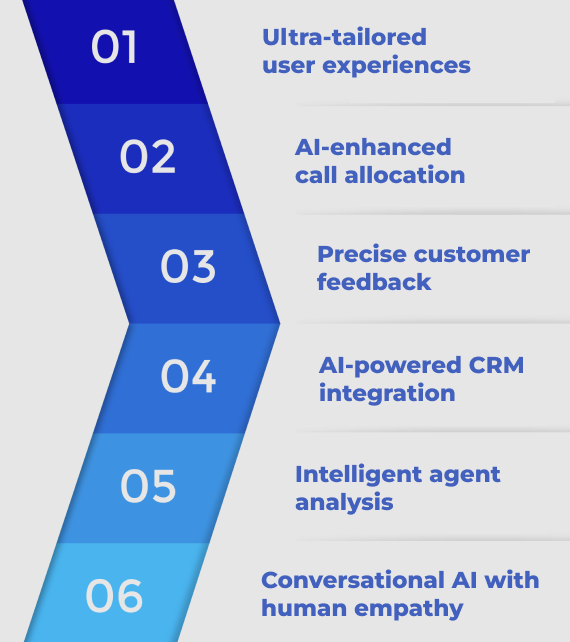
Why use AI in customer service:
Increase cyber defenses with AI tools
Over half of business leaders employ artificial intelligence for cybersecurity and fraud control, according to the data from the Forbes Advisor survey. By incorporating AI into your business cybersecurity systems, you can enhance operational efficiency by leveraging advanced capabilities such as predictive analytics, threat detection, and automated incident response. Security systems based on AI can ratify malware attacks, network intrusions, phishing and spam emails, and data breaches, to name a few, and proactively address security incidents before they exploit vulnerabilities.
Indeed, using AI in cyber defense is a double-gates game. Why so? You may see headlines surrounding the effect of AI on cybersecurity, with two main perspectives: “bad AI” and “good AI.” Surely, this is a broad generalization, but it shows the contrasting ways businesses can use AI in cybersecurity.
On the one hand, AI in cybersecurity can provoke security issues, as cybercriminals can employ it to automate and expand their malicious actions. On the other hand, when properly defended and monitored, AI can be applied to foster security architecture by building robust AI-driven security software that detects and responds to security-related issues in real-time.
AI’s duality highlights the importance of elaborated AI adoption strategies in your cybersecurity system. Therefore, it’s crucial to carefully plan before implementing AI-driven cybersecurity solutions to maximize their benefits while mitigating potential risks.
Microsoft is a good example of how organizations can use AI to force security posture. The company employs AI within its Intelligent Security Graph to safeguard its cloud infrastructure. This AI system processes over 6.5 trillion signals daily, helping Microsoft detect threats in under an hour — a dramatic reduction from the previous 24-hour detection timeframe.
Streamline supply chains
A 2024 McKinsey research revealed that organizations reported achieving the greatest cost savings through AI implementation in supply chain management compared to other business functions. These savings are primarily referred to reductions in human resource expenditures. Additionally, integrating AI-driven software in supply chain and inventory management can lead to a revenue increase of up to 5%, according to the same research.
The escalating focus on real-time insights and anticipating future trends are stimulating logistics and e-commerce businesses to use AI for optimized stock management and more precise AI demand forecasting. Leveraging AI can optimize resource allocation and improve decision-making in supply chains. The widespread adoption of autonomous systems and robotics also drives the trend toward AI technologies adoption in logistics.
For example, for a logistics and transportation company, 8allocate team built an AI-powered shipping container recognition system that leveraged machine learning and computer vision to automatically recognize container labels and numbers. The AI-based system we created allowed the logistics business to streamline their supply chain operations, reducing errors and cutting operational costs by 10%. We continue to work with the client, and the company has plans for further development of their logistics solution with AI.
This is a good example of how AI is refining supply chain management by automating complex processes, improving accuracy, and reducing operational inefficiencies. By integrating AI, logistics businesses can reduce costs, increase speed, and provide a higher level of service to their customers.
Optimize sales and marketing
Artificial intelligence is deeply rooted in the digital marketing landscape, with the global AI marketing value projected to surge from $36 billion in 2024 to $108 billion by 2028, based on the data from Statista report. This astonishing growth underscores that AI will significantly impact sales and marketing functions.
Artificial intelligence can make sales forecasting more accurate, adjust pricing strategies in real time, optimize ad spending, and improve customer experiences at every touchpoint with the brand. And this is just scratching the surface. Then, going deeper, you can unpack data-driven insights to understand what marketing initiatives were working and why.
AI’s ability to process vast amounts of data and deliver real-time insights is revolutionizing the marketing landscape. The effectiveness of AI in sales and marketing will hinge on smart integration and cooperation with intelligence technology.
Conclusion
Looking ahead, smart technologies will advance, and more business leaders will integrate AI into their workflows to chase efficiency and innovation. So, if you and your team are performing tasks that AI is capable of doing faster and more efficiently, it’s time to review your internal processes and consider integrating AI for business operations optimization.
Here are a couple of recommendations to get started with AI initiatives to maximize business efficiency:
- Create a vision and road map. Come up with a “North Star” vision for your marketing future, where AI solutions can address time-, cost-, and resource-intensive tasks.
- Engage a team to get it done. Collaborate with a technology partner with the necessary skills and expertise to successfully build and implement AI-based products.
- Get some fast wins going. Start small; begin with a pilot solution in one business area where AI can have the most impact.
- Measure impact and plan for growth. Finally, establish and track KPIs to assess effectiveness and analyze the outcomes. See the advancements? Great. After one to two years, use these insights to decide on scaling up the AI initiatives.
If you need help building and integrating AI solutions into your processes, contact us. At 8allocate, we have the expertise to deliver AI for optimizing business operations and boosting your efficiency. Our team will guide you through every step of the AI implementation process, from understanding your business needs for smart solutions to deployment and continuous support.

Frequently Asked Questions
Quick Guide to Common Questions
How can AI improve operational efficiency in businesses?
AI enhances efficiency by automating repetitive tasks, streamlining workflow management, optimizing supply chains, improving decision-making with data analytics, and enhancing customer service with AI-driven chatbots and assistants.
What AI-driven automation strategies improve workflow management?
Implementing AI-powered process automation reduces manual workloads, increases accuracy, and identifies optimization opportunities. Businesses can integrate AI into logistics, finance, and customer support to improve efficiency and scale operations seamlessly.
How does AI support customer service teams?
AI-powered virtual assistants, chatbots, and sentiment analysis tools help automate customer queries, improve response times, and provide personalized interactions while allowing human agents to focus on complex cases requiring empathy and decision-making.
What role does AI play in cybersecurity?
AI-driven security systems detect threats in real-time, prevent fraud, and automate incident responses. By analyzing behavioral patterns and anomalies, AI enhances cyber defenses and mitigates risks before they escalate.
How can AI optimize supply chains?
AI improves demand forecasting, inventory management, and route optimization, leading to reduced costs and better resource allocation. Businesses implementing AI in logistics see faster deliveries, fewer errors, and higher profitability.
How does AI enhance sales and marketing efforts?
AI-powered tools analyze consumer behavior, personalize marketing campaigns, optimize pricing strategies, and improve lead generation. Predictive analytics allows businesses to make data-driven marketing decisions and increase conversion rates.
What challenges do businesses face when integrating AI?
Common challenges include legacy system compatibility, data privacy concerns, lack of in-house AI expertise, and unclear ROI measurement. Businesses should assess AI readiness and ensure their IT infrastructure supports AI adoption.
How can businesses successfully implement AI solutions?
- Define clear objectives aligned with business needs.
- Start small with a pilot project to validate AI’s impact.
- Engage AI experts or technology partners for development and integration.
- Monitor and refine AI models based on real-world performance.
How does 8allocate support businesses in AI implementation?
8allocate helps businesses develop, integrate, and scale AI-driven solutions by assessing current systems, designing tailored AI models, and ensuring seamless deployment for enhanced efficiency and innovation.