
In 2006, British mathematician Clive Humby coined the catchphrase that “data is the new oil”. Similar to crude oil, data in its raw state has almost no value. But when it’s refined, processed, and transformed into something more useful (e.g., a business report), its value skyrockets.
Many businesses today still sit on massive data reserves, but far fewer operate an effective “refinery” and thus benefit from the data they own. If that sounds like your case, this post explains how to start building up a strong base for your data analytics program.
What is Data Management?
Data management is the combination of lifecycle processes, policies, and procedures aimed at establishing an effective information lifecycle at a company. It covers all processes related to data collection, organization, storage, and analytics.
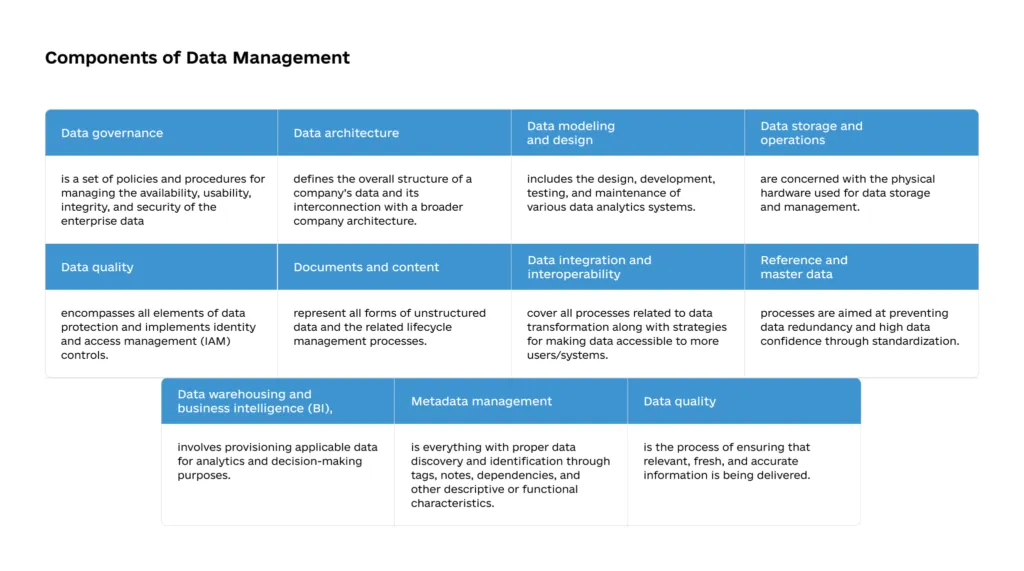
DAMA, an international consortium of master data management professionals, identifies the 11 key components of data management:
Key Data Management Objectives
The fundamental goal of data management is to ensure that data in corporate systems is accurate, available, accessible, and well-secured.
A strong data management process is crucial for effective business process execution, as well as deployment of various data analytics use cases, ranging from IT infrastructure monitoring and baseline financial analytics to predictive, AI-driven models.
Without a fail-proof data management process, analytics is impossible at worst and unreliable at best.
Other objectives of data management include:
- High data trust. Integrity and high confidence in data accuracy, authenticity, relevancy, reliability, and usefulness are the main reasons for investing in better data management processes.
- Wider data availability. With the optimal data management strategy, access to data takes minutes, rather than months. Datasets can be resurfaced from relevant systems and used for ad-hoc data science projects or queried with business intelligence (BI) tools.
- Improved collaboration. All people on your team have streamlined access to the data they need to perform their jobs via self-service tools, pre-built dashboards, or custom analytics applications. Most of the data flows are automated, synced, and updated in real-time, offering a 360-degree view into various aspects of the business.
- Permissioned access. The right people (and applications) have appropriate permission levels for different data operations. Sensitive data is well protected and analytics systems only use anonymized data when required.
- Easy auditing. Data management establishes clear data lineage and data ownership structure. Organizations can easily track data origination paths and monitor how different users and systems consume data.
- Compliance. Data is collected, stored, and operationalized in line with applicable industry regulations. Relevant reports can be easily provided to the monitoring authorities.
In short, good data management practices help organizations become data-driven.
Data-driven companies rely on timely, unbiased, and accurate insights in most of their decision-making processes. They treat data as a strategic asset and build capabilities that enable its usage at every level and function.
Coca-Cola, for example, actively expanded its data analytics functions over the years. Its artificial intelligence (AI) algorithms were trained on customer data from 200+ countries and now provide the management with insights for new product development. The company employs supply chain analytics, based on data about weather, crop yields, pricing, and taste, combined with satellite images, to secure the best procurement deals for oranges. The algorithms also match customer tastes across markets to local ingredient availability
Data and advanced analytics techniques also help the company’s sales workforce make better decisions for ordering specific products and quantities to minimize out-of-stock incidents.
Overall, McKinsey estimates that data-driven organizations achieve 15% to 25% EBITDA increases and report above-market growth.

Data Management Trends for 2023 and Onward
Data management went a long way from rudimentary, rule-based models and on-premises data storage. From self-service analytics to collaborative data ecosystems, companies today are actively evolving their data management capabilities.
Data Embedded in Every Process
Data is in no short supply, but access to it is often constrained due to system interoperability issues and limitations of legacy data querying approaches. Traditional ETL (extract, transform, load) and ELT (extract, load, transform) pipelines cannot cope with the organizations’ demands for real-time insights and concurrent dataset querying.
Emerging architecture patterns like data mesh and data fabric are helping companies accelerate the speed and quality of analytics. Amazon, for example, built out a new data lakehouse infrastructure with data mesh components for its supply chain function. With the new architecture, the company saw a 10X increase in query performance and reduced the response times to clicks or filter selection from 60 seconds to only 4-6 seconds. With higher data processing capabilities, Amazon managed to bring high-quality, consistent, and reliable analytics to more users and embed insights into more workflows.
Companies now also aim to bring data closer to users by providing them with self-service data management tools for exploratory data analysis and premade, curated datasets. Self-serve interfaces are implemented to promote internal data sharing (between departments) and external data sharing (with the ecosystem partners).
The global self-service BI market is expected to grow from $7.1 billion in 2022 to $14.7 billion by 2029.
McKinsey predicts that by 2025, nearly all enterprise employees will regularly leverage data to support their work and will leverage data management techniques to resolve operational challenges in hours or days, rather than months.
Focus on Observability
Data analytics has progressed tremendously from rule-based, statistical systems to self-learning AI algorithms. Companies in the EdTech and FinTech sectors among others already heavily rely on intelligent models to deliver more innovative products.
Yet, the common challenge of using AI-powered analytics is understanding their behavior in production. Machine learning models are prone to drift — a decay of performance over time, which decreases their accuracy levels, compared to the training period.
The common causes of model drift are data quality issues, in particular training done on outdated data or inability to properly process fresh data insights.
To promote model longevity and efficacy, organizations are now increasing their focus on data observability — a set of processes, aimed at proactive detection, resolution, and prevention of data anomalies.
Observability enables organizations to reduce the time it takes to identify the root cause of performance-impacting problems and make timely, cost-effective business decisions using reliable and accurate data,
says Gareth Herschel, a VP Analyst at Gartner.
Among companies with mature observability practices, 100% indicate that these help improve revenue retention through a better understanding of customer behaviors, compared to 34% whose practices were less mature.
Flexible Data Storage
Organizations struggle to grapple with multiplying data volumes. Some 60% of US companies feel overwhelmed by the amount of managed data. And 75% believe that their current infrastructure won’t be able to meet the upcoming demands, according to a Hitachi Vantara report.
As part of their data infrastructure modernization efforts, smart leaders are switching from homogeneous to multiplex data environments. Leaders now combine different database types — NoSQL databases, time-series, and graph structures — to enable more flexible ways of data storage and organization.
By combining different types of databases, you can better accommodate structured and semi-structured data, plus map the relationships between such assets. Effective data organization is key to deploying AI-driven models and real-time data analytics.
Collaborative Data Ecosystems
Leaders realize that joining up forces in data collection and analysis harnesses better results. A Capgemini study found that companies using more than 7 data sources experience nearly 14X fixed-asset turnover and achieve 2X market capitalization, compared to peers who don’t leverage any external data for decision-making.
So it should be a surprise that 84% of companies plan to launch collaborative data ecosystems within the next three years.
A collaborative data ecosystem is the practice of combining data and technology assets to create joint value that is greater than each participant can create individually. Such partnerships require seamless integrations, governance, and technical interoperability between the participating sides, as well as a shared vision for expected outcomes.
Emerging technologies such as federated analytics and federated learning help participants implement granular data sharing and privacy-focused access to insights to harness the benefits without magnifying compliance risks.
Main Data Management Challenges
Most businesses aspire to be data-driven. But far fewer actually are at the high levels of data management maturity. Although 71% of business leaders agree that their company values data, only 19% have strong data management in place.
Such a large gap between aspirations and reality is often caused by the following data management challenges.
Complex Data Landscape
Data gets produced at skyrocketing volumes. By 2025 the total amount of business data will reach 175 zettabytes. That’s far from being the plateau. With the proliferation of sensing technologies, increased levels of connectivity, and increased process digitization, the growth of data will only accelerate.
Data now originates from multiple sources — internal and external APIs, business apps, IoT devices — and gets stored in multiple locations, on-premises and in the cloud. The volume and variations in data formats require tremendous efforts for data standardization and transformation.
Enterprises also have vast raw data reserves in multiple business systems, ranging from on-premises databases to cloud-based CRM software. Yet, resurfacing such data for analytics is hard due to poor system interoperability and insufficient data processing infrastructure.
Growing Infrastructure Costs
Big data volumes translate to big operational bills. Over 80% of data managers ranked “cost control” as a challenge for their data ecosystem. Cloud storage boasts limitless scalability, but it comes at a cost. Usage-based pricing models introduce a month-to-month cost variability, making budgeting harder.
Moreover, haphazard usage of cloud data lakes as a central repository for aggregated raw insights eventually breeds data swamps — badly designed, poorly maintained, and exorbitantly expensive data lakes.
Data warehousing (DWH) solutions, in turn, promote greater data structure but come with even higher operating costs. DWHs are also better suited for supporting standard analytics use cases and are less suitable for running complex ML/DL models,
Low Data Confidence
Chaotic data storage leads to high levels of data duplication and low data traceability. As a result, organizations cannot evaluate the completeness, accuracy, and relevancy of available data, which leads to skewed decision-making.
Three-quarters of business leaders have difficulty understanding the data available due to its poor quality or lack of wider contextual clues.
Organizations also struggle with the misalignment between the available data management and the evolving business requirements. Legacy ETF/ETL pipelines cannot be scaled to support a growing number of users. Data silos, in turn, increase the time data teams need to deliver requested data sets.
Regulatory and Security Issues
Without proper management, data can turn from being the most valuable asset in your company to one costly liability.
The global average cost of a data breach in 2023 was USD 4.45 million, a 15% increase over 3 years.
Companies aren’t doing enough to protect their growing data estates, which are a lucrative target for hackers. Over six million data records were exposed as a result of data breaches worldwide during the first quarter of 2023.
The regulatory landscape also continues to evolve with new data privacy laws emerging around the world. Depending on the industry, you may be subject to: GDPR, HIPAA, CCPA, Colorado Privacy Act, New York SHIELD Act, or the EU-U.S. Data Privacy Framework. In each case, most regulators want businesses to provide direct evidence of their abilities to ethically collect or exchange, securely store, and discretionary analyze the obtained customer data.
Solving the above challenges is impossible without an effective data management strategy.
How 8allocate Can Help with Data Management
8allocate helps companies turn their big data reserves into new business opportunities through strategic process transformation and new effective data management solutions.
Whether you’re trying to decide on the optimal tech stack and data storage patterns or seeking hands-on expertise with machine learning development, our data engineering teams are up to the task.
We have successfully shipped data analytics products for the financial industry, developed scalable data lakehouse architecture to support predictive analytics solutions, and shipped cognitive computing applications with NLP, DL, and ML features.
Contact us to receive further information about our data engineering capabilities and successfully delivered projects.
Frequently Asked Questions
Quick Guide to Common Questions
What is data management, and why is it important?
Data management is the process of collecting, organizing, storing, and analyzing data to ensure accuracy, security, and accessibility. It enables businesses to extract value from their data, make informed decisions, and drive operational efficiency. Without structured data management, analytics becomes unreliable, and regulatory compliance becomes challenging.
What are the key objectives of a strong data management strategy?
The main goals of data management include ensuring data accuracy, accessibility, and security. Effective data management enhances decision-making, fosters collaboration through self-service data access, streamlines compliance, and improves operational efficiency. Organizations that manage data well can trust their insights and act on them with confidence.
How does data management contribute to business success?
Data-driven organizations use analytics to optimize processes, improve customer experiences, and create new revenue streams. Companies like Coca-Cola leverage data management to enhance supply chain efficiency, personalize marketing efforts, and refine product development strategies. Businesses that integrate data management into decision-making achieve faster growth and higher profitability.
What are the emerging data management trends?
New trends in data management focus on making data more accessible and actionable:
- Embedded Data in Every Process: Companies are adopting data mesh and data fabric architectures to improve real-time analytics and system interoperability.
- Observability for Data Accuracy: Organizations are prioritizing data observability to detect anomalies and prevent AI model drift.
- Flexible Data Storage: Businesses are integrating different database types (NoSQL, time-series, and graph databases) to store and process data more efficiently.
- Collaborative Data Ecosystems: Companies are sharing insights with partners and leveraging federated learning to improve decision-making without compromising data privacy.
Why is real-time data access becoming a priority?
Traditional ETL and ELT pipelines struggle to keep up with the need for instant insights. By implementing real-time data processing, businesses can act on trends as they happen, rather than relying on outdated reports. Companies like Amazon have achieved significant performance gains by adopting advanced data lakehouse architectures, reducing response times and improving user experience.
What challenges do companies face in managing their data?
Many organizations struggle with:
- Complex Data Landscapes: Multiple data sources, formats, and storage locations make it difficult to create a unified view.
- Rising Infrastructure Costs: Cloud storage and processing expenses increase as data volumes grow, requiring careful cost management.
- Low Data Confidence: Inaccurate, inconsistent, or duplicated data leads to poor decision-making.
- Regulatory and Security Concerns: Strict data privacy laws and evolving cybersecurity threats require strong governance and compliance measures.
How can businesses improve data quality and trust?
High-quality data requires governance frameworks that establish clear ownership, validation rules, and monitoring mechanisms. Organizations should implement:
- Data observability tools to detect inconsistencies and anomalies.
- Standardized data pipelines for consistent transformation and integration.
- Automated compliance monitoring to ensure regulatory adherence.
How can companies control data management costs?
Businesses should optimize their infrastructure by:
- Using multi-tiered storage to balance cost and performance.
- Implementing data lifecycle management policies to archive or delete outdated records.
- Leveraging automation to reduce manual data handling and processing inefficiencies.
How does regulatory compliance impact data management?
Organizations must comply with laws like GDPR, HIPAA, and CCPA, ensuring that data is stored securely and accessed responsibly. Non-compliance can result in heavy fines and reputational damage. Implementing robust access controls, encryption, and audit trails helps businesses maintain compliance while securely managing their data assets.