
The financial sector is on the brink of major transformations as artificial intelligence (AI) technologies continue to proliferate and create new opportunities for value generation.
But with the market being all-so-hot, it may be hard to separate the fads from the viable AI use cases in finance.
In this post, you’ll learn how exactly AI can be used to drive tangible business outcomes in the financial sector and how FinTech market leaders leverage emerging financial technologies to outpace their competition.
The State of AI in FinTech: Summary
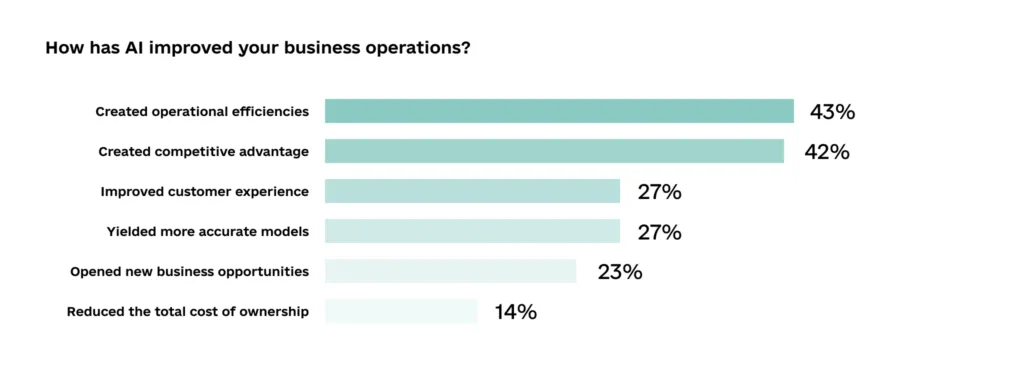
Overall, 91% of financial companies see improvements from implementing AI, according to the 2024 State of AI in Financial Services, NVIDIA Report.
Source: Nvidia
In other words: Machine learning (ML) and deep learning (DL) are helping financial companies become more profitable and capture bigger market share.
Many players are increasing the velocity at which they deploy AI-powered solutions into production. In 2023, 43% of financial leaders expressed intent to invest in AI/ML, and 42% prioritized advanced predictive analytics, according to a survey by OneStream.
AI now powers a new generation of customer-facing products such as personal finance management apps, robo-advisors, and lending tools among others. For instance, the Royal Bank of Canada (RBC) launched an AI-powered personal finance management app, NOMI, which 53% of users now rated as game-changing for their finances.
At the backend, financial services workers benefit from intelligent process automation, advanced financial analytics, next-best-action recommendations, automated account reconciliation, and risk management. For example, in 2023, Daniel Pinto, President and COO of JPMorgan Chase, estimated that the firm’s AI use cases had the potential to generate up to $1.5 billion in business value.
By leveraging AI in FinTech, companies can achieve four key outcomes: higher profits, at-scale personalization, distinctive omnichannel experiences, and faster product innovation.
But the big question is: which AI use cases in FinTech are actually worth pursuing? Here’s our data-backed lowdown.

AI in FinTech: 7 Viable Use Cases
To help you focus your product development efforts on the right targets, we’ve analyzed the main market trends and circled out the most promising AI in FinTech use cases.
Learn how AI can be deployed to augment front-office (customer-facing) processes and backend operations and help you secure your position as a market leader.
1. Fraud Detection and Prevention
Traditional rule-based fraud detection systems can’t effectively accommodate the current scale of transactions and payment methods. Programmed by humans, such systems now produce high false-positive rates, creating frustration among end-users, whose payment method has been declined. Given that 41% of consumers won’t shop again with the business after a false decline, merchants with high card decline rates eagerly switch their payment services provider (PSP).
AI-powered fraud detection algorithms, in comparison, can progressively learn about the different transaction patterns to better distinguish between legitimate actions and suspicious or potentially fraudulent activities.
For example, Stripe Radar, an AI-powered fraud detection system, can assess over 1,000 characteristics of a potential transaction to determine the likelihood that it’s fraudulent in a matter of seconds. Stripe’s fraud detection system also continuously evolves. Powered by a deep neural network (DNN) architecture, the system can be re-trained in less than two hours to include new insights, aggregated from all Stripe transactions.
Given that over 90% of cards used on the Stripe network have been seen more than once, the company can make richer financial data assessments and decrease the number of false positives. Stripe Radar incorrectly blocks just 0.1% of legitimate payments on its network.
With the rapid growth of the payments sector, investments in AI-based fraud detection bring almost immediate ROI in the form of lower financial losses and higher merchant satisfaction.
2. Automated Credit Scoring
Lending is a profitable market segment for FinTechs. From credit cards and buy now, pay later (BNPL) products to home mortgages and business financing solutions, the FinTech lending market is expected to top $2.3 trillion by 2032.
For instance, Upstart, an online lending platform, utilizes AI models to assess creditworthiness, incorporating a wide array of variables beyond traditional credit scores. The AI model approves 44.28% more borrowers compared to traditional methods, often at significantly lower APRs (36% reduction). Around 28.8% of loans powered by the platform go to low-to-moderate income (LMI) communities, making lending more inclusive.
Ant Group, a leading Chinese fintech company, employs AI to power its credit technology, enabling its clients to make faster, more accurate, and inclusive credit decisions. Ant Group uses sophisticated AI technologies such as graph models and machine learning to evaluate creditworthiness. These models analyze sparse or incomplete data, transforming it into reliable credit attributes, allowing for more nuanced risk assessments.
Unlike traditional credit scoring systems, machine learning models can be trained to process a wider range of data points to draw correlations between the applicant’s financial history and potential ability to make repayments (e.g., by estimating their income from multiple sources and analyzing their history of on-time bill payments).
Recent studies also found that:
- ML-based credit scoring models can better predict losses and defaults following a negative shock to the aggregate credit supply
- The usage of alternative data sources and applying balancing techniques improve the performance of ML-based credit scoring models. These enhancements lead to more accurate predictions of borrower defaults, particularly during financial stress or economic downturns.
Ultimately, AI-powered lending solutions can help FinTechs engage a wider audience of unbanked and underbanked consumers, which can bring in about $380 billion in extra annual revenue.
3. Personal Finance Management
Budgeting, tax planning, debt management — financial matters can feel overwhelming. In fact, 77% of Americans surveyed report feeling anxious about their financial situation. So no wonder that the market for personal finance management (PFM) software is growing at an annual rate of 6.94%, increasing from $1.73 billion in 2023 to $1.85 billion in 2024.
Smart FinTech leaders recognize that coaching people on better money management practices is the key to nurturing a loyal, high-income (and high-profit) customer base. And AI algorithms can deliver personalized coaching at scale by analyzing vast amounts of data and delivering predictive insights and prescriptive advice.
Oportun, an AI-powered digital banking solution, is a bright example of how smart personal finance management can drive meaningful impact. The platform addresses two key financial challenges: building savings and accessing responsible credit. Using predictive insights and personalized financial coaching, the solution helps users manage budgets and achieve financial stability. In 2024, the company claims to have helped save its users more than $2.4 billion in interest and fees, fostering customer loyalty and driving long-term growth.
The newer PFM tools are also powered by generative AI. For example, Wally is the first GPT-powered personal finance company, which uses OpenAI algorithms to provide users with accessible advice on reaching their financial goals. The app analyzes a range of data points including age, location, and debt to generate conversational advice e.g., propose a sample retirement plan or student loan repayment schedule.
Overall, AI can revolutionize multiple personal finance management processes including expense tracking, budgeting, debt management, and wealth building, making it a particularly attractive niche for new product development.
Discover how 8allocate helps FinTech leaders deploy competitive products faster.
4. Conversational Banking Services
Historically, financial services was an industry with one of the lowest customer satisfaction scores and highest service costs.
When it comes to customer experience (CX), companies that measure and act on good client service achieve 41% faster revenue growth, 49% faster profit growth, and 51% better customer retention compared to those that neglect CX, according to Forrester research 2024. Because most financial products are inherently complex, delivering exceptional CX in the financial sector requires simplifying interactions, personalizing services, and providing seamless omnichannel experiences.
Yet, delivering personalized CX at scale (and at a low cost) wasn’t feasible for most FinTechs until AI and gen AI entered the mainstream.
GenAI models and conversational interfaces can revolutionize the way consumers interact with banking products. In fact, 50% of financial executives consider AI crucial to their company’s future success, based on the data from NVIDIA’s 2024 State of AI in Financial Services Report.
For example, Cleo built one of the best conversational finance tools with a witty personality and robust personal finance management capabilities. The smart chatbot, powered by the AWS AI/ML platform, can inform consumers about company policies and product requirements, plus handle a wide range of inquiries regarding a user’s personal situation. Cleo’s comforting personality and robust tools netted the company $150 million in annual recurring revenue (ARR) as of October 2024.
Traditional banks are also experimenting with generative AI use cases. American Express (Amex) is exploring how large language models (LLMs) can be deployed to analyze customer feedback and queries at its customer service portals, as well as social media.
Stripe, in turn, partnered with OpenAI on exploring 15 possible GPT-4 applications in its product, ranging from customer support to fraud monitoring. Whereas, Bloomberg announced the launch of BloombergGPT — an LLM, purpose-built for sentiment analysis, named entity recognition, and question-answering tasks in the financial domain.
Overall, the use cases of generative AI in FinTech are two-fold: deployment of conversational AI bots to improve customer service levels, as seen with AI chatbots in fintech, and development of embedded GenAI-powered products for B2C and B2B use cases.
Interested in conversational AI systems? Check out our dedicated article, ‘What is Conversational AI?’.
5. Robo Advisors
Investing is a great example of a sector, largely commoditized with technologies. Robo-investing apps like Robinhood and Acorns reduced the entry barrier to the trading space, allowing anyone to invest spare change and trade fractional shares via a convenient interface.
Today, over $2.76 trillion of global assets are under the management of robo-advisory apps and the market is far from reaching its full potential. Advancements in machine learning and deep learning are creating further growth momentum.
In terms of AI use cases in robo-investing, most players are concentrated on user personalization, portfolio performance management, and optimization. Machine learning methods address the shortcomings of linear statistical models such as the inability to account for multiple, non-linear variables or overreliance on the model creators’ assumptions and biases, leading to superior performance.
In practice, several AI algorithms have shown superior performance in use cases such as stock portfolio optimization, asset allocation, and dynamic portfolio rebalancing. For example, Ai for Alpha created a machine-learning model for dynamic asset allocation, based on real-time market conditions. Its product relies on macroeconomic factors, interest rates, government decisions, and company valuation data among other insights to provide users with prescriptive advice.
Generative AI is also making inroads into the investing sector, much to users’ delight. The survey found that 38% of U.S. consumers trust generative AI as much or more than human advisors for personal financial management.
FinChat is one of the pioneers in the space. Powered by ChatGPT, it provides investors with intel about public companies, stock market trends, and business key performance indicators (KPIs). Unlike the regular “GPT edition”, FinChat was trained exclusively on financial data.
Public, an online investing platform, also launched a conversational assistant in May 2023, Alpha is powered by GPT-4 and can guide investors through real-time and historical market data via a conversational interface. The model has a wealth of knowledge about all major asset classes including crypto.
Source: Nvidia
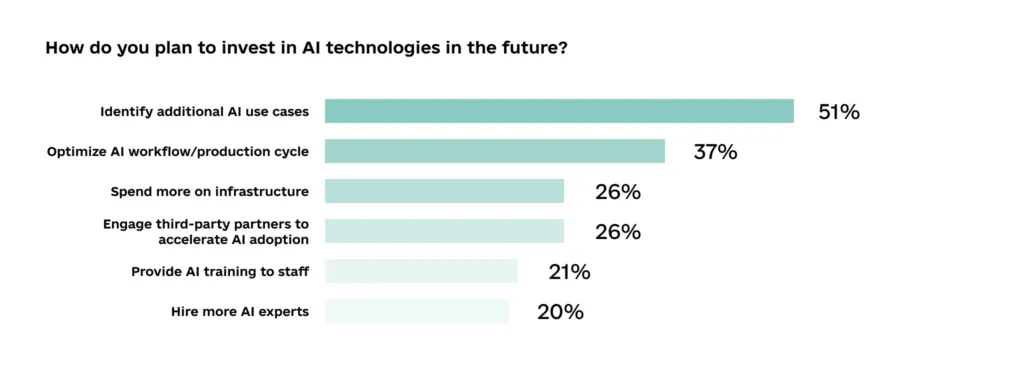
What this data tells us is that the investing space still has ample growth opportunities for FinTechs, which can launch new products faster.
Need help with AI, ML & data science?
Discover how 8allocate helps market leaders scale their operations.
6. Next-Best Action Recommendations
A next-best-action (NBA) system uses data-driven algorithms to answer the most fundamental question about your customer: What do they need and when?
Such predictive financial analytics is usually based on the customer’s:
- Current and past purchases and subscriptions
- Transaction history and account balances
- Demographic insights such as age, income, gender, etc
- On-site behaviors (e.g., visited product pages, customer support requests)
- Preferred interaction channels (e.g., web, mobile, in-branch, etc).
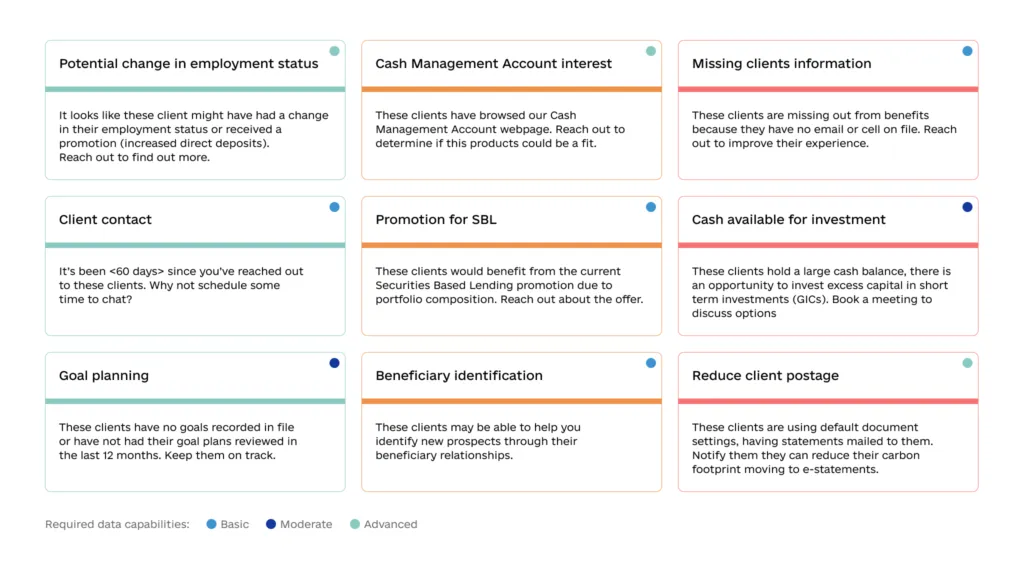
Combined, these insights can provide a 360-degree picture of your customers’ overall financial health, as well as immediate and latent needs. For example, Morgan Stanley WealthDesk software provides bank advisers with alerts about important customer events. If customers recently had children, the system might suggest setting up a college fund and offering other financial management advice.
Overall, NBA systems can provide contextual cues to your human workforce on the optimal client engagement, nurturing, or support strategies, plus draw attention to important operational and compliance tasks (e.g., obtaining extra client information for KYC purposes).
Source: EY
Next-best-action solutions are particularly attractive for companies in the wealth management space. Most FinTechs don’t have the luxury to employ a huge advisory workforce. Intelligent algorithms can help provide personalized advice at scale without putting extra pressure on your people. For example, about 90% of brokers in Morgan Stanley, a global financial services firm, use an AI-driven NBA system to make investment offers based on client preferences. About 98% of clients are satisfied with their financial advisor’s responsiveness.
Personetics, a B2B provider of advanced PFM and money management solutions uses deep learning recommendation models to analyze banking big data from numerous API endpoints and transform it into customer behavior predictions and contextual recommendations.
The advantage of learning DL models is that they can collect more granular data points such as banking app timing or order of customer interactions to build a full picture of customer relationships with its banking provider(s) over time.
As consumers expect a higher degree of personalization, investments in NBA solutions will bring tangible ROI in the form of higher sales, improve customer retention, and higher user satisfaction.
7. Risk Management
The use of AI in financial risk management has become synonymous with increased efficiency and reduced operating costs.
ML and DL algorithms enable the handling and analysis of large volumes of unstructured data at higher speeds with significantly less human oversight. Thanks to this, FinTechs can automate a substantial part of compliance monitoring tasks, ranging from anti-money laundering (AML) to payment fraud prevention. For example, Wells Fargo, a multinational financial services company with approximately $1.9 trillion in assets, leverages the TradeSun AI platform to digitize and optimize its trade finance processes. The AI system mitigates risks by harvesting, verifying, and classifying unstructured data, strengthening compliance and document validation.
On the AML side, AI algorithms can detect signs of financial fraud at a scale inaccessible to humans. Such algorithms can flag minuscule discrepancies between the truthful and tampered data to identify behavioral patterns, associated with money laundering and other illegal financial activities. Moreover, such algorithms can suggest issues with customer data accuracy and completeness to enable quick corrections and better customer protection.
For instance, Pi by Paytm risk management app dynamically assigns custom risk scores to every user and updates them throughout their lifecycle. By using unsupervised machine learning, the company’s fraud detection model monitors user activities 24/7, recommending custom rule sets and alerts to users, based on their activity and risk exposure.
Another prominent AI use case for risk management in finance is advanced forecasting. Traditional statistical models don’t accurately represent the non-linear relationships between the macro economy and the financials of the company. ML and DL models can help banks model more complex scenarios, based on real-time data points and multiple risk factors, to make smarter investing and lending decisions.
With AI-based early warning systems in place, fintech leaders can proactively identify potential risks, such as credit defaults, fraudulent transactions, or market volatility, before they escalate.
Final Thoughts
AI has already made a strong impact in the financial sector as the above examples have demonstrated. Leaders in adoption reported both cost reductions and revenue increases in the business units where AI was deployed, according to the McKinsey 2024 report.
FinTechs have the agility to move faster than traditional institutions and win over consumers with more convenient, innovative, and cost-effective financial products. What’s more, smart FinTech leaders choose to partner with external AI & ML experts like 8allocate to accelerate the time-to-market speed even further without ballooning product development costs.
At 8allocate, a software development company headquartered in Tallinn, Estonia, we specialize in delivering AI/ML implementation and integration services, with the FinTech sector leading the way. As a strategic technology partner to forward-thinking businesses, we empower FinTech companies to harness the power of AI to optimize operations, enhance customer experiences, and drive innovation.
If you’re looking to deploy AI/ML solutions that deliver measurable results, 8allocate is here to help. Contact 8allocate to discover how our expert team can help develop and deploy AI/ML models in the FinTech sector.
Frequently Asked Questions
Quick Guide to Common Questions
How is AI transforming the FinTech industry?
AI is reshaping FinTech by enhancing fraud detection, automating credit scoring, personalizing financial services, and improving risk management. It allows FinTech companies to optimize operations, reduce costs, and provide a seamless customer experience at scale.
What are the most impactful AI use cases in FinTech?
AI is driving innovation in several key areas, including:
- Fraud Detection & Prevention – AI models analyze transaction patterns to detect fraudulent activity with high accuracy.
- Automated Credit Scoring – AI-powered risk models assess borrowers more accurately than traditional credit scoring methods.
- Personal Finance Management – AI-driven financial assistants help users optimize spending, budgeting, and saving.
- Conversational Banking Services – AI-powered chatbots and virtual assistants enhance customer interactions and service.
- Robo-Advisors – AI-driven investment tools provide automated portfolio management and trading strategies.
- Next-Best Action Recommendations – AI predicts customer needs and recommends personalized financial products.
- Risk Management – AI models assess market risks, fraud exposure, and regulatory compliance in real-time.
How does AI improve fraud detection in financial services?
AI models analyze thousands of data points per transaction in real-time, identifying anomalies and reducing false positives. By continuously learning from new data, AI-powered fraud detection minimizes financial losses and enhances customer trust.
How does AI enhance credit scoring beyond traditional methods?
AI-powered credit scoring models incorporate alternative data sources, behavioral analytics, and predictive insights to assess borrower risk more accurately. This allows FinTechs to expand financial inclusion by approving loans for underserved markets while managing risk effectively.
How can AI improve customer experience in FinTech?
AI-powered chatbots, virtual financial assistants, and generative AI models offer personalized financial advice, automate routine transactions, and provide real-time assistance, leading to improved customer engagement and satisfaction.
What role does AI play in financial risk management?
AI enables real-time risk assessment, predictive analytics, and automated compliance monitoring. It helps financial institutions detect money laundering, assess market volatility, and prevent security threats before they escalate.
How can FinTech companies scale AI-powered solutions efficiently?
Scaling AI in FinTech requires:
- Robust data infrastructure for real-time analytics and secure transactions.
- Advanced AI governance to ensure compliance and transparency.
- Scalable AI/ML deployment strategies to optimize system performance.
- Continuous monitoring and model retraining to maintain accuracy and efficiency.