
The success of your software development project depends on many factors. One crucial factor, though, is often overlooked—the time it is going to take to hire tech specialists who will bring your project to fruition: from the sourcing (or application) stage to the moment when they join your software development team. This hiring process is vital as it affects every subsequent phase of the project.
Admittedly, time-to-hire (TTH) will vary depending, to no small extent, on your country of residence. Workable has estimated that the average hiring time in IT globally is 56 days. The average time to hire tech specialists in the US and Canada is 51 days, while in the UK and Ireland, it’s close to a global average of 55 days. All in all, the time to fill any position, regardless of industry, will range from days to four months, but hiring software developers may take more than seven weeks.
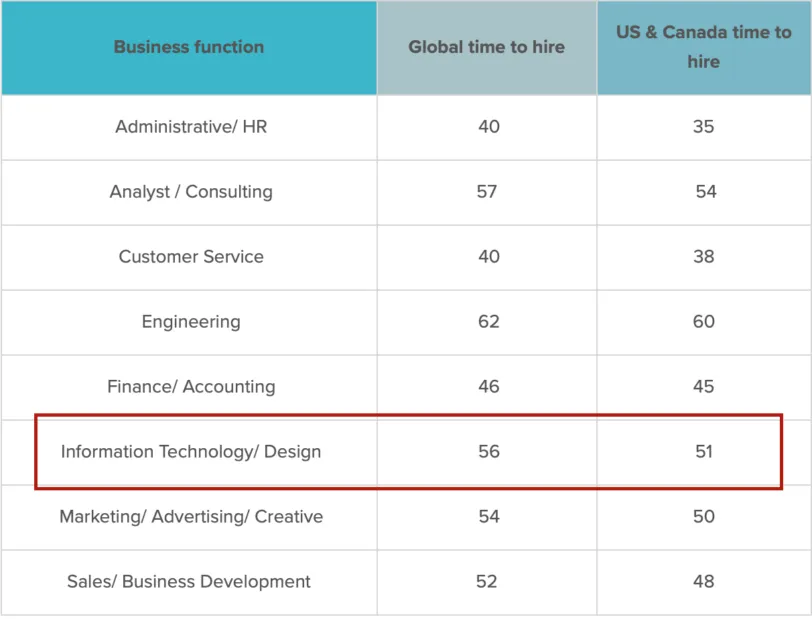
Time to hire by function and location. Source: Workable.com
According to TalentNow, 35% of employers globally have tech positions that stay open for 12 weeks or longer!
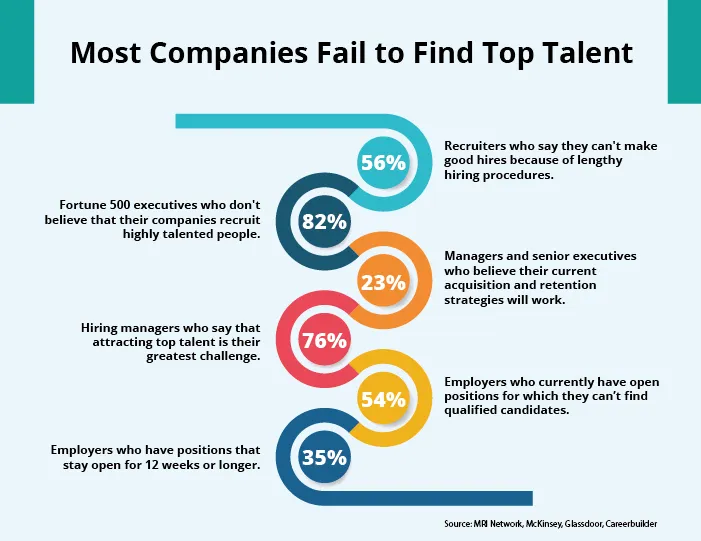
Six Biggest Recruitment Challenges
Why Time-To-Hire Matters
In HR expertise, time-to-hire (here, it’s used interchangeably with time-to-fill) is an important metric. Not only does it impact the recruitment budget, but its correct estimation also affects business planning. More often than not, companies set up unrealistic growth plans, neglecting the pitfalls of the recruitment process and underestimating the eventual time to fill. This makes the hiring process a strategic area to address.
Knowing an average time-to-hire for a particular position is also important since it lets you estimate how long it will take to hire a replacement, should any of the developers on your team leave. Knowing an average time-to-hire in your business segment will also help you estimate whether or not you are lagging behind competitors.
More specifically, why does longer time-to-hire have negative consequences?
Time-to-hire impacts time-to-market
In other words, the longer you can’t fill your open positions, the longer your idle time, which translates into wasted dollars. Instead of forging ahead with your project, your progress gets stalled – much to the delight of your competitors.
Risk losing competitive advantage
In the dynamic business environment of today, more swift and flexible competitors may hit the market with their product/solution faster and gain dominance while you’ll be left behind.
Increase in recruitment budget
Given the global tech talent shortage, the recruitment and hiring process is no cakewalk. The longer you search, the higher your total cost per hire. To find software developers or any other tech specialists for your project, you may need to involve recruitment agencies, increase referral bonuses, run costly ad campaigns on networks like LinkedIn, etc.
Cost to Hire Talent: Staff Augmentation vs In-House Recruitment
Motivation plummets
The lengthy recruitment process and its complications may feel disheartening to the point that your confidence starts to wane. The longer it takes to launch, the more time you will ultimately have to start questioning your business idea and its potential for success.
In fact, long time-to-hire may be an early indicator that your job advertising isn’t working and a warning sign that your search for talent may be taking longer than expected. It also often serves as an indicator that the recruiters on your HR team could be doing a better job.
How To Shorten Time-To-Hire
Here’s what you can do to shorten TTH and reduce the cost per hire for your project.
Measure the number of qualified candidates
How many qualified candidates actually make it to the final stages of job interviewing? If little or none, this means you should rethink your job advertising or an entire recruitment strategy. Knowing the ratio of qualified candidates compared to the less qualified ones is also essential: your recruiters may be spending too much time on less-skilled developers hoping a more suitable candidate will eventually come along.
Coach your recruiters
If you have an in-house recruitment team working on filling your positions, test their understanding of the job specifics and the position requirements. Chances are, they may not have the correct knowledge and thus are incapable of selecting the right candidates. If this is the case, you can improve the situation by offering them relevant information and training.
Indicate the bottlenecks
Exactly which positions are the most difficult to fill? For example, although the average TTH for IT specialists is 56 days, it may take 60 days to fill the Data Scientist position, 70 – if you’re looking for a Senior Data Scientist. Extended time-to-hire may be the result of external factors. The talent you are looking for may be scarce in your country and residential area or be in high demand on a global level. In this case, you may have to rethink your entire project timeline.
If you discover that a long time to hire can be attributed to the local talent shortage, outsourcing could be a reasonable alternative. Unlike in Western IT, hiring cycles in outsourcing destinations like Ukraine are shorter, due to a high number of qualified IT talent. Thus, each stage of the hiring process (finding candidates, preliminary, intermediary, and final interviews, discussing conditions and signing an offer) usually takes 1-3 weeks. The stages often overlap, so it usually takes 4-10 weeks to fill a particular position. If a candidate in question is bound by an agreement with his previous employer, assuming the vacancy may take an additional 2-4 weeks.
Surely, even in Ukraine, some technologies are in higher demand than others. For example, it would be easier to find Ukrainian developers specializing in Java, .Net, and PHP, as well as iOS, Android, and front-end developers, than experts with a good working knowledge of Golang, C++, Python, or ROR. It’s also relatively easy to find a sound QA engineer and a PM, while qualified Business Analysts and DevOps engineers are rare. However, if you choose a reliable outsourcing partner with access to vast talent pools within the Ukrainian developer community, recruiting such experts wouldn’t be a problem.
How To Improve Bottom-Line Growth With White Label Solutions Outsourcing
The key to success is keeping your recruitment process as transparent as possible. Ideally, you should be aware of exactly how long it takes to fill various positions on your team, how this time compares to the industry average, how many stages your recruiting process has, and how long it takes candidates to move from one stage to another.
The ratio of good/poor job applications you normally get is also important. If you’re sure your recruiters are doing all it takes to fill all vacant positions and the reason for the long time-to-hire is a talent shortage, use outsourcing. The good news is that outsourcing providers typically take care of all the legal and administrative hassle, while you get to interview candidates and get the final word regarding the selection process.
Enhance Your Project’s Success with 8allocate
Streamline your hiring process and accelerate your software project with 8allocate. Our comprehensive services—from technology roadmap development to custom software solutions and cybersecurity—support your strategic goals and drive digital transformation. Ready to gain a competitive edge with the right talent and cutting-edge technology?
Connect with 8allocate today for a consultation, and let’s discuss how our tailored solutions can meet your unique needs.