
Finding it tough to manage and control data across the fragmented logistics partner ecosystems? Read this post. This piece is essential for logistics business leaders who want to explore AI in data management for efficient supply chain information control. You’ll discover three advanced AI-powered solutions to help you analyze data and ensure high-quality information across your supply chain network.
Overview of AI Applications in Logistics
Artificial intelligence is revolutionizing the logistics industry by enhancing decision-making, boosting efficiency, and enabling real-time monitoring through sensor-driven approaches highlighted in AIoT applications transforming industries. AI applications in logistics are vast and varied, ranging from automated warehouse management to artificial intelligence data processing. For instance, AI-driven demand forecasting helps companies anticipate market needs, as outlined in AI demand forecasting, while advanced inventory management systems ensure optimal stock levels.
Leading companies like Amazon and Alibaba are at the forefront of this transformation. They employ AI technology to streamline their supply chain management processes, resulting in improved operational efficiency and accuracy. For example, Amazon has created an AI-based system known as the Package Decision Engine, optimizing how products are packaged and delivered worldwide. Alibaba Cloud’s AI in the supply chain provides real-time insights, empowering businesses to anticipate demand shifts and manage upstream operations effectively. This allows logistics managers to seamlessly track and integrate factors influencing demand, such as market trends, intermediaries, and seasonal changes.
AI is no longer a futuristic concept; it is modifying the way logistics companies operate, from supply chain management to customer service through AI for business process automation. By integrating AI, these companies can better predict demand, optimize routes, and enhance overall supply chain operations.
Read the story about 6 proven approaches to maximize business efficiency with AI
AI for data management in logistics
According to the 2024 report by GlobeNewswire, AI is expected to boost growth in the data management sector, with the market projected to reach $513.3 billion by 2030, up from 23.3 billion in 2023. This growth underscores the increasing reliance on AI technologies to enhance data management processes. AI-based solutions quietly refine how organizations manage data, enhancing its quality, accessibility, and security.
If we talk about AI and data management in logistics, AI assists in streamlining complex data flows, optimizing supply chains, and enabling real-time decision-making. As the logistics sector becomes increasingly data-intensive, the integration of AI-based solutions is pivotal for managing vast quantities of information efficiently and effectively through AI and ML implementation and integration. AI enhances data accuracy by automating error-prone processes and ensures better data accessibility, allowing logistics professionals to make informed decisions faster.
Furthermore, AI strengthens data security, which is critical in logistics where sensitive information on inventory, suppliers, and customer details is constantly exchanged. It can identify and mitigate potential security threats, safeguarding the entire logistics network.
By leveraging AI-driven predictive analytics, logistics firms can anticipate demand shifts, optimize route planning, and even forecast potential disruptions, contributing to more resilient supply chains.
Top 3 AI Data Management Solutions for Fragmented Logistics Challenges
Let’s discover how AI can help you ensure high-quality data across your entire supply chain network through advanced intelligent solutions.
AI data integration using federated learning
You can use federated learning (FL) as one of the effective AI data management that enables machine learning models to be trained across decentralized data sources, all without requiring the sharing of raw data.
Let us give you an example.
As a logistics and freight forwarding company, you generate massive amounts of data from various sources, including shipping partners, warehouses, customers, suppliers, and transport routes. This data is often spread across different geographies and systems, making it challenging to centralize without breaching privacy or data governance rules.
With federated learning, you can train AI models using these decentralized datasets without needing to transfer sensitive or raw data to a central location. Instead, FL allows models to be trained locally on each data source (e.g., warehouse systems, shipment records), and only the model updates (not the actual data) are sent to a central server for aggregation.
How federated learning can help you overcome data fragmentation?
- Decentralized model training without data sharing. FL allows you to train AI models across various logistics partners, regions, and stakeholders without requiring them to share raw data.
- Harmonizing disparate data. By using FL, you can enable AI models to learn from decentralized and fragmented data sources without the need to standardize or move the data.
- Data privacy and security. FL protects your network’s sensitive data by keeping data localized and only sharing encrypted model updates while fully complying with data privacy regulations such as GDPR.
With AI in data management, particularly through federated learning techniques, you can address the challenges of data fragmentation and lack of standardization by training AI models directly within each data silo. This allows the models to learn from these diverse datasets without requiring uniform formats or moving the data.
AI for automated data harmonization and cleaning
AI-powered harmonization tools automatically identify and standardize diverse datasets, ensuring consistency across the entire supply chain network. These tools not only standardize diverse datasets but also analyze data to ensure consistency across the entire supply chain network. Machine learning algorithms, such as probabilistic (fuzzy) matching, can link different datasets even when they are inconsistently labeled, creating a unified data layer.
For example, probabilistic matching can link disparate datasets like shipment records, customer information, and supplier data across different systems. Even if data from two sources is formatted differently (e.g., “Warehouse A” vs. “W.A.”), fuzzy matching ensures that they are recognized as the same entity, ensuring seamless flow and interpretation of data.
Through a probabilistic matching approach, you can successfully apply AI for data management to harmonize supply chain info across fragmented sources by connecting the dots between contract manufacturers, suppliers, and customers.
AI tools for data harmonization can also ensure that you comply with regulatory requirements like GDPR by allowing data to be processed locally before being aggregated into a unified logistics system. This is especially relevant in light of the European Union Corporate Sustainability Due Diligence Directive (CSDDD), approved by the European Parliament on April 24, 2024. The directive mandates companies operating within the EU or with EU-based partners to verify their supply chains for issues like forced labor or environmental damage and to take proactive measures to prevent harm throughout their global operations.
AI can automate manual data cleaning processes, such as correcting or removing errors, inconsistencies, and duplicates, ensuring that clean, reliable data is available for analysis and operations. One of the best practices is the use of AI data solutions to automate data cleaning processes by identifying and correcting errors, removing redundancies, and ensuring the accuracy of real-time data. This approach is supported by the May 2024 AI in Logistics White Paper from the Alliance for Logistics Innovation through Collaboration in Europe (ALICE).
Explore how our can help you create advanced solutions for predictive analytics, transforming historical and real-time supply chain data into actionable insights
AI-driven predictive analytics for proactive decision-making
AI-driven predictive analytics offers a proactive solution by using historical data, real-time inputs, and machine learning algorithms to predict potential disruptions before they occur along the supply chain. These tools enable you to forecast issues, such as delivery delays, port congestion, weather-related disruptions, or supplier failures, by analyzing both historical and real-time data. Based on these insights, freight coordinators can take preemptive actions, such as rerouting shipments or adjusting inventory levels, even when data is fragmented across multiple partners and geographies.
The potential of predictive analytics is underscored by the projected growth of the market, expected to reach $95.30 billion by 2032, up from $14.71 billion in 2023. This market growth demonstrates how industries, especially logistics, are increasingly adopting predictive analytics for supply chain disruptions, especially given the complexities and fragmentation of modern logistics ecosystems.
But what’s important to note here is that the effectiveness of AI-driven predictive analytics in managing disruptions is directly tied to the accuracy, completeness, and relevance of the data it processes. While big data is often touted as a foundation for predictive analytics, data quality is what matters. If you don’t have high-quality data, even the most sophisticated AI systems will falter, leading to poor data management and unreliable insights.
Data quality is what matters. If you don’t have high-quality data, even the most sophisticated AI systems will falter, leading to poor data management and unreliable insights.
Predictive Analytics vs. Generative AI
Many freight forwarding and logistics companies, and you could be one of them, use generative AI for automated document generation as one of the tasks. I will limit it to this case since we are talking about AI for data management. What am I getting at?
When comparing predictive analytics to generative AI in managing data in fragmented logistics, predictive analytics often delivers more practical value. Generative AI, for example, might streamline the creation of shipping labels, invoices, or other logistics-related documents. Still, it cannot ensure that information is accurate or useful for decision-making. Predictive AI, in turn, can identify inconsistencies in data sets and help consolidate information for more accurate forecasting. This is especially valuable since logistics data is often dispersed across various regions and platforms.
Here’s a simplified table comparing predictive analytics and generative AI for managing data in fragmented logistics.
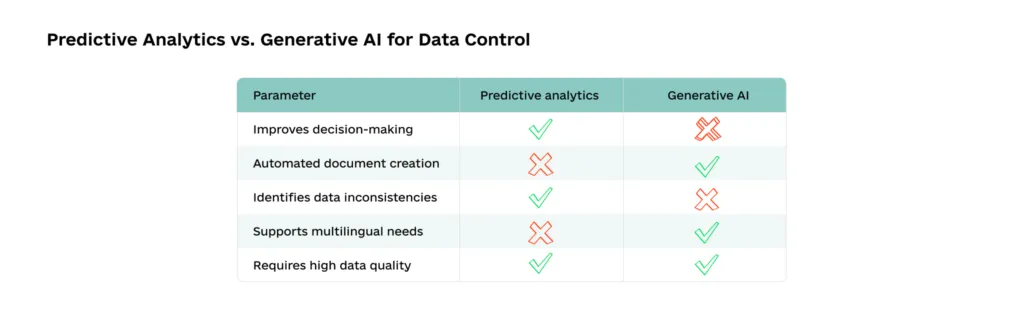
Given these points, consider employing AI for data management in multiple ways, discovering new technology possibilities. Just be aware, instead of choosing an attractive technology and then seeking a problem — solution, ask yourself, ‘Where are the best opportunities for improving data control?’ This could involve areas like shipment tracking, supplier data integration, route optimization, etc. And then decide on the solution to help pursue that opportunity and sustain an operational win.
Final Thoughts
Fusing AI technology with robust data management practices is like orchestrating a symphony, where AI implementation and data management analytics operate in sync to achieve a seamless flow of information across fragmented supply chains. Rather than treating them as separate initiatives, AI in data management should be seen as an indispensable tool for ensuring information consistency and integrity. As a strategic technology partner, we recommend aiming for this holistic approach to enhance real-time decision-making and optimize data administration in the fragmented logistics landscape.
At 8allocate, we offer AI for business operations optimization services to help logistics businesses develop solutions that address data fragmentation by unifying scattered datasets across multiple platforms and locations. Our expertise enables you to consolidate data into a single source of truth, providing seamless access and streamlining supply chain operations. Get in touch with us today to learn how our AI experts can support your logistics business.

Frequently Asked Questions
Quick Guide to Common Questions
How can AI improve data management in fragmented logistics networks?
AI enhances data management by automating data integration, harmonization, and predictive analytics. It helps unify disparate data sources, ensuring accuracy, accessibility, and security across supply chain operations. AI-driven tools improve decision-making by analyzing historical and real-time data, optimizing logistics workflows.
What is federated learning, and how does it help with logistics data integration?
Federated learning enables AI models to be trained on decentralized data sources without requiring raw data transfer. This allows logistics companies to use AI-driven insights across multiple partners while maintaining data privacy and compliance with regulations like GDPR. It is particularly useful for companies managing distributed supply chains with fragmented data ecosystems.
How does AI automate data harmonization and cleaning in logistics?
AI uses machine learning techniques like probabilistic (fuzzy) matching to standardize and clean diverse datasets. This ensures that inconsistently labeled data—such as different formats for warehouse names or shipment codes—is correctly linked, reducing errors and improving operational efficiency. AI-driven data harmonization also supports compliance with regulatory frameworks like the European Corporate Sustainability Due Diligence Directive.
How do AI-driven predictive analytics improve supply chain resilience?
Predictive analytics leverages historical and real-time data to forecast supply chain disruptions, such as weather delays, port congestion, or supplier failures. By providing actionable insights, AI allows logistics managers to take proactive measures like rerouting shipments or adjusting inventory levels to mitigate risks and improve efficiency.
How does predictive analytics compare to generative AI in logistics?
Predictive analytics focuses on forecasting disruptions and optimizing operations using structured data. In contrast, generative AI automates tasks like document generation (e.g., invoices and shipping labels). While generative AI improves administrative efficiency, predictive analytics plays a more critical role in ensuring supply chain accuracy and reliability by analyzing logistics data for better decision-making.