
According to Yahoo Finance, the EdTech market is anticipated to reach a value of around USD 549.6 Billion by 2033, reflecting significant growth from USD 146.0 Billion in 2023, with a projected Compound Annual Growth Rate (CAGR) of 14.2% during the forecast period.
With the steady growth of the sector, we will witness how the EdTech data volume will grow exponentially. If managed effectively, this data can be the source of valuable insights into the learning process, factors, outcomes, learning trends, and more.
However, managing and analyzing the growing volumes of EdTech data and finding the best application of it can be challenging. The purpose of this article is to give readers a better understanding of data management in the EdTech realm.
Let’s together explore what types of data are valuable for EdTech firms, how data is utilized in this sector, what challenges may arise in the process, and how to overcome them.
The further implications of this article will be of interest to educators, EdTech firms, students, and tech-driven organizations looking for effective EdTech initiatives. Keep reading to look at data management from the perspective of education and technology.
Understanding Data in EdTech
In EdTech, data is one of the main drivers of growth. Various types of data are collected, stored, analyzed, and utilized to make the learning process more effective and insightful for both educators and learners. Let’s have a look at the major data types utilized in this sector:
Learning Outcomes Data: Learning outcomes data provides insights into student performance. Examples of this data type include test scores, grades, progress reports, etc. Having such data at hand, educators can better understand the outcomes of the learning process for each particular learner. This, in turn, enables teachers to detect performance gaps and use effective teaching strategies to help learners eliminate them.
Engagement Data: Engagement data explains how learners interact with learning material. For example, session duration, bounce rate, pages visited, and others. Engagement data is collected to help educators detect engagement gaps and patterns, improve the learning materials people use, and offer help or support when necessary.
Usability Data: Usability data provides insights into the technical side of the learning process and focuses on user experience with EdTech solutions. Namely, EdTech firms collect data on user navigation on a learning platform, bugs or issues users encounter, interaction with specific interface design elements, etc. EdTech software vendors use usability data to continuously improve the solutions, making them intuitive and error-free.
Collectively, these data types provide a holistic view of the learning process, enabling educators and EdTech companies to create more effective, personalized, and engaging learning experiences.
The Role of Data Management in EdTech
Data should not be collected just for the sake of being collected. It can be the source of insights when making strategic decisions. If managed effectively, data can help EdTech companies improve academic progress, personalize the learning process, and increase user satisfaction with educational solutions.
Let’s dive deeper into the impact data management makes in EdTech:
Data-Driven Decision-Making
In education, effective data management fuels the decision-making process. The decisions made by educators can vary from minor choices on curriculum or teaching tactics to business decisions that shape the company’s growth.
Effective data management enables decision-makers to know what data they can refer to to rationalize their strategy. Instead of relying on gut or assumptions, educators leverage the power of data and get evidence confirming their choices.
The recent case study discusses the application of data-driven decision-making in the context of higher education (HE) assessment. The researchers make use of the performance data to make an informed decision for moving from exam-based assessments to non-exam assessment methods. The authors analyze data before, during, and after the COVID-19 pandemic using different learning metrics such as failure rates and mean marks.
This study leveraging a data-driven decision-making approach supports innovation in teaching and assessment redesign in response to the many challenges that HE providers face as a result of adopting blended learning. It also demonstrates how data is leveraged in EdTech to fuel decisions and strategies that, in turn, are expected to increase the flexibility of learning.
Thus, incorporating data management practices into your decision-making processes empowers you to make informed choices, stay proactive, and drive value for your organization.
Improving Learning Outcomes
Data in EdTech plays a crucial role in improving learning outcomes in several ways, according to the UNESCO IIEP Learning Portal. As highlighted in their recent brief, data can reveal gaps in student achievement and service provision, helping to identify those groups that are underserved or underperforming. Once identified, such inequities can be addressed.
For example, if a learner is having a tough time with a certain subject, an educator can detect this by analyzing their performance data and comparing academic performance in various subjects. The teacher can then give that learner some extra resources or a bit more one-on-one time.
Data management can be used to hold the system accountable for the use of resources by showing whether increased investment in education has resulted in improved student performance. Besides, additional information on an individual learner’s background allows the teacher to diagnose possible causes of poor performance and apply remedies.
In a nutshell, when educators use data effectively, they get a 360-degree view of how their audience is doing. With data accessible 24/7, educators can track learner progress, spot situations when learners might need extra help, and step in with support.
Personalization of Learning
One of the big wins of using data in EdTech is that it allows firms to customize education. By digging into data about how a learner is performing, their preferred way of learning, and their level of engagement, they can adjust the educational content to match each student’s specific needs. This customization can facilitate the learning experience, making it more engaging and effective for each learner.
One of the effective strategies for implementing personalized learning is the use of learner profiles. These profiles keep a detailed and current record of a student’s strengths, needs, goals, and progress. Profile-based data management involves analyzing big volumes of data about each student’s learning journey, which is then used to personalize their learning path.
Data management is crucial in this context as it involves collecting, analyzing, and using data to inform these practices. This suggests that effective data management, which allows for the continuous monitoring and adjustment of personalized learning strategies based on student performance data, is key to the success of PL.

Common Challenges in EdTech Data Management
As the use of technology in education continues to grow, so does the need for effective data management. However, managing data in educational technology is not without challenges. Here, we discuss the common issues that educators and administrators face when dealing with EdTech data management.
Data Breaches in EdTech
One of the most pressing challenges in EdTech data management is the risk of data breaches. Educational institutions store a wealth of sensitive information, from personal learner details to academic records. This makes them attractive targets for cybercriminals.
According to Comparitech, 2021 has been recorded as the year with the highest number of data breaches in the education sector, affecting 771 educational institutions and close to 2.6 million records. A data breach can lead to unauthorized access to this sensitive information, potentially causing severe damage to the institution’s reputation and even legal repercussions.
Recently, the Federal Trade Commission (FTC) of the United States has taken action against the education technology provider Chegg Inc. for its lax data security practices that exposed sensitive information about millions of its customers and employees. The FTC alleges that Chegg failed to fix problems with its data security despite experiencing four security breaches since 2017.
Chegg, which sells educational products and services directly to high school and college students, collected a variety of personal information about its users. However, the FTC alleged that Chegg failed to protect this information, leading to four data breaches. These breaches exposed personal information, including names, email addresses, passwords, and, for certain users, sensitive scholarship data.
The FTC’s proposed order requires the company to bolster its data security, limit the data the company can collect and retain, offer users multifactor authentication to secure their accounts, and allow users to access and delete their data.
As seen from this example, EdTech providers must prioritize robust security measures to protect user data, maintain trust, uphold privacy, and ensure a safe digital learning environment.
Data Fragmentation
Data fragmentation is another significant challenge in EdTech. In many cases, educational data is scattered across various platforms and systems, making it difficult to gather and analyze. This fragmentation can hinder the ability to gain a comprehensive view of student performance and learning outcomes, which is crucial for improving educational practices and strategies.
As revealed by Education Week, fragmented data systems can lead to inefficiencies in schools. When data is scattered across different platforms and systems, it becomes challenging to gather, analyze, and use effectively.
Being a major problem in educational data management, data fragmentation can hinder the ability to get a consistent view of learner performance and learning outcomes, which is crucial for improving educational practices and strategies.
Lack of Interoperability
The lack of system interoperability is another common issue in EdTech. Many educational tools and platforms do not seamlessly integrate with each other, making it challenging to transfer and synchronize data across different systems. This lack of interoperability can lead to inefficiencies and inconsistencies in data management strategy, negatively impacting the effectiveness of educational strategies.
The problem of data interoperability is a significant issue in the development of software collaboration environments. Data interoperability becomes a problem when consumers need to use data owned by producers, and the syntax and/or semantics of such data at both endpoints are not already aligned. This misalignment can lead to difficulties in data integration, hindering effective collaboration among data stakeholders.
At 8allocate, technology is a driving force of modern collaborative education. For years, we have helped companies build elearning solutions and seamlessly integrate them into their EdTech infrastructures. Contact us if you need help with EdTech development, finetuning EdTech systems, or configuring system interoperability via APIs.
In conclusion, while EdTech offers immense potential for enhancing education, it also presents unique challenges in data management. Addressing these challenges is crucial for unlocking the full potential of EdTech and ensuring the security and effectiveness of educational practices. By understanding and addressing these challenges, educators can effectively use data to improve education.
3 Pillars of Effective EdTech Data Management
Effective data management is crucial for the successful implementation of educational technology. It ensures that data is accurate, accessible, and secure, thereby enabling informed decision-making and personalized learning. Here, we discuss the three pillars of data management in EdTech that help EdTech firms achieve positive outcomes.
Data Security and Compliance
Data security and compliance is the first pillar of EdTech data management. Ensuring the security of data is paramount to protect against data breaches and comply with data protection regulations. This involves implementing robust security measures, such as encryption and access controls, and regularly auditing data to ensure compliance with relevant laws and standards.
Keeping data secure involves EdTech companies, schools, and even regulatory bodies all working together and following privacy laws like FERPA and GDPR. However, many EdTech companies are going the extra mile. They’re sticking to strict privacy laws and getting certifications like ISO/IEC 27001.
So, EdTech companies must navigate the opportunities and challenges of protecting student data, adhering to privacy laws, and implementing robust cybersecurity measures. By doing this, these companies are showing they’re serious about managing and protecting data, using it fairly and ethically.
Centralized Data Management
Centralized data management is the second pillar. With data often scattered across various platforms and systems, centralizing data management can help overcome the challenge of data fragmentation.
A centralized system provides a unified view of data, making it easier to gather, analyze, and use effectively. This can enhance the ability to gain a deep understanding of learner performance and learning outcomes, which is crucial for improving educational practices and strategies. Here is an example of what a centralized data repository can look like:
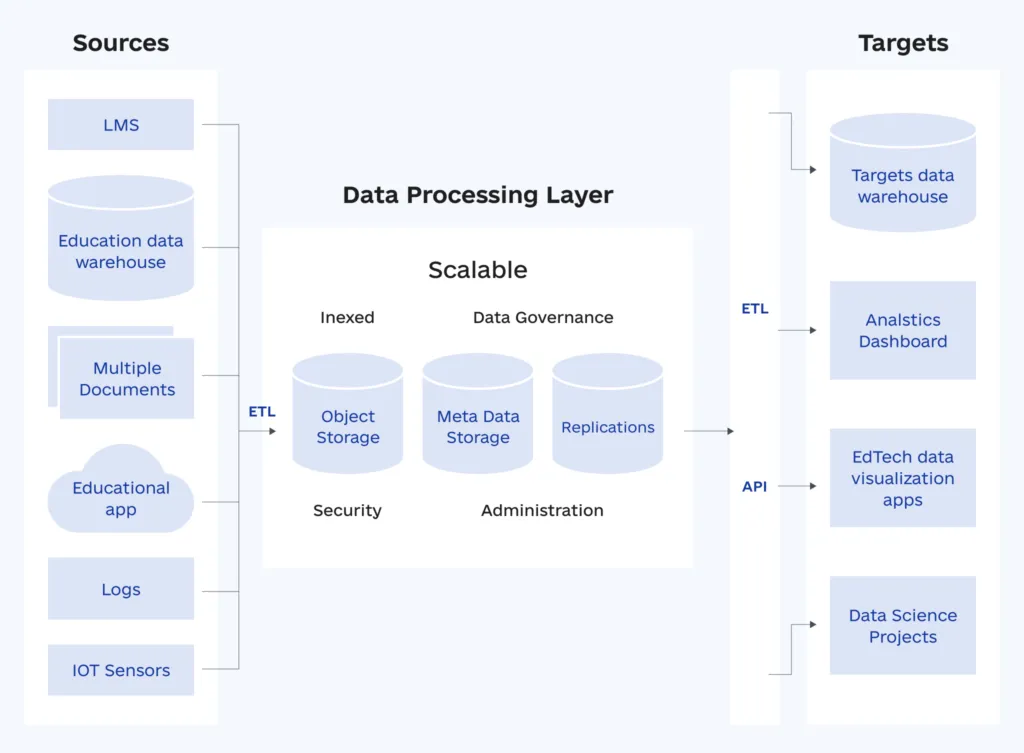
SaaS Viya, a product of SAS, is an example of a robust data management system. It provides an integrated development environment and modern data catalog that allows developers to load, import, profile, cleanse, prepare, and transform data.
SaaS Viya also offers functions to manage and provide governance for data assets and their relationships. The centralized approach to student data management the company cultivates enables a unified view of data, enhancing the ability to understand student performance and learning outcomes.
Informatica, another key player in the field, offers master data management (MDM) solutions that unleash the value in data with a trusted, single source of truth. It provides integration, quality, enrichment, and governance in one cloud-native solution.
Informatica’s MDM solutions are built on a high-level architecture that includes Data Explorer and Data Studio for managing data and building and executing data collection and transformation. This helps in loading data from a variety of sources, including files, databases, social media sources, etc.
The tools like SAS Viya or Informatica play big roles in centralizing EdTech data. While the first focuses on analytics, performance, and cloud-native capabilities, the latter excels in data integration, quality, and governance. Together, they empower educational institutions to make informed decisions and enhance learner experiences.
EdTech System Integrity
The third pillar is the integrity of EdTech systems, with a particular focus on the role of APIs (Application Programming Interfaces) in system interoperability. APIs allow different systems to communicate and exchange data, overcoming the problem of system interoperability.
APIs supported by Learning Management Systems (LMS) allow data sharing with external systems, enriching the LMS with additional data and providing third-party tools with valuable LMS records.
This data exchange enables educators to personalize programs based on students’ past and current achievements. Learning decisions are informed by additional information about each learner, educational plans, process tracking features, course materials, etc.
The use of APIs effectively addresses major challenges in educational technology interoperability. They facilitate quick, secure, and cost-effective integration. The return on investment for such solutions often exceeds the expenses, making them a valuable asset in the EdTech landscape.
In conclusion, data security and compliance, centralized data management, and integrated EdTech systems form the three pillars of data management in EdTech. By focusing on these aspects, educational institutions can leverage the full potential of EdTech, ensuring the security, accessibility, and effective use of data to enhance educational outcomes.
The Future of Data Management Systems in EdTech
The landscape of EdTech has changed due to the spread of advanced technologies, including AI and ML. These technologies are streamlining the way data is managed in the sector, making the process more efficient and less susceptible to errors.
AI in EdTech, for instance, is automating the collection and analysis of data. AI algorithms collect and track students’ academic progress and alert instructors when there’s a risk of course failure. By analyzing data, the algorithm assesses students’ academic standing and presents a consolidated report to instructors. Additionally, AI technology is leveraged in education to ensure high-level personalization of learning, automate routine tasks, and streamline student-teacher interactions.
On the other hand, ML is proving to be a game-changer in analyzing vast amounts of data to uncover patterns and trends that can shape educational strategies. For example, ML algorithms can forecast a student’s performance based on past data, enabling timely interventions.
Let’s look at some real-world examples of how novel technologies are leveraged in EdTech solutions. Century Tech, an AI-based teaching and learning platform, is used by educational institutions ranging from schools to universities. It offers personalized learning journeys for students and provides educators with data-driven and AI-powered insights.
The platform not only enhances learner engagement and understanding through intelligent personalization but also reduces the workload of teachers by automating tasks like marking and data analysis. Moreover, it enhances teaching by providing data insights that support timely and targeted interventions.
Another example is Content Technologies, Inc. (CTI), an AI firm that leverages deep learning to create tailor-made textbooks. Their platform can take a set of guidelines and churn out a textbook that aligns with those specifications, thereby simplifying the task of providing customized learning materials for educators. Both CTI and Century Tech are revolutionizing the education industry, cultivating a data-driven approach to designing learning strategies and tactics.
The examples show that we can anticipate a future where learning experiences are more personalized and adaptive, thanks to data analytics and management. Powered by AI and ML, data management will remain a key player in decision-making, curriculum development, and student assessment.
Final Thoughts
In this paper, we explored data management in EdTech, the types of data collected in this field, and the challenges one may face when dealing with EdTech data management. Besides, we looked at the role of emerging technologies, including AI and ML, in transforming the educational sector and shaping the future of EdTech.
The main takeaway from this article is that data management is crucial for EdTech success. By leveraging the right data, EdTech vendors can make informed decisions on their strategy, personalize learning, increase engagement, improve learner outcomes, and more.
Yet, working with data presumes several challenges that often are hard to overcome. Eliminating these issues requires EdTech vendors to apply a consistent approach that involves effective data security measures, quality data management, and the integrity of EdTech’s data infrastructure.
If you’re an EdTech company looking for help overcoming data management challenges, our team is ready to help. We have extensive experience developing robust, secure, and user-friendly EdTech solutions. Feel free to reach out to us for a consultation.
Frequently Asked Questions
Quick Guide to Common Questions
Why is data management crucial in EdTech?
Effective data management enables personalized learning, improved student outcomes, and data-driven decision-making for educators and EdTech providers. As the industry expands, managing vast amounts of student performance, engagement, and usability data becomes essential to delivering scalable, secure, and high-impact learning experiences.
What are the key types of data collected in EdTech?
EdTech platforms gather:
- Learning Outcomes Data – Test scores, grades, and progress reports to assess student performance.
- Engagement Data – Session duration, content interactions, and behavioral insights to optimize learning materials.
- Usability Data – User navigation, interface interactions, and technical performance to enhance EdTech platform design.
How does data improve learning outcomes?
By analyzing performance trends and engagement patterns, educators can identify struggling students, personalize learning paths, and improve instructional methods. Data also helps schools and institutions track the impact of curriculum changes and optimize teaching strategies.
What challenges do EdTech companies face in data management?
- Data Breaches – Cybersecurity risks threaten student privacy and institutional trust.
- Data Fragmentation – Information is often spread across multiple platforms, making analysis difficult.
- Lack of Interoperability – Many EdTech tools do not seamlessly integrate, reducing efficiency in data sharing.
How can EdTech companies strengthen data security and compliance?
Ensuring regulatory compliance with FERPA, GDPR, and local education laws is essential. Strong encryption, access controls, multi-factor authentication, and regular security audits help protect sensitive student and institutional data.
How can centralized data management benefit EdTech platforms?
A centralized data infrastructure eliminates silos and enables real-time analytics, efficient data governance, and seamless integration across learning management systems (LMS) and other EdTech tools. This ensures better tracking of student progress and data-driven curriculum improvements.
What role does AI play in EdTech data management?
AI-powered tools analyze student data in real time, automate routine administrative tasks, and personalize learning experiences. Machine learning models predict learning patterns, recommend tailored resources, and enhance early intervention strategies for at-risk students.
How does 8allocate support EdTech companies in optimizing data management?
8allocate provides secure, scalable, and AI-driven data management solutions to help EdTech platforms integrate, analyze, and utilize educational data effectively. Our expertise ensures seamless interoperability, compliance, and enhanced learning experiences through data-driven insights.