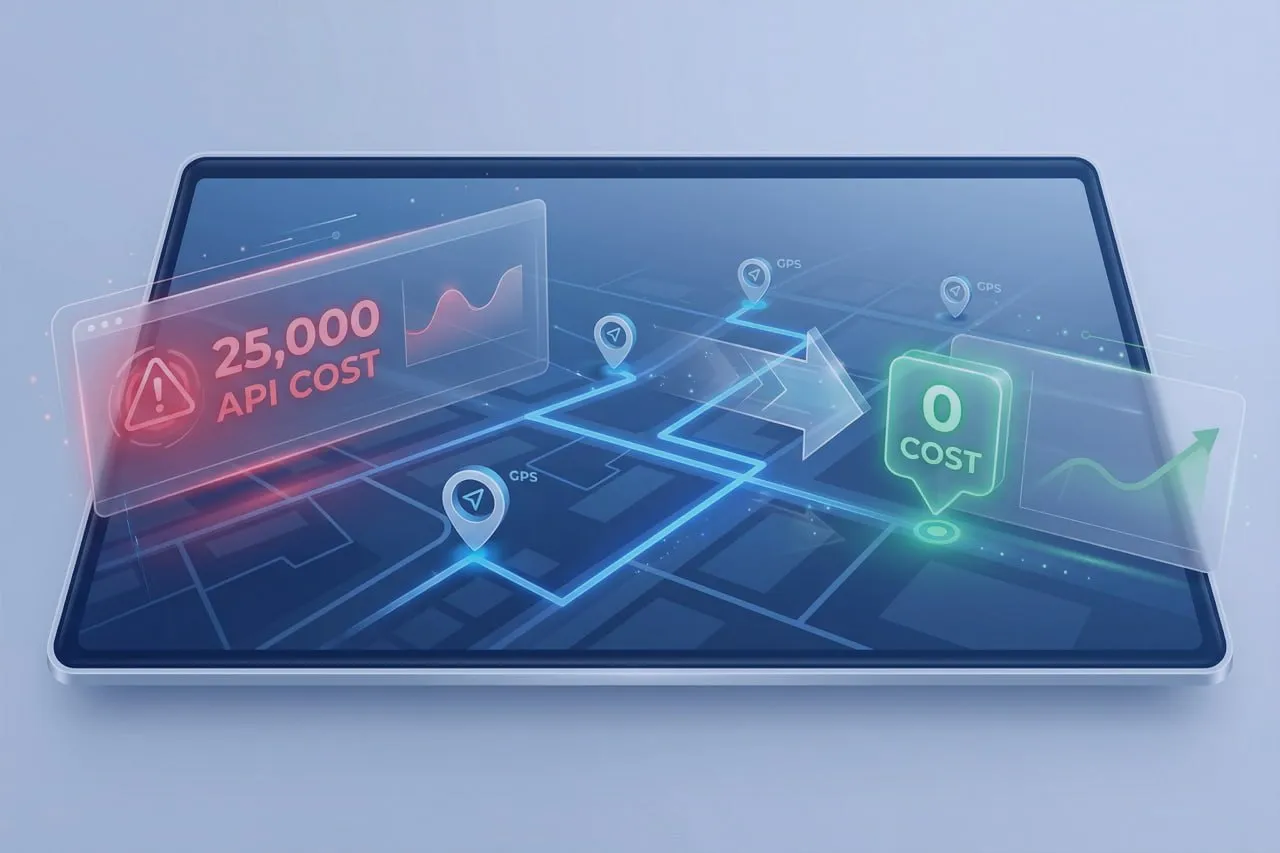
Imagine launching a real-time contractor tracking system in November, only to open December’s invoice and see a $25,000 Google Maps API charge. That’s exactly what happened to one of our clients.
In this case study, we’ll break down why it happened and how 8allocate PRIME helped redesign the tracking approach to reduce unnecessary API calls and costs.
Client Background
The client operates a contractor-based field service model, coordinating 150–200 contractors moving across multiple locations daily. Real-time tracking is critical for dispatch, customer expectations, and operational control.
Business Challenge
To keep operations aligned, the company needed real-time answers to two questions: Where is each contractor? and When will they arrive?
To move fast, they built a live tracking flow on top of Google Maps:
- Contractors’ locations were captured frequently
- Updates appeared in real time on a map
- Estimated Time of Arrival (ETAs) were recalculated continuously
The system went live in November and scaled further in December. It worked technically, but it triggered an expensive side effect: a $25,000 Google Maps API bill.
Even after the initial spike, ongoing usage was still running at roughly $2K-$3K per month, driven by the same high-frequency update approach.
In short, the company wasn’t paying for better tracking. It was paying for unnecessary update frequency.
The $25,000 Lesson: When Live Tracking Meets Google’s API Costs
The issue wasn’t Google Maps itself. It was how the tracking was designed.
Google Maps APIs are billed per request. At the scale of 150-200 moving contractors, high-frequency updates quickly translate into a huge volume of paid API calls. That’s how a normal-looking tracking feature became a cost engine.
Root cause in one line: The product treated “real-time” as “constantly ask Google,” instead of “update only when something meaningful changes.”
Why Frequent Location Updates Break the Bank
A real-time tracking feature can become expensive fast for four reasons:
- Update volume multiplies at scale. One contractor sending frequent updates is manageable. 150-200 contractors moving all day turns “small” into “massive” very quickly.
- Request-based pricing compounds quickly. When each update contributes to paid API usage, total cost rises with every movement.
- “Real-time” gets overbuilt. Many systems treat every small movement as a meaningful change, even when it doesn’t improve operational decisions.
- No built-in efficiency logic. Without limiting updates to meaningful moments, usage grows silently until the invoice arrives.
Bottom line: frequent location updates plus pay-per-call pricing is a recipe for bill shock. The problem isn’t Google Maps, it’s how you use it.
So how do you keep the functionality and kill the cost? That’s what we did by redesigning tracking with 8allocate PRIME.
How We Resolved the Issue: Smarter Tracking with PRIME
After the wake-up call, the client partnered with 8allocate to redesign their tracking architecture. We used 8allocate PRIME to reduce paid API usage while maintaining an effective real-time experience.
Here’s what changed:
- Route-Based Tracking Algorithm. We anchored tracking to the contractor’s planned route and recalculated progress and ETA based on route context. Updates happen at meaningful points (milestones, deviations), not every few meters.
- Smarter ETA Recalculation. ETA is recalculated based on the planned route and progress, without requiring constant location reporting to the map.
- Key-Point Location Reporting. Instead of reporting location every 50–75 feet, tracking updates were reduced to key points that still preserve operational visibility.
In essence, PRIME delivered the same live tracking experience with far fewer Google Maps API calls by relying on route context, smarter triggers, and local calculation.
The Outcome: From $2-3K/Month To (Almost) $0
After the redesign, the client’s Google Maps API costs dropped from roughly $2K-$3K per month to basically free.
What changed:
- Costs Reduced To Basically Freeю The previous tracking setup was replaced with a route-based approach that reduced paid API usage.
- Predictable Operating Costs. The new design removed the cost spike risk caused by high-frequency location reporting.
- Same Operational Value. Dispatch still had live tracking and ETA updates, without reporting location every 50-75 feet.
Conclusion: Smart Architecture Matters in Logistics Tech
Location-based features often look simple until they reach production scale. This case shows how “real-time” can become an always-on expense when usage-based APIs are hit continuously.
As the client put it, the change felt like switching from an “open faucet” to a “measured drip” with the same outcome, without the waste.
What PRIME Is
PRIME is a product engineering framework for building and running scalable applications. For logistics, transportation, and mobility teams, it supports real-time workflows like tracking and ETA logic without letting architecture choices turn into runaway operating costs.
Building something complex? Let’s build it right. Contact us to learn how PRIME supports full-cycle product engineering.